
Ink Word Family Worksheets




About Our 15 Worksheets
The ink word family helps young readers recognize short vowel patterns that appear in many familiar words. Words like ink, pink, sink, and think show students how the same ending sound can be reused across different words. By learning to spot the -ink ending, children gain confidence in decoding and spelling. This pattern-based approach makes reading feel more manageable and less overwhelming.
Our Ink word family worksheets give learners many chances to practice this sound in fun, meaningful ways. Students sort, match, write, trace, cut, paste, and search for ink words, reinforcing the pattern again and again. The variety of activities keeps learners engaged while supporting different learning styles. These worksheets are easy to use in classrooms, literacy centers, or at home.
Together, this collection strengthens phonics awareness, spelling accuracy, handwriting, and vocabulary development. Students learn to quickly recognize the -ink ending and apply it to new words. With repeated practice, decoding becomes faster and more automatic. These worksheets help build a strong foundation for confident, fluent reading.
About Each Worksheet
Picture Sort
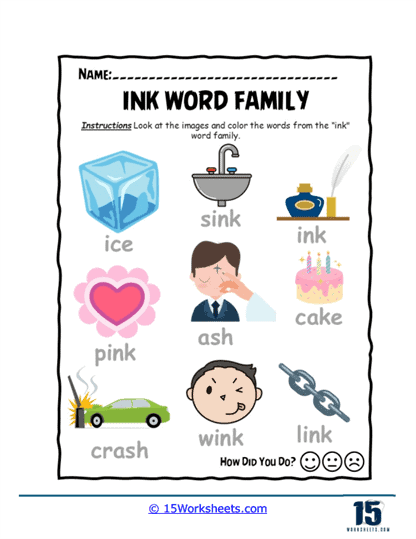
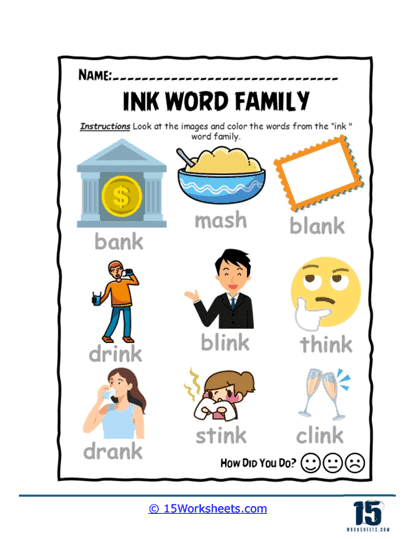
This worksheet asks students to look at pictures and identify which words belong to the ink word family. Learners compare correct and incorrect examples using visual clues. Careful attention is needed to spot the shared ending. The activity keeps students actively engaged with phonics. It works well for independent practice or centers.
Action Sort
Students examine pictures and words to find those ending in -ink. Each image provides helpful context for decision-making. Learners mark or color the correct word family members. The task reinforces sound-meaning connections. It supports accuracy and confidence in phonics skills.
Match Pairs
In this worksheet, students match ink words to their corresponding images. Visual clues guide learners toward correct matches. The activity encourages active participation. Matching strengthens word recognition and fluency. It also promotes self-checking habits.
Picture Match
Students read ink words and connect them to the correct images. Multiple picture options require careful comparison. Learners confirm meaning before choosing. The worksheet blends reading with visual reasoning. It supports early comprehension development.
Write Words
This worksheet shows pictures and asks students to write the correct ink word on tracing lines. Learners rely on visual cues and phonics recall. Writing reinforces the shared word pattern. Tracing supports handwriting development. It builds spelling confidence.
Picture Write
Students label pictures by writing the correct ink word without a word bank. This encourages independent recall and careful spelling. Each image reinforces word meaning. Writing supports sequencing and neatness. The worksheet strengthens reading-to-writing transfer.
Cut Paste
This hands-on worksheet asks students to cut and paste pictures into ink word boxes. Learners analyze each image before placing it correctly. The tactile format increases engagement. Categorizing builds word family recognition. It’s great for interactive learning time.
Word Complete
Students complete partially written ink words using picture clues. Each blank focuses on adding the correct beginning sounds. The activity strengthens phonemic blending skills. Learners see how words are built. It builds decoding confidence.
Writing Lines
This worksheet provides lined spaces for writing ink words next to pictures. Students practice neat handwriting and repetition. Writing words multiple times reinforces spelling patterns. Learners build writing stamina. It supports independent practice.
Word Practice
Students write a set of ink words in a structured format while referencing pictures. The worksheet emphasizes accuracy and completion. Repetition builds spelling confidence. Learners work independently at their own pace. It prepares students for more advanced writing tasks.
Word Hunt
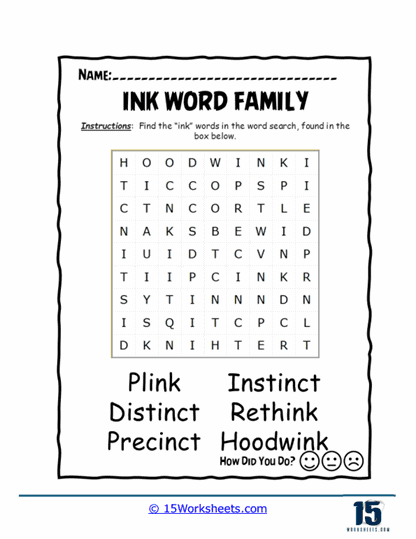
Students search a word search puzzle to find hidden ink words. They scan carefully to match spelling patterns. The activity reinforces phonics through repetition. Puzzle-style learning keeps students engaged. It builds focus and persistence.
Search Challenge
This worksheet features a new word search with different ink words. Learners must search methodically and double-check their answers. The challenge strengthens pattern recognition. It improves attention to detail. Students build confidence with word families.
Advanced Search
Students locate longer and more advanced ink words hidden in a grid. The increased difficulty encourages deeper word analysis. Learners confirm spelling and structure. The activity strengthens reading fluency. It prepares students for higher-level word study.
Picture Name
Students write the correct ink word that names each picture shown. No word bank encourages memory recall. The worksheet blends vocabulary with spelling practice. Writing builds confidence and accuracy. It supports expressive language skills.
Trace Lines
This worksheet asks students to trace ink words across numbered handwriting lines. Repetition reinforces correct letter formation. Tracing builds muscle memory for spelling. Learners focus on neatness and spacing. It supports phonics fluency and handwriting control.
What is the Ink Word Family?
The ink word family includes words that end with -ink and share the same short vowel sound. This pattern helps students read words like ink, pink, sink, and think more easily. Once learners recognize the ending, they only need to focus on the beginning sound. This makes decoding quicker and less stressful. It’s a helpful step for early readers.
Words in the ink family can describe actions or objects. For example, sink can be an action, while pink describes a color. Even though the meaning changes, the spelling pattern stays the same. This helps students understand how sounds and letters work together. It also supports vocabulary growth and comprehension.
The ink ending appears often in children’s books and everyday speech. You might hear sentences like, “I think the cup will sink,” or “The pink pig has ink.” Because these words are common, mastering them improves reading fluency. Learning this word family gives students another powerful tool for decoding new words.
Word List for the Ink Word Family
ink, pink, sink, think, wink
Example Sentences
1. I think the boat will sink in the ink.
2. The pink pig gave a quick wink.
3. I think the pink hat fell in the sink.