
Ine Word Family Worksheets



About These 15 Worksheets
The ine word family introduces learners to words that share a common ending sound, helping them recognize patterns that make reading smoother and more predictable. Words like line, fine, dine, and shine appear often in early reading and everyday conversations. By focusing on this shared -ine ending, students learn that they don’t have to sound out every word from scratch. Instead, they can use familiar patterns to decode new words with confidence.
Our Ine word family worksheets are designed to support students at every stage of early phonics learning. Through sorting, matching, writing, cutting, pasting, tracing, and searching, children interact with the same word pattern in many meaningful ways. This variety keeps learning engaging while reinforcing the same core skill again and again. Whether used at home or in the classroom, these worksheets help learners build strong connections between sounds, letters, and meaning.
Together, this collection strengthens phonemic awareness, spelling accuracy, handwriting, and vocabulary development. Students learn to notice the long i sound often heard in -ine words and see how it stays consistent across many examples. As they practice, reading becomes faster and more fluent. These worksheets help turn pattern recognition into real reading success that students can carry into future literacy tasks.
About Each Worksheet
Picture Sort
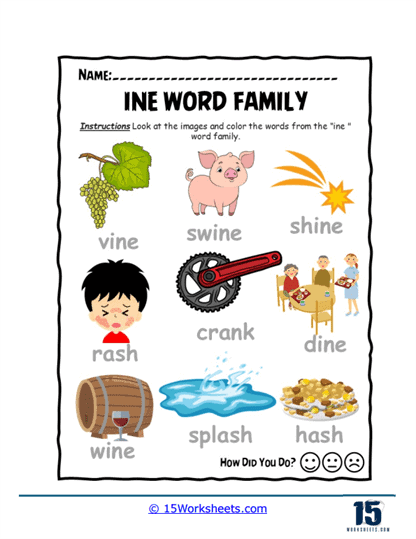
This worksheet asks students to study pictures and identify which words belong to the ine word family. Learners compare correct and incorrect examples to spot the shared ending. The activity encourages careful reading and observation. Visual support makes the task accessible and engaging. It works well for independent practice or phonics centers.
Visual Sort
Students examine a new set of pictures and words to find the ine family members. Each image provides helpful context for deciding the correct answer. Learners mark or color only the matching words. Repetition reinforces the sound and spelling pattern. This worksheet supports focus and accuracy.
Match-Up
In this activity, students match written ine words to their correct pictures. They must read each word carefully and compare it with visual clues. The task blends reading and reasoning skills. Matching builds confidence through clear right-or-wrong feedback. It’s ideal for small groups or independent work.
Picture Match
Students connect ine words to the correct images from multiple choices. The layout encourages learners to slow down and double-check each match. This reinforces phonics and vocabulary together. Visual-verbal connections grow stronger with each pairing. The worksheet keeps students actively engaged.
Write Words
This worksheet shows pictures and asks students to write the matching ine words on tracing lines. Learners rely on visual cues and phonics recall. Writing reinforces the shared word pattern. Tracing lines support developing handwriting skills. It’s a great bridge from reading to writing.
Picture Write
Students label pictures by writing the correct ine word without a word bank. This encourages independent recall and spelling accuracy. Each image reinforces word meaning. The activity builds confidence in producing words from memory. It supports early writing development.
Cut Paste
This hands-on worksheet asks students to cut out pictures and paste them into the correct ine word boxes. Learners must analyze each image before making a choice. The movement keeps students engaged and focused. Categorizing builds strong word family recognition. It’s perfect for interactive learning time.
Word Complete
Students complete partially written ine words using picture clues. Each blank focuses on adding the correct beginning sound. The activity strengthens phonemic blending skills. Learners see how one ending can form many words. This worksheet supports decoding confidence.
Writing Lines
This worksheet provides lined spaces for writing ine words next to pictures. Students practice neat handwriting and correct spelling. Repetition helps solidify phonics patterns. Learners build endurance for longer writing tasks. It’s useful for daily practice.
Word Practice
Students repeatedly write ine words while referencing pictures for support. The structured format emphasizes accuracy and consistency. Writing builds spelling confidence over time. Learners work independently at their own pace. This worksheet prepares students for more advanced literacy tasks.
Word Hunt
Students search a word puzzle to find hidden ine family words. They scan carefully to locate each target word. The activity combines problem-solving with phonics practice. Repeated exposure reinforces spelling patterns. The puzzle format keeps learning fun.
Search Challenge
This worksheet challenges students to find ine words like shine, wine, and dine in a grid. Learners must search methodically and check their work. The game-like format boosts engagement. Pattern recognition skills grow stronger. It builds confidence with varied vocabulary.
Advanced Search
Students locate longer and more complex ine words hidden in a word search. The increased difficulty encourages deeper word analysis. Learners confirm spelling and structure as they search. This worksheet supports reading fluency development. It’s great for students ready for a challenge.
Picture Name
Students write the correct ine word to name each picture shown. No word bank is provided, encouraging memory recall. The task blends vocabulary knowledge with spelling. Writing reinforces sound-letter connections. It supports independent learning.
Trace Lines
This worksheet asks students to trace ine words across multiple numbered lines. Repetition emphasizes correct letter formation and spacing. Tracing builds muscle memory for spelling. Learners develop handwriting control and neatness. It’s ideal for reinforcing phonics fluency.
What is the Ine Word Family?
The ine word family includes words that end with -ine and usually share a long i sound. When students learn this pattern, they can recognize and read many words more easily. Examples include line, fine, dine, mine, and shine. Even though the beginning letters change, the ending sound stays consistent. This predictability makes decoding less intimidating for new readers.
Words in the ine family can serve different roles in a sentence. Some words name things, like line or mine, while others describe actions, like dine or shine. The spelling pattern stays the same, but meaning shifts depending on the word. This helps students understand how word parts work together. It also supports vocabulary growth and comprehension.
The ine word family appears often in children’s books and everyday speech. You might hear sentences like, “The star will shine,” or “We dine at nine.” Because these words are common, mastering them helps improve reading fluency quickly. Once students recognize this pattern, they can confidently approach new words. It’s a powerful step toward becoming a strong reader.
Word List
dine, fine, line, mine, nine, pine, shine, vine, wine
Example Sentences
1. I will dine at nine and drink wine.
2. The pine tree will shine in a straight line.
3. This book is mine, and the words look fine.