
Ick Word Family Worksheets




About These 15 Worksheets
The ick word family is a lively, high-interest set of words that young readers love to say and spell. Because the ending stays the same while the beginning changes, students quickly see how one pattern can unlock many words. This collection uses coloring, matching, tracing, writing, cutting, and word searches to make the ick pattern stick. Each worksheet offers a slightly different way to practice, which keeps learners engaged and supported. Whether you’re teaching in a classroom or working at home, these activities help make phonics practice feel playful and approachable.
Working with word families like ick helps students move beyond letter-by-letter reading into chunking and pattern recognition. As children meet words such as stick, kick, chick, and brick over and over, they become faster and more accurate decoders. These worksheets encourage students to notice the shared ending while paying attention to the beginning consonants and blends. That combination supports both phonemic awareness and strong spelling habits. Over time, students start to transfer this pattern knowledge to new words they have never seen before.
The activities in this set gradually move from simple recognition to more independent reading and writing of ick words. Early worksheets focus on identifying which words belong in the family, while later ones add more advanced words like slick, thick, and trick. Students connect sounds, spellings, and meanings using pictures, handwriting lines, and puzzles. This layered approach helps learners at different skill levels feel successful. Together, these 15 worksheets build a solid foundation for future fluency and more complex phonics patterns.
About Each Worksheet
Color Ick
In this worksheet, students color only the words that belong to the ick word family. They must sort true family words like stick, trick, chick, click, and quick from distractors such as ice or cake. This careful selection builds early phonics awareness and sharpens visual discrimination. The coloring element keeps the task fun while encouraging slow, thoughtful reading of each word. It’s a great choice for centers, morning work, or at-home practice.
Find Ick
Students examine a new set of pictures and decide which ones match ick words such as kick, brick, pick, lick, and sick. They must ignore non-family distractors, applying their phonics knowledge to make accurate choices. This builds discrimination between similar-looking words with different endings. The activity also reinforces vocabulary meaning through picture support. It works well as a partner activity or independent word-family review.
Match Picks
Learners match the words pick, sick, brick, and kick to their corresponding images. Each picture offers a clear clue, prompting students to think about both sound and meaning. This matching process strengthens decoding skills as they repeatedly see the ick ending. Students also practice distinguishing between similar rhyming words by their initial letters. It’s a simple, supportive worksheet ideal for young or emerging readers.
Click Match
Students match four ick words-trick, click, quick, and chick-to images like a computer cursor, a running child, a baby chick, and a Halloween treat bucket. The visual cues make it easier to connect the written words to their meanings. This helps students lock in both vocabulary and phonics patterns. The focus on varied beginning consonant blends gives extra practice with reading more complex onsets. This worksheet is excellent for small-group reading rotations.
Write Ick
In this worksheet, students look at pictures representing trick, click, stick, chick, quick, and kick, and then write the correct word on handwriting lines. Each word appears lightly for tracing before students write it on their own. This structure gives support first, then gradually releases responsibility. Learners strengthen spelling, letter formation, and word recognition at the same time. It’s perfect for combining phonics and handwriting instruction.
Write Brick
Students write ick words like lick, brick, sick, pick, and kick beneath matching images. Traceable models at the start of each line guide correct spelling and handwriting. The pictures ensure that students connect each word to its meaning. This repeated writing helps encode the ick pattern into long-term memory. The worksheet fits nicely into writing centers or targeted intervention time.
Cut Ick
Students cut out small picture tiles and paste them into boxes labeled with ick words such as chick, trick, click, stick, quick, brick, sick, kick, and lick. The cut-and-paste format turns phonics practice into a hands-on project. Matching images to words reinforces decoding and vocabulary knowledge. This multisensory approach supports a wide range of learners, including those who benefit from tactile activities. It’s a great option for small groups or independent practice.
Complete Ick
In this worksheet, students complete partially written ick words using picture clues. Images represent words like lick, brick, sick, click, stick, kick, quick, and chick, and students fill in the missing letters. This process reinforces the consistent ick ending as they supply the correct pattern again and again. Visual support helps them choose the right word for each picture. It’s a strong bridge between recognition and independent spelling.
Line Writing
Students write kick, chick, quick, and lick on handwriting lines next to matching pictures. The repeated writing on structured lines encourages careful spelling and neat penmanship. Each repetition reinforces the ick ending and the initial consonant sounds. Picture prompts keep the task meaningful and connected to real vocabulary. This worksheet is ideal for early writers who need extra practice with both phonics and handwriting.
Brick Lines
Learners write trick, sick, stick, and brick on lines beside the correct images. The combination of visual clues and repeated writing deepens word-family recognition. Students strengthen decoding as they read and select each word, then encoding as they spell it. Handwriting lines support consistent letter size and spacing. This worksheet works well as homework, seatwork, or a reading center activity.
Ick Search
Students search a word-search grid for kick, lick, pick, sick, tick, and wick. The words appear in different directions, requiring careful scanning and pattern spotting. This builds visual tracking skills and helps students recognize the ick chunk quickly. The puzzle format adds an element of fun and challenge. It’s an excellent independent activity for early finishers.
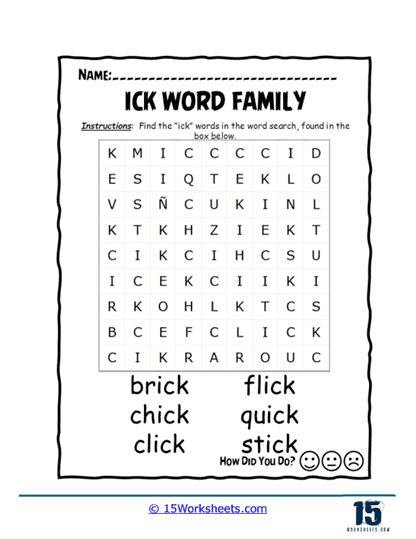
Brick Search
Learners hunt for ick words like brick, chick, click, flick, quick, and stick in a dense letter grid. The variety of blends and beginning consonants gives extra practice reading more complex onsets. Finding each word reinforces the shared ick ending. Students develop stamina and focus as they scan through the puzzle. This worksheet is great for small-group competitions or independent phonics review.
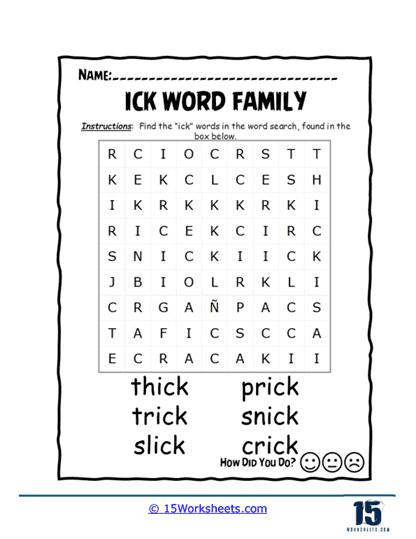
Trick Grid
Students look for more advanced ick family words such as thick, trick, slick, prick, snick, and crick. Some of these words may be new to students, which encourages flexible decoding strategies. The grid format requires them to rely on the spelling pattern and blends to find matches. This introduces them to less common vocabulary while keeping phonics consistent. It’s especially useful for enrichment and more confident readers.
Picture Words
Students write the correct ick family word for pictures showing sick, trick, quick, stick, brick, chick, and lick. The blank spaces under each image invite independent spelling. Picture cues reinforce meaning and help students recall the right word. This activity pushes learners to apply their phonics knowledge without word banks. It’s a strong assessment-style worksheet that still feels accessible.
Trace Ick
In this worksheet, students trace and write ick words such as slick, brick, stick, quick, thick, and trick. The tracing lines support correct letter formation and rhythm in writing. After tracing, students write each word on their own to show mastery. Repeating the pattern across multiple words strengthens orthographic memory. This is an ideal resource for combining handwriting practice with word-family review.
What Is the ick Word Family?
The ick word family is a group of words that share the same ending spelling pattern: ick. This pattern creates a consistent /ɪk/ sound, which is easy for young learners to hear and blend. By focusing on a stable ending, students can concentrate on changing the beginning sounds to make new words. This shows them how one pattern can unlock many different vocabulary items. It’s a powerful way to move from sounding out individual letters to reading in chunks.
Common ick words include kick, stick, chick, brick, trick, lick, sick, and quick. Most of these words are short, concrete nouns or action verbs that appear in early readers and children’s stories. Because they rhyme, students quickly hear how they belong together, which helps with memory and recall. The mix of beginning consonants and blends-like st- in stick or br- in brick-also gives extra practice with more complex sounds. This variety makes the ick family a useful teaching tool for both phonemic awareness and decoding.
You’ll also find the ick pattern inside longer or less common words like thick, slick, prick, snick, and crick, which broadens students’ vocabulary. As children become comfortable with the pattern, they can apply it when they encounter new words in stories or informational texts. Sentences such as “The chick gave a little kick to jump off the brick wall” help students see these words working together naturally. Over time, recognizing the ick chunk becomes automatic, freeing up energy for comprehension. This is exactly the kind of fluent pattern use that supports strong, confident reading.
Word List for the ick Word Family
Word List (Alphabetical)
- brick
- chick
- click
- crick
- flick
- kick
- lick
- pick
- prick
- quick
- sick
- slick
- snick
- stick
- thick
- tick
- trick
- wick
Example Sentences
1. The chick gave a tiny kick and hopped onto a brick and a stick by the path.
2. He used a quick little trick to pull the stick from the slick mud.
3. I saw a tick on a brick while a chick tried to pick up a stick.