
Ike Word Family Worksheets







About These 15 Worksheets
The ike word family is a fun and friendly group of rhyming words that kids love to read and say out loud. Words like bike, hike, and like show up all the time in early readers, so getting comfortable with this pattern really helps. These worksheets use pictures, coloring, matching, cutting, writing, tracing, and word searches to give students lots of practice with the -ike chunk. Learners move from simply noticing rhymes to confidently reading and spelling full words. Whether you’re teaching in a classroom or working one-on-one at home, this collection makes phonics practice feel playful and approachable.
Working with word families helps students shift from sounding out every letter slowly to recognizing chunks of spelling quickly. When children repeatedly see words like bike, mike, pike, and spike, they begin to trust the -ike pattern. These worksheets ask students to spot real rhyming words, ignore tricky distractors, and connect what they hear to what they see. Matching, writing, and tracing build strong connections between sound, print, and meaning. Over time, this leads to smoother, more confident decoding in all kinds of texts.
This collection also gently stretches students with slightly longer or less familiar words such as strike, trike, and tike. The mix of simple and more advanced vocabulary lets learners revisit the same pattern at different levels of challenge. Visual supports keep activities accessible, while handwriting lines and tracing models support neat, consistent letter formation. Cut-and-paste and puzzle-style pages add a hands-on element for students who learn best by doing. Together, these 15 worksheets form a complete mini-unit on the ike family that supports reading, spelling, and writing growth.
About Each Worksheet
Colorful Rhymes
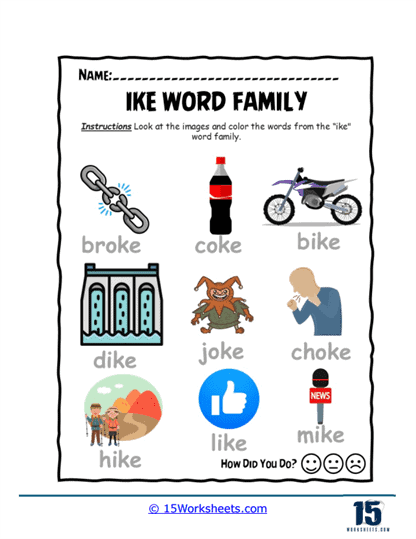
In this worksheet, students look at a set of pictures and decide which words rhyme with ike, such as bike, hike, and like, and which do not. They color only the correct -ike words, leaving distractors like broke and coke uncolored. This simple choice-making keeps students focused on the sound and spelling pattern. The activity blends visual cues with rhyming practice to support early phonics awareness. It’s perfect for centers, warm-ups, or a quick at-home review.
Rhyme Safari
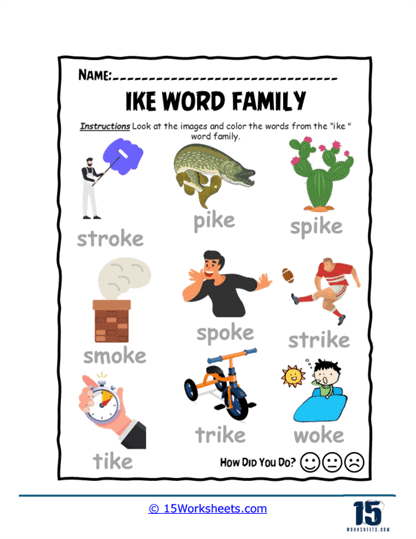
Students go on a “safari” through images paired with words like pike, spike, stroke, smoke, and more. They decide which ones truly belong in the -ike rhyming family and which do not. The mix of real and playful images keeps engagement high. Learners practice noticing how small changes in word endings create different sounds and meanings. This worksheet builds careful phonics thinking in a fun, exploratory way.
Match Magic
This worksheet asks students to match four -ike words-bike, hike, like, and dike-to their correct pictures. Each word appears with a circle where students indicate their match, encouraging close attention. Matching reinforces how each written word connects to a familiar object or action. The activity supports both vocabulary recall and phonics recognition. It’s a great fit for early readers who benefit from strong picture support.
Picture Pairing
Learners continue the matching practice with words such as tike, spike, pike, and trike. Pictures like a cactus, fish, tricycle, or child give clear visual clues. Students must read each word carefully to choose the right image. This helps them hear and see how the -ike ending can appear in different beginning blends. The worksheet supports decoding, rhyme awareness, and careful decision-making.
Write Right
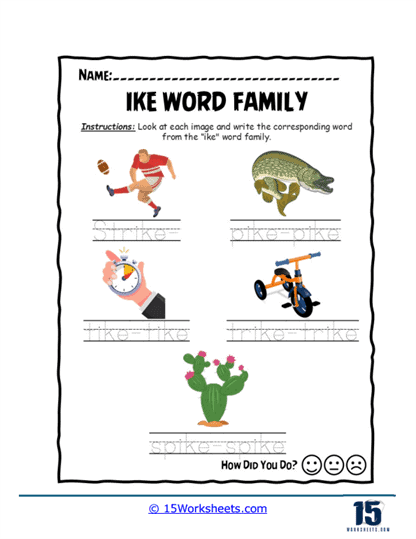
In this worksheet, students see pictures and write -ike words like mike, bike, dike, like, and hike underneath. Lined spaces guide neat handwriting while they practice spelling. Writing the words helps lock the phonics pattern into memory. Students also strengthen fine motor skills as they form each letter. It’s an effective blend of phonics practice and early writing instruction.
Rhyme Writers
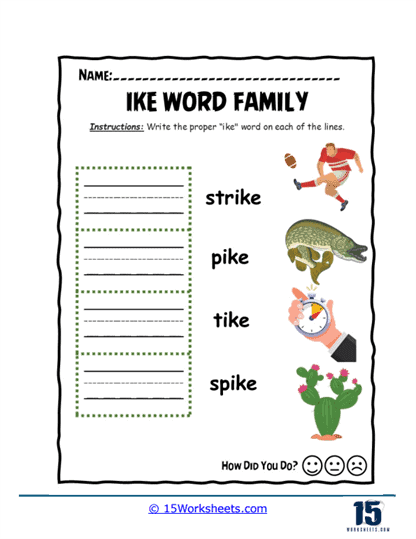
This page mirrors the previous one but uses another set of words, including strike, pike, tike, and spike. Students study each picture and choose the correct rhyming word to write on the lines. Repeating the same structure with new vocabulary deepens familiarity with the -ike pattern. Learners translate sounds into written words, reinforcing phoneme-grapheme connections. This worksheet is excellent for building fluency with word-family spelling.
Cut Connect
Students complete a cut-and-paste sorting activity using a grid of images and matching -ike words like mike, pike, hike, strike, and more. They cut out each picture and glue it into the correct labeled box. This hands-on task combines reading comprehension with tactile learning. Sorting the images into the right word-family boxes reinforces pattern recognition. It’s a lively, multisensory way to practice phonics.
Fill Families
This worksheet asks students to finish partially spelled -ike words under each picture. They add missing letters to complete words such as bike, mike, dike, hike, spike, and pike. Picture clues guide them toward the right choice. The fill-in-the-blank format encourages students to think about sounds and spelling at the same time. It’s a focused way to practice decoding and spelling accuracy.
Rhyme Lines
Students see a set of images and a small word bank of -ike words-such as strike, pike, tike, and spike-and must write the correct one beside each picture. The guided lines support neat, consistent handwriting. Matching words to images reinforces vocabulary and rhyme patterns. Repeated writing gives extra practice with the -ike spelling. This worksheet works well for independent practice or quick assessments.
Word Tracer
In this activity, students complete partly written -ike words that start with a given letter, using picture clues to help. They finish words such as bike, mike, like, hike, and dike on handwriting lines. The tracing and completion steps help learners blend initial sounds with the familiar -ike ending. This reinforces letter-sound associations and accurate spelling. It’s a gentle step toward more independent reading and writing.
Search Sprint
This word search challenges students to find -ike words like like, mike, pike, spike, strike, and tike hidden in a grid. The words may appear horizontally, vertically, or diagonally. Students scan carefully and cross off each one as it’s found. The puzzle-style format makes phonics review feel like a game. It strengthens visual tracking, attention to detail, and recognition of the -ike pattern.
Grid Hunt
Learners work through a second word search featuring bike, dike, hike, strike, tike, and trike. They must look closely for letter combinations that match the target list. The repeated focus on -ike endings builds spelling familiarity and word-memory. Checking off each found word gives a clear sense of progress. It’s a fun way to build stamina and persistence with reading-based tasks.
Rhyme Finder
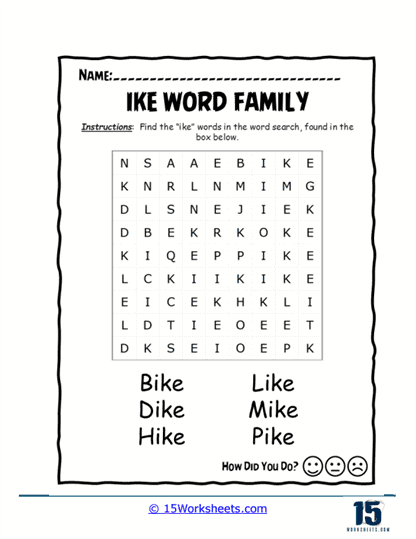
This worksheet combines earlier word lists into one larger -ike word search, including bike, dike, hike, like, mike, and pike. Students search the grid in all directions to locate each word. Having several similar-looking words raises the challenge slightly. The activity pushes students to use careful scanning and strong pattern awareness. It’s a great capstone puzzle for the -ike word-search series.
Label Lane
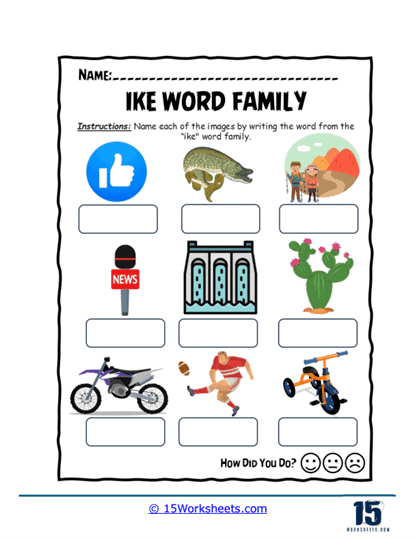
Students see a variety of images-such as a thumbs-up symbol, fish, hikers, microphone, cactus, motorcycle, athlete, and tricycle-and write the matching -ike word beneath each one. For example, they might use like, pike, hike, mike, spike, bike, or trike. Pictures provide clear context clues for each vocabulary word. Learners practice spelling, handwriting, and meaning all at once. This worksheet ties together word-family recognition in a very concrete, meaningful way.
Trace Train
This worksheet provides several lines of traceable -ike words for students to read and trace repeatedly. Learners see familiar words from the unit and follow the models across each line. The repeated tracing builds comfort with the spelling pattern and letter sequence. Students also practice neatness and control in their handwriting. It’s a calming, confidence-building way to wrap up the ike word family.
What Is the ike Word Family?
The ike word family is a group of words that all share the same ending spelling and rhyming pattern: -ike. In most of these words, the letters stand for a long i sound followed by a hard /k/ sound, as in bike and like. Because the chunk is so consistent, it gives beginning readers a reliable pattern to latch onto. Once students know the -ike family, they can quickly read new words just by changing the first letter or blend. This makes early reading feel more predictable and less frustrating.
Words in this family include common, kid-friendly terms like bike, hike, and like, as well as slightly trickier ones like mike, pike, spike, strike, tike, and trike. Many of these words are nouns for familiar objects or people (like bike and mike) or verbs that describe actions (like strike and hike). Because they rhyme, children can easily hear how they belong together when reading aloud or playing word games. Seeing the same pattern across different meanings helps students understand that spelling chunks can be reused. This gives them a powerful strategy for decoding new vocabulary.
Learning the ike word family also supports spelling and writing. Instead of memorizing every letter of each new word separately, students remember the shared -ike ending and then attach different beginning sounds. When they write sentences such as “I like to hike with my bike,” they experience how several related words can work together naturally. This chunking approach frees up space in their working memory so they can focus more on what a sentence means. Over time, recognizing and using word families like ike leads to smoother, more confident reading and writing.
Word List for the ike Word Family
Word List (Alphabetical)
- bike
- dike
- hike
- like
- mike
- pike
- spike
- strike
- tike
- trike
Example Sentences
1. I like to ride my bike with my friend mike and a little tike on a trike.
2. The fish called a pike swam past the dike while we watched a bird strike the water.
3. We will hike up the hill, bike back home, and talk about how much we like the big spike rock.