
Ab Word Family Worksheets




About These 15 Worksheets
The -ab word family is a friendly doorway into rhyming, blending, and early spelling for young readers. Because all the words share the same ending, children get repeated practice hearing and seeing how beginning sounds change word meaning. Our worksheets invite kids to color, trace, cut-and-paste, search, and write so they meet -ab words from lots of fun angles. Whether you’re a parent at the kitchen table or a teacher planning literacy centers, this collection gives you ready-to-go practice that feels like play. Along the way, learners build confidence decoding new words that look and sound alike.
Each page is designed to strengthen phonemic awareness-matching sounds to letters, isolating beginning consonants, and recognizing shared endings like -ab. This kind of learning connects closely with AB pattern recognition, where students begin to notice repeating structures and predictable sequences. As they work with words like cab, jab, grab, and crab, students build meaningful connections between sounds and spelling instead of just memorizing lists.
The -ab family pops up in real-life reading too-labels, signs, stories, science terms like lab, and even common slang like fab. Seeing the same spelling chunk again and again helps kids predict, check, and self-correct while reading emergent texts. When children realize that changing just one starting sound can make a brand-new word, they lean into experimentation and word play. That playful mindset fuels curiosity and stamina for longer reading tasks. In short, these worksheets help kids hear patterns, see patterns, and then use those patterns everywhere.
About Each Worksheet
Wordy Cab
This intro page gets kids cozy with the -ab family using bright pictures and simple words like cab, jab, gab, and lab. Learners color only the images that match -ab words, reinforcing look-and-sound connections. It highlights the shared ending so beginning sounds take center stage. Expect lots of “Ohhh, they rhyme!” moments as patterns click. Try it as a whole-group mini-lesson or a quick warm-up at home.
Blabby Crab
Students meet lively images such as crab, grab, blab, and scab and color only the ones from the -ab family. The choose-and-color format boosts attention to detail and phonics discrimination. Kids practice sorting by sound while meeting both familiar and new vocabulary. It’s playful enough to feel like art time but focused enough to build skills. Use it in literacy centers or as early finisher work.
Matchy Jab
This matching page pairs written -ab words with picture clues like jab, gab, lab, and cab. Matching strengthens comprehension because kids must connect spelling, sound, and meaning. The simple layout keeps cognitive load low while practice stays high. Students begin to anticipate the -ab chunk and scan for it quickly. Great for small-group review or independent practice.
Snippy Crab
Kids cut out picture tiles and paste them to the correct -ab words such as crab, gab, lab, and jab. The hands-on step adds fine-motor fun to the phonics routine. Learners categorize by shared ending while focusing on the right beginning consonant. Movement helps memory, so the words stick longer. Perfect for centers, RTI groups, or a Friday fun station.
Swabby Match
Learners match words like grab, crab, swab, and blab to friendly pictures. Repetition builds automatic recognition of the -ab rime. Because visuals carry meaning, students decode with confidence instead of guessing. The routine is quick to explain and easy to differentiate. Slot it into partner practice or send home for light homework.
Finishy Lab
Students complete words by adding the missing first letter for tab, jab, gab, and lab. This pushes careful listening for initial sounds. The finish-the-word format nudges accurate spelling and handwriting in one go. Kids see how one new letter makes a whole new word. Ideal as a morning tub or short skill check.
Tricky Lab
Learners look at each image and write the matching word-lab, tab, gab, jab, or cab-underneath. Writing from memory deepens orthographic mapping of the -ab pattern. The page blends phonics with neat letter formation and spacing. Expect a satisfying “I can spell these!” boost. Use it for independent work or as a quick assessment.
Crabby Words
Students write the correct word beneath pictures like scab, swab, grab, blab, and crab. Clear art cues make choosing the right beginning sound feel doable. Repetition across similar words builds speed and accuracy. The mix of common and slightly trickier terms keeps interest high. Run it in small groups or assign for practice at home.
Handy Cab
Kids write gab, cab, jab, and lab on lines beside matching pictures. The write-it-again routine cements muscle memory and spelling consistency. Visuals keep meaning front and center while students focus on neat letters. The rhythm of repeat-to-master supports fluency. Try as a station rotation or handwriting warm-up.
Grabby Crab
Learners copy and write words such as swab, grab, blab, and crab next to each picture. Copying plus composing builds confidence step by step. Students notice how swapping first letters changes meaning but preserves the -ab sound. It’s a tidy capstone review of the set. Use it for spiral practice or a quick check-for-understanding.
Fab Grab
This word search hides cab, dab, fab, gab, jab, and lab in a tidy grid. Hunting for recurring letter patterns sharpens scanning and decoding. It feels like a puzzle, so motivation stays high. Students celebrate each find while reinforcing spelling. Great for early finishers, partner play, or take-home fun.
Crabby Search
Another hunt-and-circle grid features nab, tab, blab, crab, grab, and scab. Learners practice visual tracking and pattern spotting with the -ab chunk. The grid format turns phonics into a game. Words repeat across the set for extra stickiness. Pop it into a literacy center or quiet-work block.
Snabby Search
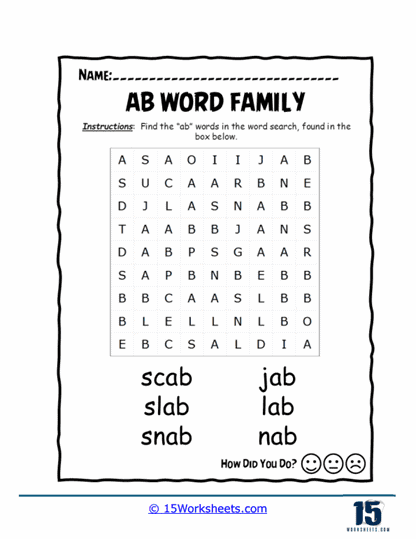
This search includes scab, slab, snab, jab, lab, and nab for an extra challenge. Students scan for both common and less common -ab words. Repeated exposure sharpens recognition of the shared rime. The puzzle vibe keeps attention engaged longer. Use it as a stamina builder or team challenge.
Labby Labels
Kids label pictures with words like swab, grab, lab, gab, tab, jab, cab, blab, and crab. The image-to-word link locks in meaning and spelling together. Multisensory cues help learners remember the pattern. There’s just enough writing to build endurance without frustration. Ideal for centers, small groups, or homework.
Tracing Lab
Students read and trace cab, lab, jab, and crab across neat handwriting lines. Tracing builds correct letter formation while reinforcing the -ab pattern. The rhythm of trace-and-read supports fluency and confidence. Kids hear it, see it, say it, and write it. Perfect as a warm-up or calm independent practice.
What is the -ab Word Family?
A word family is a set of words that share a common spelling chunk and sound-in this case, -ab. Words like cab, lab, jab, and crab rhyme because they all end the same way. Readers learn to keep the ending steady while swapping the first sound to make new words. That swap is where the fun (and the learning!) happens. It’s a quick path to decoding many words with just a few moves.
In the -ab family, you’ll find nouns (cab, lab, crab, scab, slab), verbs (grab, blab, dab, swab, nab), and even adjectives or informal slang (fab). Changing the first letter changes the meaning entirely while keeping the rime intact. Spelling stays predictable: consonant + ab almost always says /ab/. Some words feel everyday (like cab and grab) while others are great stretch vocabulary (like swab or slab). Mixing both builds range and curiosity.
Morphology is straightforward here-no prefixes or suffixes needed to see the pattern clearly. Pronunciation is consistent across the set, which helps early readers rely on what they already know. You’ll see these words in stories, science labs, craft directions, and playful dialogue. Try them in sentences like, “I will grab the cab,” or “The lab has a concrete slab.” Once kids crack the code for -ab, they often transfer that success to other families like -at or -ap.
Word List for the -ab Word Family
blab
cab
crab
dab
fab
gab
grab
jab
lab
nab
scab
slab
snab
swab
tab
Example Sentences:
1. I will grab the cab while you tell me the lab job.
2. The crab got a jab, and we used a swab in the lab.
3.Don’t blab; just grab the tab and help the cab driver.