
Aw Word Family Worksheets






About These 15 Worksheets
The -aw word family helps young readers master one of English’s most expressive vowel sounds – the open “aw” found in paw, saw, and draw. These familiar words appear often in early reading, making the pattern perfect for practice. Students learn how changing the first sound creates a family of rhyming words that share both look and sound. This recognition builds decoding confidence and smoother reading fluency.
Our -aw worksheets turn phonics study into a creative adventure. Learners color, match, trace, write, and search for -aw words in fun, engaging formats. Each page connects the written pattern with real-world images that make sense to kids. The variety keeps motivation high while reinforcing spelling consistency and sound recognition. They’re perfect for independent literacy stations or at-home phonics practice.
By mastering the -aw pattern, learners gain essential skills for reading accuracy and word prediction. They discover that word families act like clues, helping them decode new vocabulary with ease. The -aw sound family lays the foundation for smoother reading, stronger writing, and lifelong spelling success.
About Each Worksheet
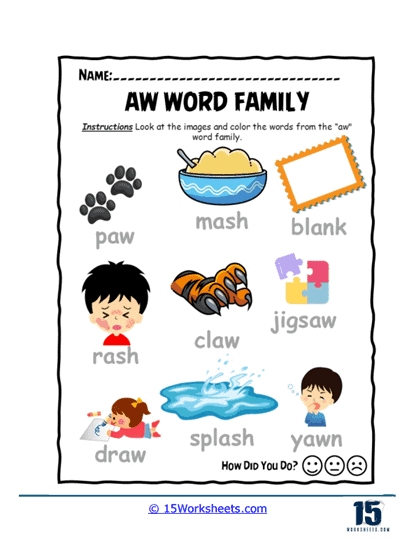
Color and Learn “-aw” Words
Students color bright pictures representing paw, claw, draw, jigsaw, saw, and yawn. This activity teaches learners to hear and see the -aw sound in everyday words. The visuals and coloring make phonics playful and memorable. It’s great for introducing pattern recognition through creativity. Perfect for whole-group review or independent fun.
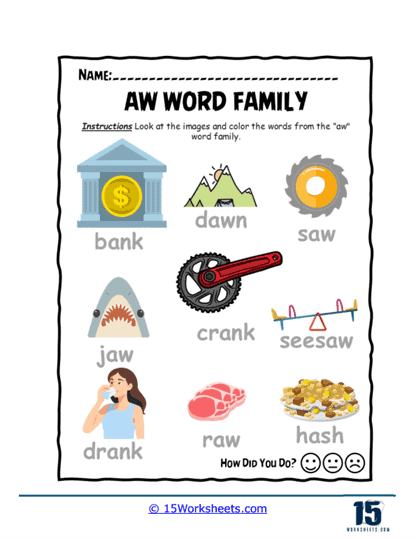
Spot the “-aw” Family Words
Learners identify and color words like jaw, dawn, raw, saw, claw, and seesaw. This page builds vocabulary while reinforcing the shared -aw sound. Coloring connects fine-motor skills with auditory recognition. Students learn to link spelling patterns to spoken words. It’s ideal for centers or early literacy review sessions.
Match and Learn
Students match -aw words such as paw, jaw, draw, and jigsaw to clear, colorful pictures. The matching format strengthens comprehension and decoding skills. Learners connect sound to meaning in an intuitive way. It’s a focused, visual introduction to the -aw pattern. Great for partner work or guided reading groups.
Matching -aw
Learners continue matching words like claw, raw, saw, and seesaw with the right images. This repetition reinforces reading and recognition accuracy. The visuals make it easier to understand subtle sound similarities. It strengthens memory, focus, and phonetic confidence. A simple, effective review for all learners.
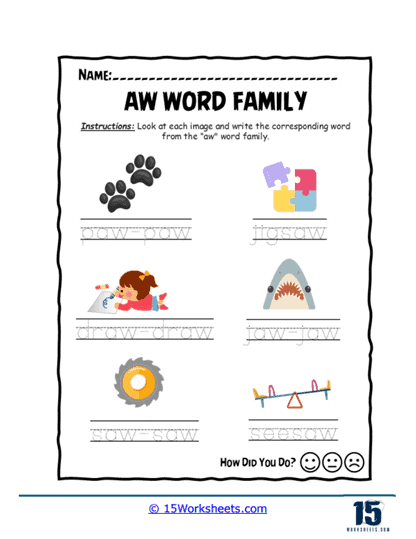
Write the “-aw” Word
Students identify each picture and write its -aw word – paw, draw, jaw, saw, and seesaw. Tracing lines help guide neat handwriting. The exercise reinforces spelling and sound association through repetition. Writing solidifies understanding of the -aw pattern. Ideal for early writers or handwriting stations.
Word Paw
Learners identify and write -aw words like paw, claw, draw, and yawn below pictures. Each image supports spelling and phonetic understanding. Students trace and write to strengthen recall and handwriting fluency. The activity ties sound, sight, and meaning together. Great for morning warm-ups or phonics notebooks.
Match & Paste
Students cut and paste pictures next to words such as jaw, dawn, raw, and jigsaw. This hands-on activity engages tactile learners and reinforces word meaning. Cutting and sorting promote motor coordination and focus. The task helps learners apply vocabulary through interactive play. Perfect for small groups or learning centers.
Fill & Finish
Learners fill in missing letters to complete -aw words like saw, draw, claw, and yawn. Picture clues guide accurate spelling and recall. The puzzle format encourages critical thinking and problem-solving. Each word completion builds phonetic confidence. A fun and effective literacy challenge for all skill levels.
Write & Match
Students write -aw words such as paw, draw, raw, and jigsaw beside matching images. The repetition boosts spelling and handwriting fluency. Visual prompts keep practice meaningful and easy to follow. It’s a clear, simple activity that reinforces the connection between sight and sound. Excellent for literacy folders or early finishers.
Match Jaw and Saw
Learners identify images and write the correct -aw word – jaw, saw, seesaw, and dawn. The mix of new and familiar words keeps practice engaging. Students review sound patterns through writing and observation. Repetition ensures confident recognition of the -aw sound. Great for wrap-up lessons or small-group practice.
Search & Find
This lively word search invites students to find paw, raw, saw, law, jaw, and draw in a puzzle grid. The activity sharpens focus, scanning, and spelling skills. It turns phonics learning into a game-like challenge. Learners practice visual tracking while reinforcing vocabulary. Perfect for independent literacy time or early finishers.
Search & Find -aw
Students locate and circle -aw words like straw, claw, flaw, dawn, yawn, and fawn. The search strengthens sound recognition and pattern awareness. Learners develop stamina for reading and visual tracking. Finding each word reinforces vocabulary retention. It’s an energetic blend of fun and phonics mastery.
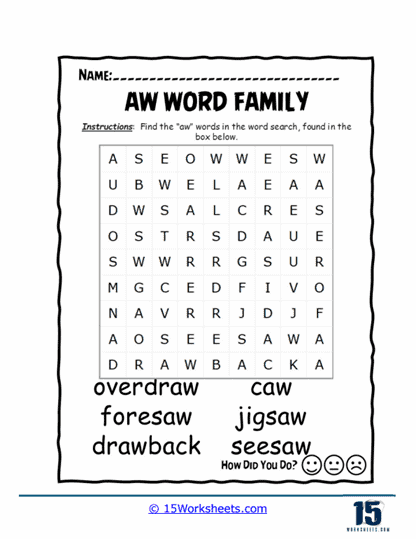
Search Longer
Learners explore extended -aw words such as overdraw, foresaw, drawback, caw, jigsaw, and seesaw. This advanced puzzle builds flexible thinking and vocabulary. Students analyze longer structures while identifying familiar sounds. It supports word decomposition and spelling awareness. Excellent enrichment for confident readers.
Picture Word Match
Students view images like paw, yawn, jaw, and seesaw and write the correct -aw word. Visual cues help connect spelling with meaning. The task enhances reading comprehension and handwriting precision. Learners grow more confident applying phonics independently. Great for literacy centers or home study.
Trace & Read
Learners trace and read -aw words such as paw, saw, draw, yawn, and law. The tracing builds handwriting rhythm and sight-word familiarity. Reading aloud strengthens phonemic awareness. Repetition transforms recognition into fluency. A calm, focused activity to close the -aw unit.
What is the -aw Word Family?
The -aw word family includes words that share the “aw” sound, often represented by the letters a-w. Examples include saw, claw, draw, paw, and yawn. The sound is a broad vowel that feels open and warm, making it memorable for young learners. These words help students understand how vowel combinations can create distinct long sounds. Recognizing this pattern strengthens both pronunciation and decoding.
Most -aw words are nouns (paw, claw, law) or verbs (draw, saw), though some can be used as both depending on context. The pattern is common in early reading materials because it appears in everyday vocabulary. Students quickly see that one sound can connect many meanings, helping them decode new text with confidence. Learning the -aw pattern also supports transition into similar sounds like -au and -aught.
In daily language, -aw words appear frequently in nature and actions – from “a cat’s paw” to “I saw a bird at dawn.” The sound is expressive and easy to identify, which makes it a favorite in early phonics instruction. Once learners grasp the -aw family, they can use the same strategy to explore new vowel combinations. This foundation leads to smoother reading and stronger spelling across the board.
Word List for the -aw Word Family
Word List
caw, claw, dawn, draw, drawback, fawn, flaw, foresaw, jigsaw, jaw, law, overdraw, paw, raw, saw, seesaw, straw, yawn
Example Sentences
The paw of the bear left a mark in the straw near the claw print.
We saw the dawn and yawned as the law said stay inside.
The artist will draw a jigsaw of a paw and a claw in the raw wood.