
Ad Word Family Worksheets




About These 15 Worksheets
The -ad word family is one of the friendliest starting points for young readers learning to decode, rhyme, and build confidence with short vowel sounds. Words like dad, sad, and glad help children hear how changing one beginning sound can create an entirely new word. Our collection of -ad worksheets turns that discovery into an adventure – full of pictures, puzzles, writing practice, and matching games that make phonics learning fun and hands-on. Perfect for home or classroom use, these pages keep children engaged while reinforcing foundational reading skills.
Each activity in this set focuses on strengthening early literacy abilities such as phonemic awareness, word recognition, and sound blending. Students practice identifying, writing, and reading -ad words through a variety of multisensory exercises – from cutting and pasting to coloring and tracing. The fun themes and friendly illustrations help learners connect each new word with meaning and emotion. Repetition and play combine to create lasting fluency and confidence in recognizing rhyming patterns.
Because -ad words appear so often in stories and conversations (“Dad is glad,” “The boy was sad,” “She wrote on the pad”), children quickly see the value of what they learn. These worksheets offer a joyful way to connect classroom phonics with everyday language. By building a strong foundation in the -ad family, students learn how reading patterns work – paving the way for success with more complex words and families to come.
About Each Worksheet
Ad Adventures
This colorful worksheet introduces the -ad family with pictures like sad, dad, and pad. Students color the word that matches each image, strengthening sound-to-symbol connections. The fun visuals make early phonics practice lively and memorable. Learners quickly begin to notice how words with similar endings rhyme and relate. It’s a cheerful start to your -ad word journey.
Sound Builders
Learners add beginning sounds to make words like glad, sad, and mad. They look at expressive pictures and choose the right starting letters to complete each word. The page emphasizes how blending consonants with familiar endings forms new vocabulary. Students hear, see, and apply phonics in action. Great for auditory learners and early readers alike.
Picture Matchers
Students circle the correct -ad word to match each picture, choosing from options like pad, sad, or dad. The task promotes careful observation and vocabulary recognition. It strengthens reading accuracy by asking children to spot small differences in spelling. Visual clues guide the process, supporting confident word selection. Use it as a quick phonics warm-up or review activity.
Ad Match-Up
This writing-based worksheet invites students to write the correct -ad word under each image using a word bank. Pictures include glad, pad, and sad, reinforcing meaning through writing. It combines spelling, handwriting, and word recognition practice. Students grow more independent as they identify and record each answer. A versatile page for both group and solo learning.
Letter Fillers
Children fill in missing first letters to complete -ad words and then rewrite them neatly. Images like a sad face or dad give strong visual hints. The dotted letters guide correct formation and spacing. Repetition reinforces spelling memory and phonics recall. It’s ideal for handwriting, fine-motor, and phonemic development.
Cut & Paste Words
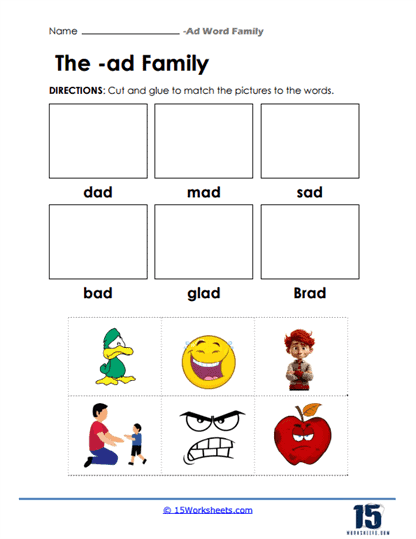
Learners cut out -ad words and glue them below matching pictures, such as a pad or sad expression. The tactile design encourages kinesthetic learning through active participation. Students strengthen scissor skills, coordination, and literacy simultaneously. Building word-picture pairs by hand enhances retention. This page makes phonics practice both creative and fun.
Word Wheel Wonders
This spinning word wheel lets students turn, read, and say -ad words aloud. With words like mad, sad, and glad, each spin brings excitement and repetition. The motion keeps young readers engaged and supports auditory fluency. Saying the words aloud reinforces pronunciation and rhythm. A perfect blend of movement and literacy practice.
Sound Match Mania
Students fill in missing letters to complete -ad words and match them with images. They choose from starting sounds like m, s, or gl to form the correct words. The mix of visual and phonetic clues builds decoding and comprehension skills. Learners apply logic while having fun. It’s a lively page for strengthening phonics and spelling.
Word Match Builders
This cut-and-glue activity has learners pair -ad words like dad, sad, and glad with their matching pictures. The creative, tactile format deepens engagement with the word family. Students practice sorting, reading, and motor coordination at once. Each match reinforces spelling accuracy and meaning recognition. Great for centers or hands-on literacy groups.
Rhyme Builders
Children complete and write -ad words using picture clues for sad, pad, and glad. They rely on phonics and visual context to choose correct spellings. The writing practice helps solidify word patterns and letter sequencing. It’s both a decoding and handwriting workout. A reliable tool for building fluency through repetition.
Circle Craze
Students color the circle next to the -ad word that matches each image. Simple visuals like dad, lad, or sad make the activity accessible and fun. The multiple-choice layout promotes focus and careful comparison. Learners improve both comprehension and visual memory. It’s perfect for reinforcing rhyming and reading fluency.
Sentence Fillers
This worksheet lets children complete short sentences with the right -ad word. Choices like sad, glad, and dad teach them how words function in real sentences. The context clues promote comprehension and reasoning. Students practice both reading and basic grammar skills. It’s a great bridge between phonics and sentence writing.
Word Builders
Students fill in missing endings to make words like pad, glad, and sad using visual cues. Each example helps them practice listening and spelling simultaneously. The repetition reinforces rhyming sound awareness. Handwriting lines guide neat, consistent writing. Excellent for connecting spoken sounds with written form.
Word Jumble Fun
Learners unscramble jumbled letters to reveal words such as dad, sad, and glad. The puzzle format adds challenge and excitement to word practice. Students strengthen spelling, sequencing, and decoding skills. Solving the jumbles encourages persistence and logic. It’s an enjoyable way to test reading readiness.
Sound Starters
Students add the correct beginning consonant to complete -ad words like mad, dad, and glad. The open-ended design invites creative thinking as children brainstorm possible matches. They practice blending and phoneme manipulation with ease. Repetition reinforces pattern recognition and fluency. A great closer for mastering the -ad sound family.
What is the -ad Word Family?
The -ad word family is a group of rhyming words that share the same ending letters and sound pattern: “a-d.” This family includes simple, familiar words like dad, sad, mad, and glad. Because these words are short and easy to pronounce, they help early readers build confidence in decoding and spelling. Once children recognize the -ad chunk, they can blend new beginning sounds to form many words. It’s an early win that makes reading feel fun and achievable!
Words in the -ad family appear in everyday language, which gives students lots of opportunities for real-world practice. You’ll find nouns (pad, dad, lad) and adjectives (glad, mad, sad) – all useful in early writing and conversation. The sound pattern is steady and predictable, making it a reliable foundation for phonics instruction. With just one short vowel and two letters, the -ad pattern becomes a building block for understanding how word families work.
From a linguistic standpoint, the short a (/æ/) sound blends smoothly with the final -d, creating that crisp “ad” sound. This pattern helps learners grasp how sounds combine to make meaning. Examples like “The dad was glad the boy was not sad” show how one small word family can fill a sentence with rhythm and rhyme. Mastering -ad not only builds fluency but also sparks the joy of recognizing patterns across new words and families like -am, -an, and -at.
Word List for the -ad Word Family
ad
bad
dad
fad
glad
lad
mad
pad
rad
sad
Example Sentences
1. My dad was glad that I wasn’t sad today.
2. The lad felt bad when he forgot his pad.
3. I am mad, but my dad says that’s just a fad.