
Ane Word Family Worksheets









About These 15 Worksheets
The -ane word family is a fun and friendly way to help young readers build strong phonics and spelling skills. Words like cane, lane, and plane all share the same sound pattern, giving students a clear structure for decoding and recognizing new words. By exploring this pattern, learners begin to see how letters and sounds connect, building confidence and fluency with every activity.
Our -ane worksheets are designed to make learning both playful and productive. Each page combines colorful visuals, hands-on writing, and sound recognition practice to keep learners engaged. Whether tracing, matching, or coloring, students are constantly reinforcing the connection between the -ane sound and the words they know. These activities are perfect for classrooms, literacy centers, or at-home learning adventures.
As children explore the -ane word family, they’re developing skills that transfer directly to reading and writing in everyday life. Understanding word patterns helps them read more smoothly and spell with accuracy. The -ane family words appear in stories, signs, and daily vocabulary-so every new word learned is one step closer to reading success.
About Each Worksheet
Sound Builder
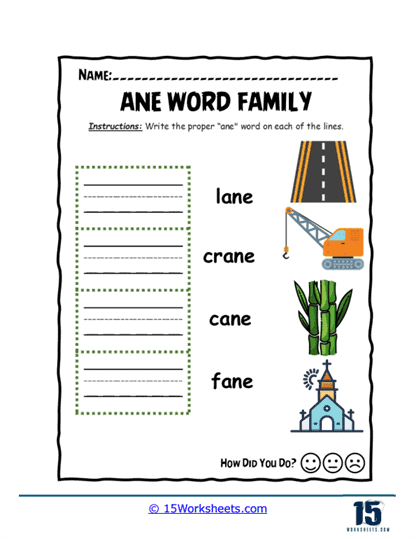
Students dive into the -ane word family by matching pictures like a cane, crane, and lane with their correct words. This worksheet focuses on connecting visual cues with sound patterns to strengthen early phonemic awareness. Learners get to practice writing each -ane word on provided lines, reinforcing correct spelling and handwriting. The colorful design keeps engagement high as students identify each image’s matching sound. It’s perfect for small group phonics practice or independent literacy time at home.
Word Finder
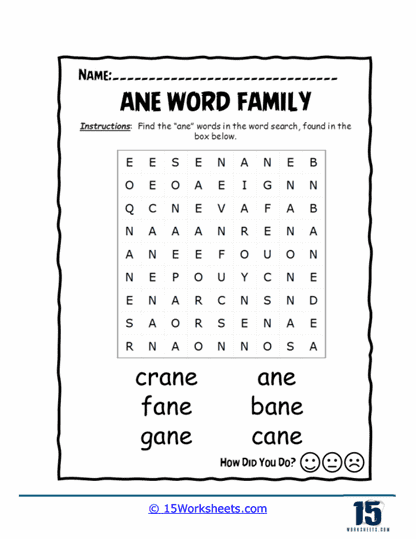
In this lively word search, students hunt for hidden -ane family words such as bane, cane, and crane. It’s a puzzle-style way to reinforce spelling and letter sequencing skills. As learners search horizontally and vertically, they sharpen their focus and attention to detail. The activity turns phonics review into an exciting game that feels like play instead of practice. Great for morning work, centers, or take-home reading fun.
Word Explorer
This second word search expands vocabulary with new words like lane, plane, and pane. Students circle each word they find, strengthening pattern recognition and visual tracking skills. It’s an easy way to reinforce phonics patterns while introducing both familiar and slightly new terms. The puzzle layout adds just the right amount of challenge to keep learners motivated. Perfect for reinforcing decoding during reading or literacy stations.
Word Hunt
Learners search for trickier -ane words such as thane, wane, and zane in this engaging challenge. The mix of common and uncommon words encourages curiosity and vocabulary growth. Students practice scanning and spelling while developing concentration and persistence. The puzzle format keeps learners focused and having fun as they discover each hidden word. Ideal for classrooms or at-home enrichment for confident readers.
Picture Matcher
Students match -ane words with bright images of things like a lion, airplane, and cane. The combination of pictures and words builds decoding and vocabulary skills simultaneously. Writing the matching -ane word next to each picture encourages handwriting practice and memory. This visual approach makes phonics learning concrete and accessible to young learners. Teachers can use it in literacy centers or one-on-one reading sessions.
Trace and Read
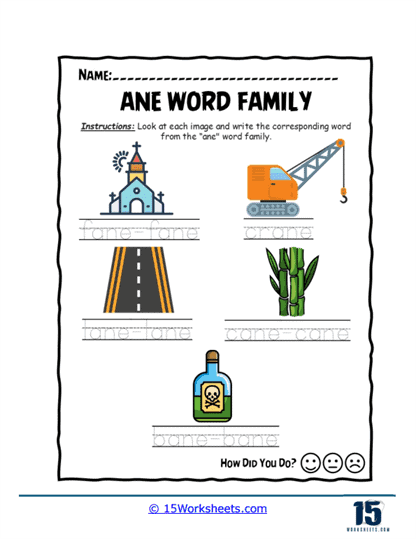
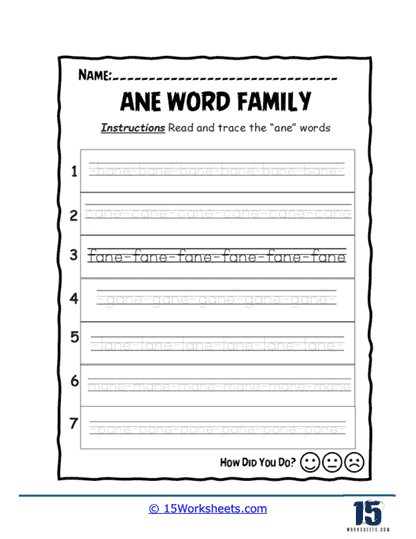
This worksheet focuses on tracing and reading -ane words to improve spelling and handwriting fluency. Learners trace each word several times, repeating the sound aloud for reinforcement. The repetition helps build automatic recognition and smooth letter formation. It’s a calm, structured way for students to internalize spelling patterns through movement and sound. Perfect for morning warm-ups or extra handwriting practice.
Color Sorter
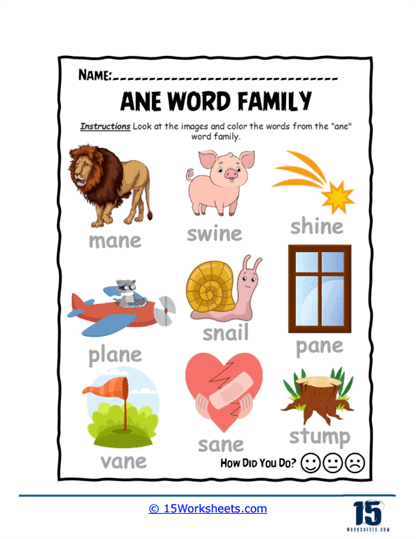
Students color only the words that belong to the -ane family, using fun images as clues. The mix of correct and incorrect words encourages critical thinking and pattern recognition. This activity strengthens both spelling awareness and fine motor control. The use of color makes phonics practice lively, creative, and memorable. It’s an ideal choice for visual learners and hands-on classrooms.
Color Challenge
Learners search through a colorful word field to find hidden -ane words like pane, mane, and plane. They color only the correct ones, sharpening their attention to spelling detail. The combination of bright pictures and decoding practice keeps engagement high. This creative task strengthens reading precision while offering a playful visual reward. Teachers can use it as a fun review or early-finisher activity.
Corresponding Pictures
Students draw lines to match -ane words such as cane, bane, and crane to their matching images. The clear visuals help learners make strong picture-word connections. This activity promotes vocabulary comprehension and careful reading. Matching also improves focus and fine motor coordination as students draw lines or circle answers. A great fit for centers or guided reading time.
Image Matcher 2
This second matching worksheet features -ane words like plane, mane, sane, and vane. Learners pair each word with its picture, reinforcing the sound-meaning link. The repetition builds fluency, while the variety keeps things interesting. The clean design makes it easy for students to stay focused on the words themselves. Use it for independent review or partner work in class.
Picture Writer
Students look at each picture and write the -ane word that matches it, such as lane, cane, or crane. Tracing lines help guide handwriting and reinforce correct spelling. This task combines visual recognition, phonics, and writing practice all in one. Learners strengthen their spelling memory and fine motor skills with each word. It’s perfect for early readers practicing neat, confident writing.
Word Tracer
This worksheet invites students to trace and write -ane words like pane, mane, plane, sane, and vane. Tracing boosts letter formation accuracy and builds confidence in spelling. Fun illustrations next to each word provide context and meaning support. The repetition of writing helps students internalize word patterns and sounds. It’s a calm, effective way to practice during handwriting or literacy block time.
Cut and Paste Challenge
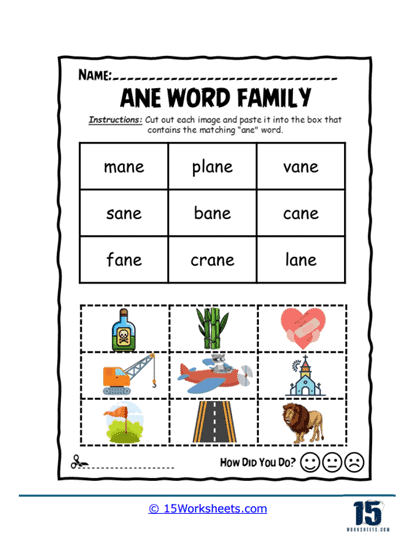
In this hands-on activity, learners cut out pictures and paste them into boxes that match words like mane, plane, crane, and lane. The tactile process reinforces spelling and phonics understanding. Sorting and arranging each piece helps students think critically about word meaning. The interactive nature keeps learners engaged while developing fine motor skills. Great for centers, crafts, or home learning sessions.
Word Builder
Students fill in missing letters to complete -ane words using picture clues for help. They might finish words like crane, lane, or plane by supplying the missing letters. This activity strengthens phonetic recall and encourages problem-solving. It challenges learners to use sound knowledge to decode and spell accurately. A wonderful blend of writing, logic, and vocabulary practice.
Word Writer
Students write the correct -ane word beside each picture, including examples like bane, mane, and vane. The repetition of writing reinforces spelling and sound association. This worksheet strengthens both handwriting and phonics understanding. Learners gain confidence as they connect familiar pictures to correct spellings. A versatile activity for individual practice or partner learning.
What is the -ane Word Family?
The -ane word family is a group of words that share the same ending sound -ane, pronounced like “ayn.” Examples include lane, plane, cane, and mane. These words are fun to learn because they sound alike but carry different meanings, helping students see how small spelling changes can create new words. The consistent pattern makes this family ideal for practicing long vowel sounds and improving reading fluency.
Most -ane words are nouns that name objects or ideas, though some can function as verbs or adjectives. For example, wane is a verb meaning “to get smaller,” while sane is an adjective meaning “mentally sound.” This variety introduces learners to different parts of speech within one spelling pattern. It also shows how language can use a shared ending to create meaning families that support comprehension.
In everyday English, -ane words pop up all over-from street names like “Lane” to familiar things like a “cane” or an “airplane.” The sound pattern is smooth and easy to pronounce, helping readers decode new words confidently. Teaching the -ane family helps students notice and predict spelling structures across texts. Once they master this pattern, they can transfer those decoding skills to other long-vowel families with ease.
Word List for the -ane Word Family
Word List
bane, cane, crane, fane, lane, mane, pane, plane, sane, thane, vane, wane, zane
Example Sentences
The plane flew over the lane while the man held his cane.
The mane of the lion looked shiny in the pane of glass.
When the moon began to wane, the wise thane walked down the lane with his cane.