
Ud Word Family Worksheets
About Our -ud Worksheets
The “-ud” word family is a fun and muddy little group of words that kids love to explore! These words all share the same ending sound, making them a perfect starting point for building phonics confidence. From “mud” to “spud,” the family is small but mighty, and it helps children see how different beginnings can combine with the same ending to make brand new words. Whether at home or in the classroom, practicing with this set brings smiles, silliness, and lots of “aha!” moments.
Our worksheets are designed to guide students through spotting, reading, writing, and even playing with “-ud” words. Each page uses playful activities like coloring, matching, cutting, and tracing to reinforce the pattern in multiple ways. By repeating the same rime with new onsets, kids start to recognize it instantly, which is exactly how fluent reading grows. Parents and teachers will love how easy it is to fit these activities into small group lessons, homework, or independent practice.
Best of all, these worksheets connect phonics practice to real-world words kids will actually encounter. Whether it’s spotting mud on the playground, planting a flower bud, or laughing at a silly dud, children begin to recognize familiar words in everyday life. That real-world connection turns abstract practice into meaningful reading growth. Step by step, the “-ud” family becomes a sturdy stepping stone on the journey to confident reading.
About Each Worksheet
Ud Detectives
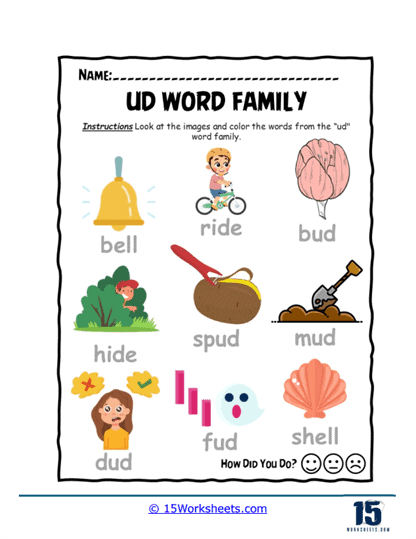
This worksheet invites students to play detective and spot only the words that belong in the “-ud” family. They’ll color words like bud, spud, and mud while skipping tricksters such as “bell” or “ride.” The activity trains learners to focus on word endings, not just the first letter. Kids will feel like word detectives on a mission, which makes it extra motivating. It’s perfect for morning warm-ups, centers, or even a quick homework check.
Ud Filter
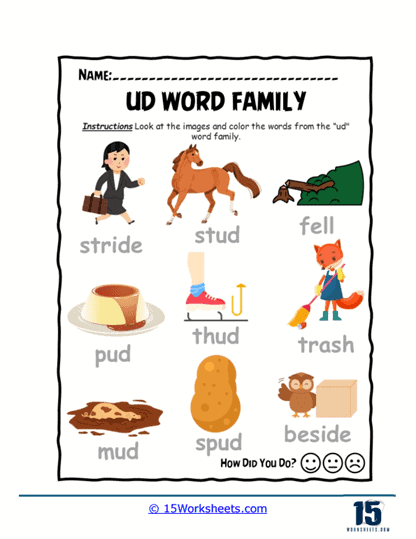
Here, students get a second chance to filter out true “-ud” words from a busy mix of pictures and words. They’ll color examples like stud and thud while leaving behind distractors such as “stride” or “fell.” The focus is on pattern recognition, encouraging kids to notice the ending rather than guessing. The format is simple yet challenging, making it fun to repeat. Teachers can use it in literacy centers or small group rotations for extra practice.
Picture Pairings
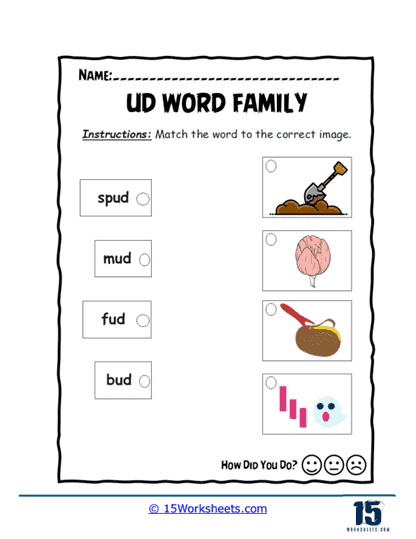
Students match spud, mud, fud, and bud to the right picture, creating instant word-image connections. The activity makes reading meaningful by linking spelling to visuals like a potato or a flower bud. Matching games like this help kids read the whole word instead of guessing. Because it’s self-checking, students quickly see if they’ve made the right choice. This worksheet works beautifully for early finishers or as a partner activity.
Match Masters
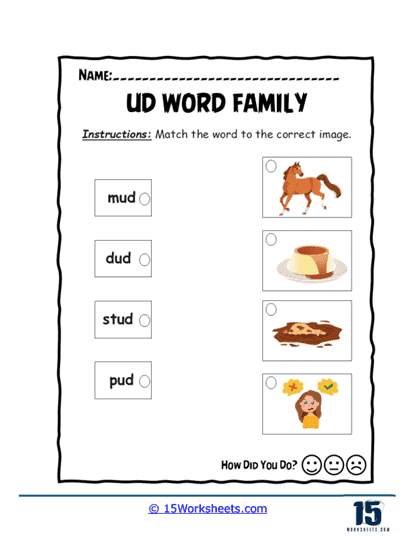
This follow-up matching page introduces words like mud, dud, stud, and pud with fresh pictures. The task is familiar, so learners can focus on accuracy instead of new directions. Repetition with a twist builds automaticity and deeper memory. Kids will enjoy the challenge of connecting new images with old patterns. It’s a great fit for independent practice or literacy stations.
Ud Labeling
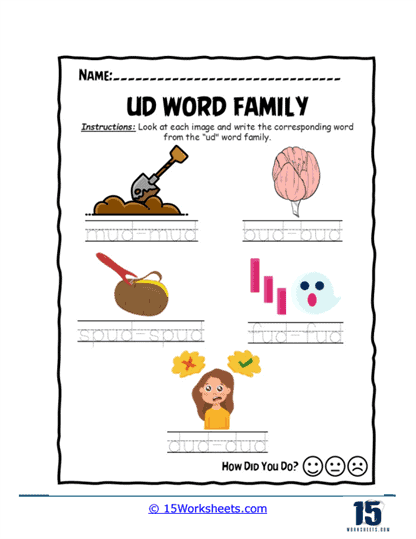
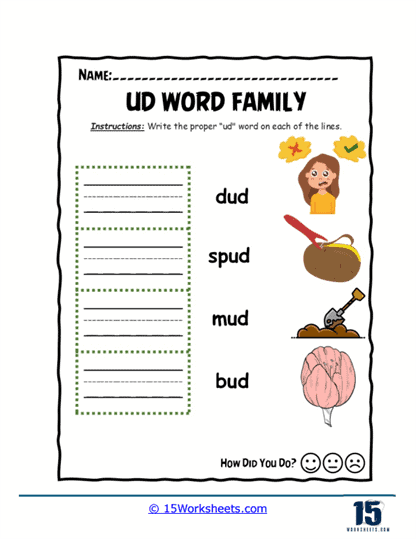
In this activity, kids see a set of pictures and write the correct “-ud” word under each one. With prompts like mud, bud, and dud, students get spelling practice that goes beyond recognition. The short writing lines encourage neat and careful handwriting. It’s a great mix of decoding and encoding skills. Teachers can assign it for handwriting practice or quick checks during small group work.
Label Lines
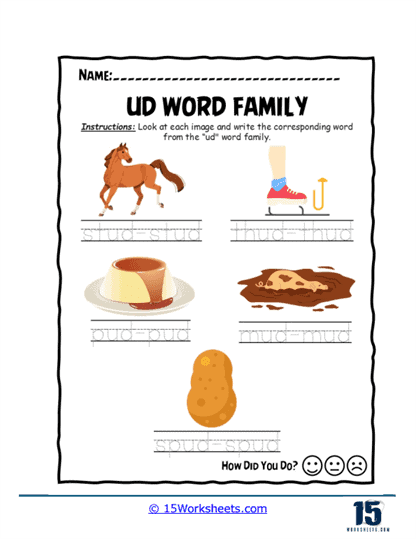
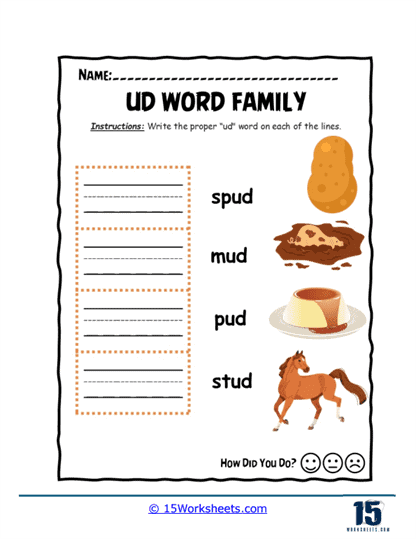
Students write words such as stud, thud, and pud under matching pictures, reinforcing both spelling and meaning. The repetition helps transfer decoding into spelling fluency. Neat handwriting practice is built into every line. The format is consistent, which makes learners more confident each time. Parents can use it as an at-home spelling routine too.
Cut & Glue
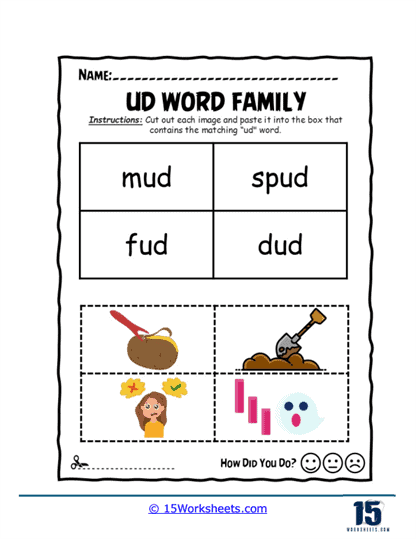
This craft-style worksheet has students cut out pictures and glue them into labeled boxes like mud or spud. It’s a hands-on way to reinforce word meaning and recognition. Kids love the tactile element of cutting and pasting, which keeps engagement high. The task also teaches them to slow down and double-check word labels. It’s ideal for a literacy center or a Friday fun activity.
Ud Fillers
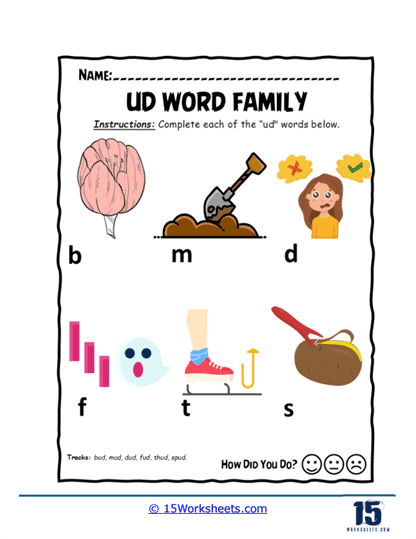
Here, students see letter starters like b__ or m__ and finish each word by adding “ud.” They’ll then read their new words aloud, boosting blending skills. The worksheet shows how one rime can build lots of words, which is a key phonics insight. Reading aloud supports fluency and pronunciation. It’s flexible for whole-class mini-lessons or independent seatwork.
Line Practice
Students choose the correct “-ud” word for each picture and then write it several times across a line. This repetition helps spelling become automatic. The exercise also encourages neatness and consistency in handwriting. Kids love the satisfaction of filling each line with the correct word. Teachers can use it for handwriting drills that also reinforce phonics.
Line Practice+
This companion sheet repeats the writing routine with words like spud, pud, and stud. Students copy each word neatly across the lines, gaining rhythm and confidence. It’s a calm and focused activity that strengthens spelling memory. The worksheet extends vocabulary while keeping directions simple. It’s perfect for independent work or homework packets.
Ud Search 1
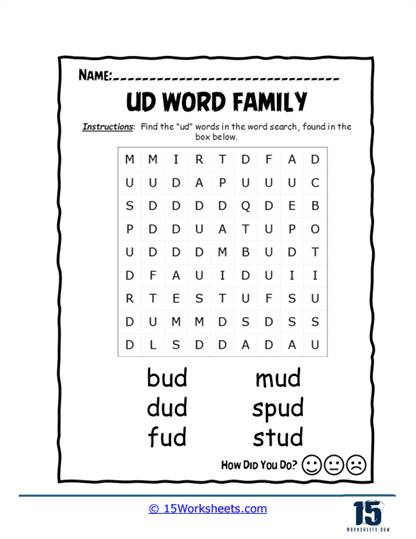
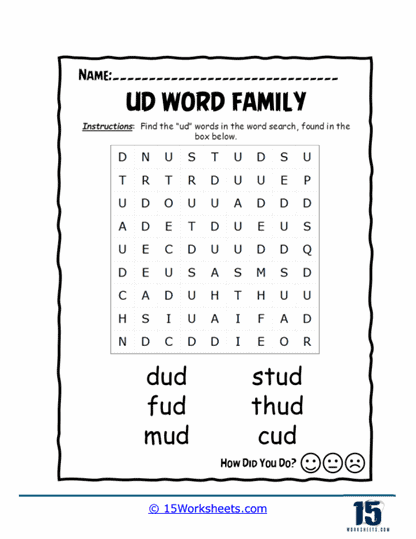
This word search puzzle hides six “-ud” words such as bud and stud inside a grid. Kids love the game-like format, which makes practice feel like play. Scanning for the same ending in different orientations sharpens visual tracking. Students gain persistence as they circle each hidden word. It’s a fun choice for early finishers or at-home review.
Ud Search 2
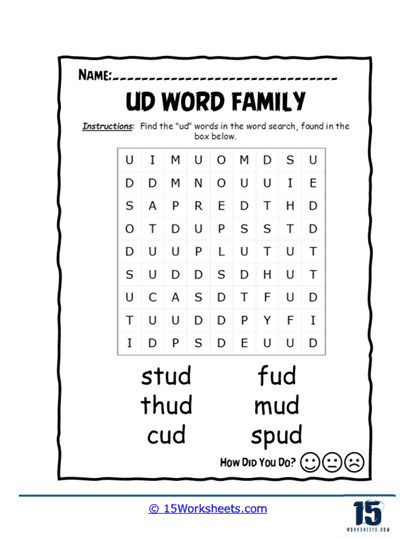
A new word search introduces slightly trickier words like thud and cud along with the classics. Learners must focus closely on both beginnings and endings. The mix of familiar and less common words keeps interest high. Kids develop attention to detail while building vocabulary. This puzzle works well for homework or literacy game time.
Ud Search 3
The third word search brings another batch of words like dud and thud. The denser grid makes it a little more challenging, encouraging perseverance. Students check off each word as they find it, building metacognitive skills. The format is consistent, so success builds with each puzzle. It’s great for brain breaks or end-of-week review.
Picture Naming
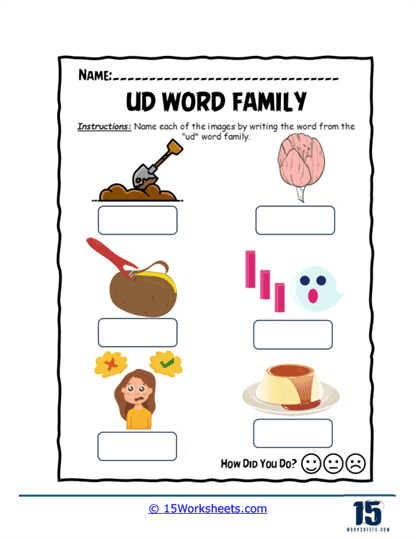
Students see pictures like a potato or a muddy puddle and write the matching “-ud” word without a word bank. The focus is on recall and spelling accuracy. It’s a step toward independence since kids must retrieve words from memory. The clean design highlights neatness and careful work. Parents and teachers can use it as a spelling quiz in disguise.
Ud Traceway
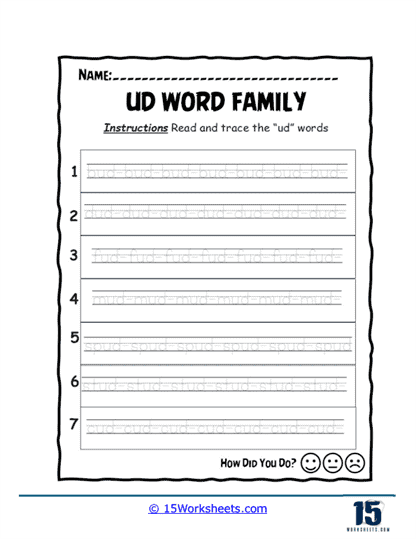
This final sheet gives dotted “-ud” words for students to trace and then write independently. Tracing supports correct letter formation and spacing. After writing, students read each word aloud to reinforce learning. The repetition builds fluency and confidence. It’s a gentle bridge from guided practice to independent spelling success.
What is the -ud Word Family?
The “-ud” word family is a collection of words that all share the same rime: -ud. The rime is the part of the word that includes the vowel and everything after it, so in this case it’s “u” plus “d.” Words like mud, bud, and spud all belong to this group. They may look short and simple, but they play an important role in early reading because they show how one ending can combine with different starting sounds. This helps children understand patterns in English spelling.
One fun thing about the “-ud” family is that the words cover a mix of meanings and parts of speech. Some are nouns like mud and spud, while others can be used as verbs (like stud in certain contexts). A few are playful or less common, such as fud or dud, which kids often find funny. This variety gives teachers a chance to expand vocabulary while keeping things lighthearted. Kids enjoy discovering that even “silly” words are part of real word families.
In everyday language, “-ud” words pop up more often than you’d think. You might hear a thud when something falls, or see a flower bud in spring. On a rainy day, children can splash in the mud, while at dinner someone might cook a baked spud. These real-world connections help kids anchor the spelling pattern in their daily lives. Once they know the “-ud” family, they can read and spell these words with ease, adding to their growing confidence as readers.
Word List for the -ud Word Family
bud, cud, dud, fud, mud, pud, spud, stud, thud
Example Sentences
The flower bud peeked out of the mud.
I cooked a spud and dropped it with a loud thud.
The game was a dud, but we laughed at the silly fud sound.
A stud horse trotted through the mud near the farm.
The cow chewed its cud while a little pud of clay sat nearby.