Ump Word Family Worksheets
About Our -ump Word Family Phonics Worksheet Collection

Recognizing word families is one of the most helpful stepping stones for early readers, and the -ump word family is a great pattern for students to explore. Words like jump, bump, pump, and stump all share the same -ump ending, which means learners can study one sound pattern and apply it to many different words. Our -ump Word Family Worksheets help young readers notice this shared spelling and sound while practicing reading, writing, and word recognition. With colorful visuals and engaging activities, students begin to see that reading is full of patterns they can recognize and use.
This worksheet collection gives students several ways to practice the -ump sound pattern so it becomes familiar and easy to recognize. Some activities ask learners to match pictures with words, while others focus on writing practice, sorting words, completing puzzles, or searching for hidden word-family patterns. By seeing the same spelling pattern in different formats, students strengthen their phonics awareness while staying engaged with interactive activities.

The worksheets also connect phonics practice to everyday vocabulary that students already recognize. Words like jump or pump appear often in stories, conversations, and classroom instructions, making them meaningful examples for early readers. Teachers and parents can use these worksheets during phonics lessons, literacy centers, or extra reading practice at home. With repeated exposure and playful activities, students build confidence recognizing and reading -ump word family words.

A Look At The Worksheets

Picture Pick: [Word Family Recognition]
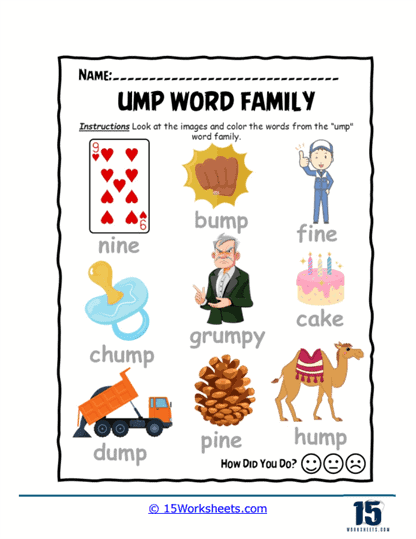
Students review several illustrated objects and decide which words belong to the -ump word family. Pictures such as bump, grumpy, chump, dump, and hump appear alongside unrelated words that act as distractors. Learners color only the correct -ump words, using picture clues to guide their decisions. This activity helps students strengthen phonics awareness while recognizing shared word endings.

Word Finder: [Pattern Recognition & Sorting]
This worksheet asks students to examine pictures and words to identify which ones belong to the -ump word family. Images representing words like jump, lump, plump, pump, and stump help learners recognize the repeating sound pattern. Students mark or color the correct choices while ignoring unrelated words. The activity builds phonemic awareness and strengthens pattern recognition.

Match Links: [Word-to-Picture Matching]
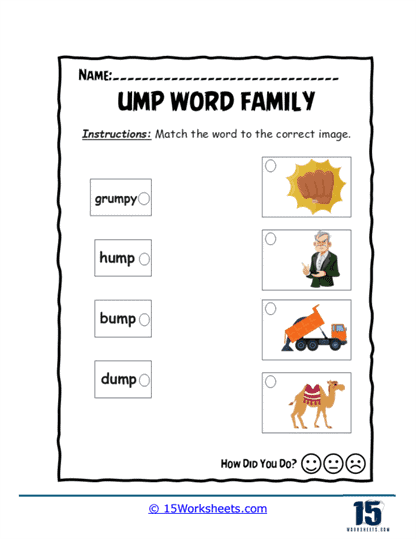
Students match written -ump words such as grumpy, hump, bump, and dump with the correct pictures. They draw lines connecting each word to the image that represents it. The task requires learners to analyze both visual clues and spelling patterns. Matching activities reinforce the connection between phonics patterns and word meaning.

Picture Match: [Vocabulary & Visual Association]
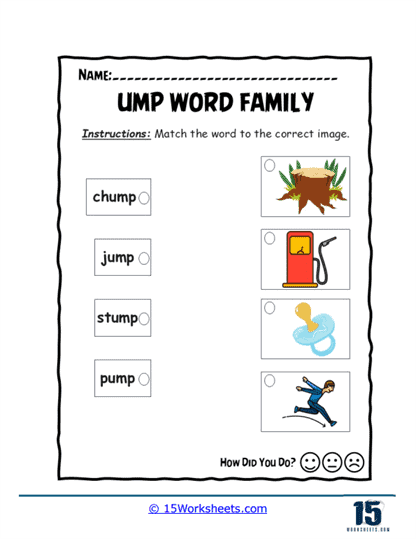
Learners pair additional -ump family words like chump, jump, stump, and pump with their corresponding pictures. Each image helps students identify the correct word before connecting the pair. This worksheet strengthens vocabulary recognition while reinforcing the shared spelling pattern. The activity encourages careful observation and attention to detail.

Word Write: [Phonics & Writing Practice]
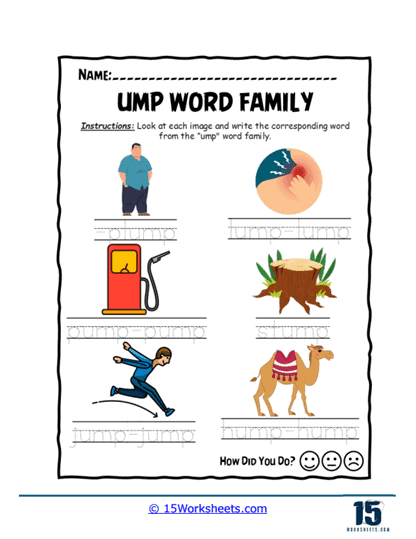
Students observe pictures such as pump, stump, jump, hump, lump, and plump and write the matching -ump word on the lines provided. Tracing guides support correct spelling and handwriting. This worksheet combines phonics recognition with writing practice. Repeated writing strengthens spelling patterns and builds early literacy confidence.

Spelling Practice: [Sound-to-Spelling Connection]
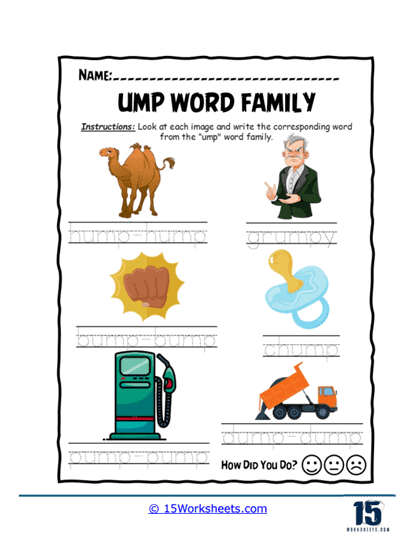
In this activity, students identify pictures representing -ump words like hump, grumpy, bump, chump, pump, and dump. They write the correct word beneath each image while using tracing patterns as guidance. The worksheet encourages learners to connect sounds, images, and written words. This strengthens phonics awareness and spelling accuracy.

Word Puzzle: [Cut-and-Paste Phonics Activity]
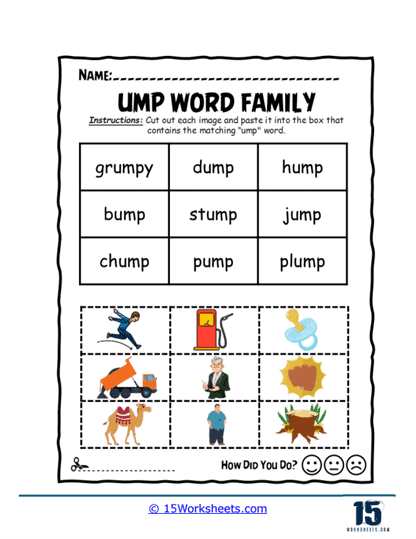
Students cut out pictures and place them in boxes labeled with matching -ump words such as jump, pump, stump, dump, and grumpy. The hands-on puzzle format turns phonics practice into an interactive activity. This worksheet supports fine motor skills while reinforcing word-family recognition. Physical interaction makes spelling patterns more memorable.

Word Builder: [Word Completion & Phonemic Awareness]
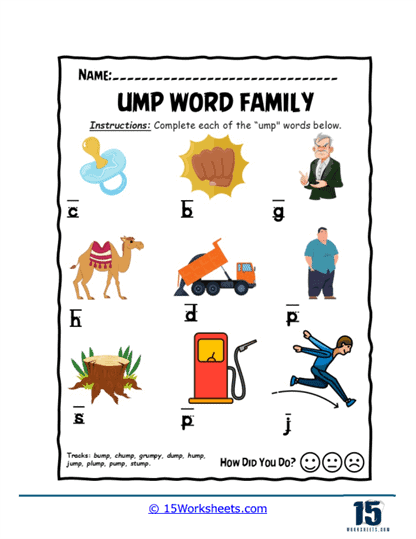
Students complete -ump words by filling in missing letters using picture clues. Each image provides the beginning letter while students add the correct ending pattern. Words like bump, jump, pump, and stump help learners focus on the shared spelling structure. This exercise strengthens decoding skills and pattern recognition.

Copy Lines: [Spelling & Handwriting Practice]
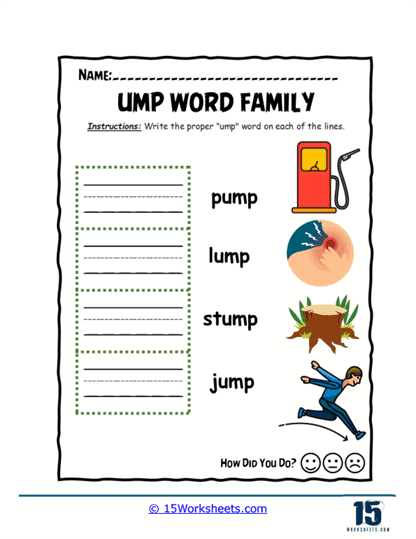
This worksheet provides lined spaces where students copy -ump words such as pump, lump, stump, and jump. Pictures appear beside each word to reinforce meaning. Repetition helps learners become familiar with spelling patterns while practicing neat handwriting. The activity supports spelling memory and early writing skills.

Writing Lines: [Vocabulary Writing Practice]
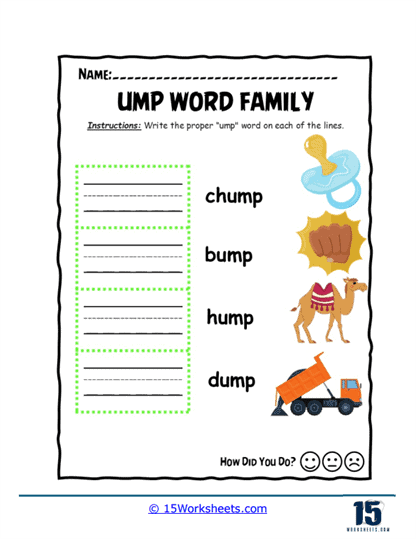
Students copy another set of -ump words including chump, bump, hump, and dump. Pictures serve as visual prompts while learners carefully write each word on lined spaces. The repetition reinforces spelling recognition and vocabulary understanding. This worksheet blends phonics practice with handwriting development.

Hidden Word Trek: [Word Search Puzzle]
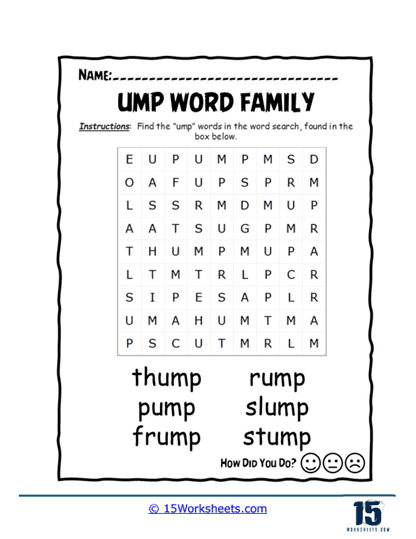
Students search a grid of letters to locate hidden -ump words such as thump, pump, frump, rump, slump, and stump. Words may appear in different directions, requiring careful scanning. This puzzle strengthens visual pattern recognition and spelling awareness. Word searches help students identify familiar phonics patterns more quickly.

Letter Grid Explorer: [Word Search & Pattern Recognition]
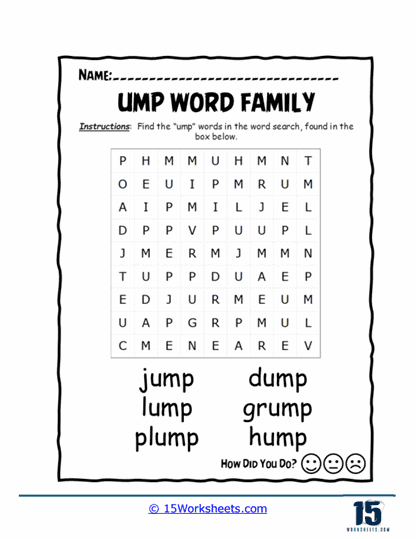
In this activity, students locate hidden words within a dense letter grid using a reference list. The puzzle encourages learners to scan carefully for specific spelling patterns. By identifying -ump words in the grid, students strengthen recognition of common word endings. This exercise builds concentration and decoding skills.

Puzzle Grid Challenge: [Spelling Pattern Puzzle]
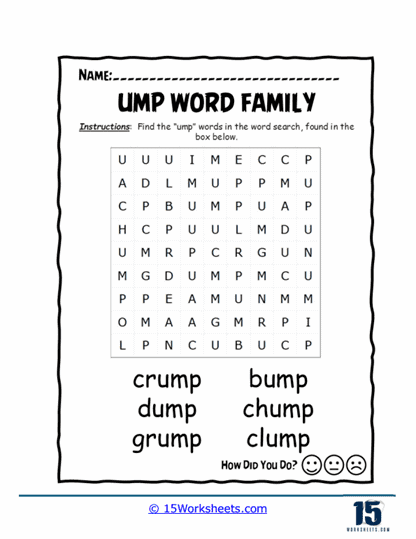
Students examine a letter grid to find hidden words that follow the -ump spelling pattern. The puzzle requires learners to analyze rows, columns, and diagonals to locate each word. This activity reinforces familiarity with shared phonics endings. It also improves visual discrimination and problem-solving.

Picture Naming Challenge: [Vocabulary & Writing]
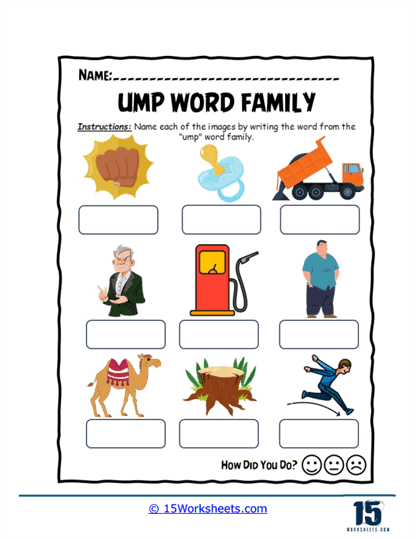
Students study a set of pictures and write the correct -ump word in the blank spaces provided. Each illustration helps guide learners toward the correct spelling. This worksheet blends visual interpretation, spelling, and vocabulary practice. Writing the words strengthens memory of phonics patterns.

Tracing Practice Lines: [Letter Formation & Word Recognition]
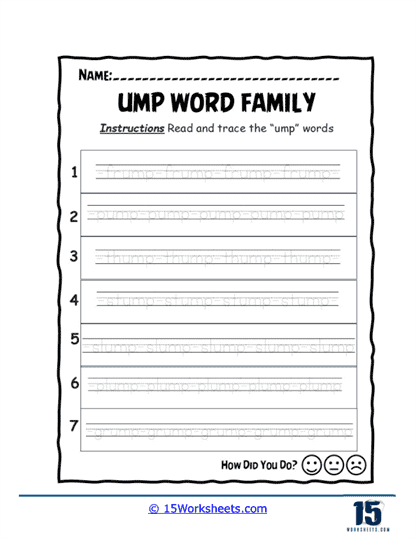
Students read and trace -ump family words across multiple rows. Each word appears lightly printed so learners can follow the letter shapes with their pencil. Repetition improves handwriting control and reinforces spelling patterns. Tracing helps build muscle memory while strengthening word recognition.

How To Use These Worksheets

Teachers

These worksheets fit nicely into a phonics lesson focused on word families. A teacher might introduce the -ump sound pattern on the board using a few example words like jump, bump, and pump, then let students practice with one or two worksheets during literacy centers. Activities such as Picture Pick or Word Finder work well as quick warm-ups, while puzzles and writing pages can reinforce the pattern later in the lesson. Using a mix of activities helps students encounter the same phonics pattern in multiple ways, which strengthens retention.

Substitute Teachers

If you’re leaving plans for a substitute, phonics worksheets like these are easy for students to start independently. Matching activities, coloring pages, and word searches require very little explanation but still keep students focused on reading skills. A substitute could also extend the activity by asking students to read the -ump words aloud or think of additional words that follow the same pattern. This keeps the lesson productive even without detailed instruction.

Homeschoolers

For homeschool families, word-family worksheets provide a simple way to build consistent phonics practice. Many parents like to start by reading the -ump words together, then letting their child complete a worksheet afterward. Because the activities include puzzles, matching, writing, and tracing, they can be spread across several short lessons rather than one long session. This keeps learning manageable and helps young readers stay engaged.

Tutors

Tutors often use word-family worksheets to reinforce phonics patterns that students may still be developing. A helpful approach is to review the sound pattern in the -ump word family first, then complete a worksheet together. Afterward, the tutor can ask the student to use the words in a simple sentence or think of additional rhyming words. This extra step helps strengthen both reading and vocabulary understanding.

Parents

Parents supporting reading at home can use these worksheets as quick practice activities. Completing one worksheet at a time keeps the task manageable while reinforcing spelling and reading skills. Parents can also turn it into a game by asking their child to find -ump words in books, signs, or labels around the house. This helps children see that phonics patterns appear everywhere in everyday reading.

Grandparents

Grandparents often enjoy helping children practice reading in a relaxed setting. These worksheets provide an easy way to explore word families together. Reading the words aloud, talking about the pictures, and celebrating correct answers can turn a simple worksheet into a shared learning activity. The encouragement and conversation often help children feel more confident about their reading skills.

How These Worksheets Align With Standards

Word-family practice is a key part of early reading instruction because it helps students understand how letters and sounds work together to form predictable patterns. When children recognize that many words share the same ending sound, they can decode new words more easily. Instead of sounding out every letter from scratch, they begin to recognize familiar chunks like -ump, which speeds up reading and improves accuracy.

These worksheets give students repeated opportunities to read, write, and recognize word-family patterns. Activities like matching pictures to words, building words from clues, and tracing spelling patterns all help reinforce the connection between sounds, letters, and meaning.

The puzzles and writing exercises also help students develop word recognition and reading fluency. As learners repeatedly encounter words such as jump, bump, and pump, the spelling pattern becomes more familiar. Over time, this repeated exposure helps students read similar words more quickly and confidently.

Because the worksheets combine phonics recognition, handwriting practice, and vocabulary development, they support the foundational reading skills that young learners need before moving into more advanced comprehension work.

Standards Supported

Common Core State Standards (CCSS)

  • CCSS.ELA-LITERACY.RF.K.2 – Demonstrate understanding of spoken words, syllables, and sounds
  • CCSS.ELA-LITERACY.RF.K.3 – Know and apply grade-level phonics and word analysis skills
  • CCSS.ELA-LITERACY.RF.1.2 – Demonstrate understanding of spoken words and phonemes
  • CCSS.ELA-LITERACY.RF.1.3 – Decode regularly spelled one-syllable words

Texas Essential Knowledge and Skills (TEKS)

  • TEKS K.2 – Phonological awareness and sound recognition
  • TEKS 1.2 – Decoding and word recognition through phonics patterns
  • TEKS 1.3 – Vocabulary development and word structure

California English Language Arts Standards

  • RF.K.2 – Phonological awareness
  • RF.K.3 – Phonics and word recognition
  • RF.1.3 – Applying phonics skills in decoding words

Florida B.E.S.T. Standards (ELA)

  • ELA.K.F.1 – Foundational phonics and phonological awareness
  • ELA.1.F.1 – Phonics and word analysis skills
  • ELA.1.F.2 – Reading words with common spelling patterns

Frequently Asked Questions

What is a “nasal blend,” and how does it apply to -ump words?

The -ump pattern includes a nasal sound followed by a consonant blend (m + p). In words like jump or stump, the /m/ sound can sometimes feel “squished” with the vowel sound before it, which makes it harder for early readers to hear each individual sound. Practicing -ump words helps students recognize that even when sounds blend together quickly in speech, each letter still represents a separate sound in writing. This awareness strengthens phonemic awareness and spelling accuracy.

At what grade level should students learn the -ump word family?

Most students begin learning simple CVC word families (like -um) in Kindergarten, but the -ump word family usually appears a little later-often in late Kindergarten or early First Grade. That’s because these words include an extra consonant sound at the end, turning them into four-sound words like /j-u-m-p/. These worksheets help students make that transition from three-sound words to slightly more complex patterns.

How does the -ump word family help students read words with consonant clusters?

Many -ump words begin with consonant clusters such as st-, gr-, or pl- (stump, grump, plump). When students learn the -ump rime, they can treat it as a familiar chunk. This allows them to focus mainly on decoding the beginning of the word instead of trying to sound out every letter individually. Recognizing common chunks like -ump makes decoding longer or more complex words much easier.

Are there any irregular or “heart words” in the -ump word family?

One helpful feature of the -ump word family is that most words in this group are highly consistent in spelling and pronunciation. Words such as jump, pump, bump, and dump follow predictable phonics patterns. Because there are very few rule-breaking words in this family, it often becomes a confidence builder for beginning readers who are learning to trust phonics patterns.

Can these worksheets help with sound-to-letter mapping (spelling practice)?

Yes. Many of the activities-especially Word Builder, Spelling Practice, and Writing Lines-encourage students to convert sounds they hear into written letters. When a child sees a picture of a word like clump or stamp and writes the letters that match the sounds, they are practicing sound-to-letter mapping, also known as encoding. This skill is an essential part of structured literacy because it strengthens both spelling and reading development.