
Ug Word Family Worksheets






About Our -ug Worksheets
The “-ug” word family is one of those cozy little groups that kids quickly grow to love. With words like bug, mug, and rug, this family feels familiar and fun, while also teaching key decoding skills. Mastering this pattern gives students a boost of confidence because they can recognize, read, and spell lots of words with just one rime. Whether at home or in the classroom, these worksheets bring the “-ug” family to life with puzzles, stories, and playful practice.
Every worksheet in this set is designed to highlight the ending pattern -ug while mixing in creativity and problem-solving. Students will color, match, label, trace, and even play bingo, all while reinforcing the same phonics skill. The repetition is intentional-it helps kids anchor the pattern in memory and makes it automatic in their reading and writing. Parents and teachers will love how adaptable the activities are for centers, small groups, or independent learning.
Most importantly, the “-ug” family connects practice to real-world reading. Kids notice bugs in the garden, sip cocoa from a mug, or snuggle into a warm rug at Storytime. These everyday connections make phonics personal and meaningful. By the end of the set, children will be spotting “-ug” words everywhere-and smiling with the confidence of a growing reader.
About Each Worksheet
Picture Pairing
Students look at lively pictures and write the matching “-ug” word on the lines. With a small bank of choices, learners focus on spelling and meaning. The repetition of decoding and labeling builds fluency. Kids enjoy the visual support as they connect sound to print. It’s a great fit for independent practice or partner review.
Pattern Practice
This tracing and writing page helps learners internalize “-ug” words through repeated modeling. Students carefully form letters on guided lines while reading aloud. The structured format encourages neatness and accuracy. Writing and reading combine to reinforce phonics memory. Teachers can use it as daily handwriting and phonics warm-up.
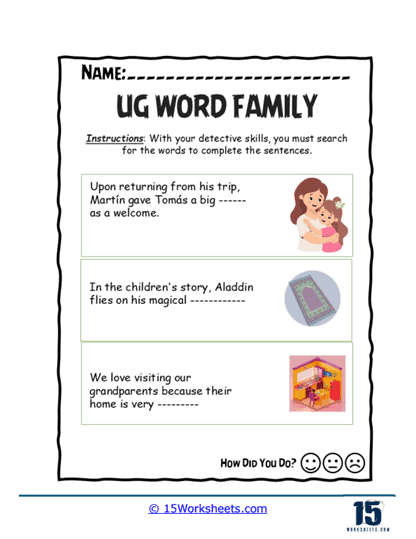
Sentence Sleuth
Learners fill in sentences with the correct “-ug” word to complete the thought. Clues come with helpful pictures, so decoding is supported by context. The task blends phonics with comprehension in a playful way. Kids feel like detectives solving mini mysteries. It’s excellent for small-group reading or homework practice.
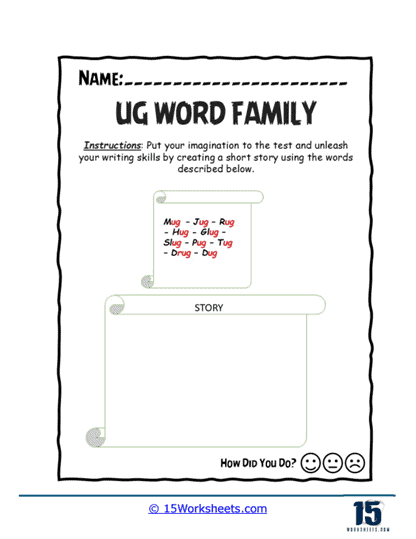
Story Spark
This worksheet invites kids to create a short story using several “-ug” words from a list. The big writing box gives room for imagination and sequencing. Students practice voice, clarity, and even dialogue while anchored to a phonics target. Writing with a word family makes new vocabulary personal. It’s perfect for writing centers or early composition lessons.
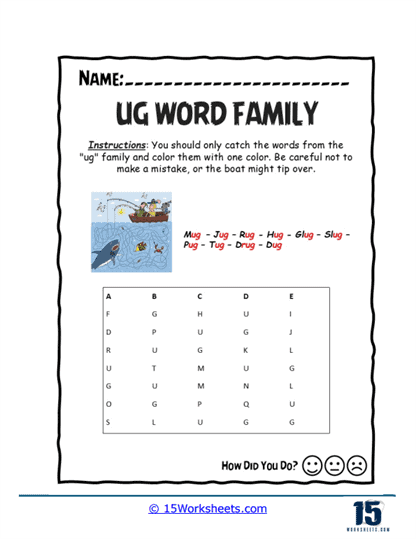
Word Catch
Learners search a word grid to find hidden “-ug” words. The game-like style keeps motivation high while sharpening visual scanning. Distractors make students pay close attention to every letter. Finding each word feels like a little victory. It’s great as a fun Friday activity or an early finisher task.
Color Select
Students color only the images and words that belong to the “-ug” family. Non-examples keep them on their toes as they double-check. The coloring element adds a creative twist to phonics practice. It strengthens focus and fine-motor skills. Teachers can use it for review or literacy centers.
Label Lines
In this worksheet, kids label each picture with the correct “-ug” word. They practice decoding, spelling, and neat handwriting all at once. The repeated read-think-write cycle cements the pattern. Confidence grows with each correctly labeled image. It works beautifully for at-home spelling practice or small-group review.
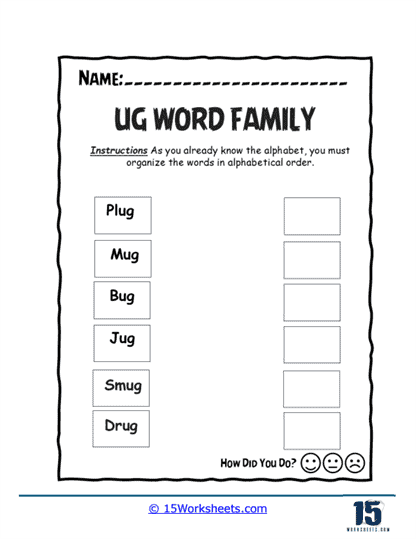
Alphabet Order
Students take a scrambled list of “-ug” words and rewrite them in ABC order. This combines phonics with sequencing and organizational thinking. Letter-by-letter comparison sharpens accuracy. Sorting requires attention to detail and self-checking. It’s a handy skill-builder for both language arts and early research skills.
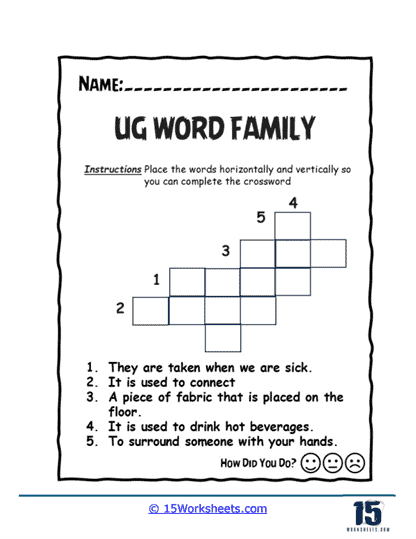
Crossword Quest
This mini crossword challenges kids to fit “-ug” words into a grid. Each clue ties vocabulary to real-world meaning. The interlocking format demands precise spelling. Kids enjoy the puzzle-solving element as they test and adjust. It’s an engaging way to reinforce both phonics and logic.
Prefix Patrol
Learners complete words by adding onsets like blends and digraphs to “-ug.” The playful patrol theme turns it into a mission. Students see how onsets and rimes combine to make many words. They write and read each one to reinforce decoding and encoding. It’s a strong tool for teaching word-building strategies.
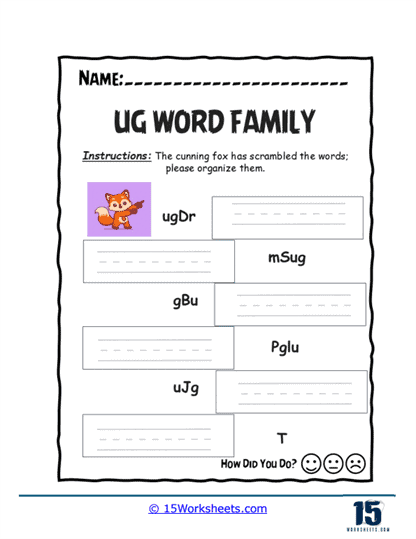
Scramble Solve
Kids unscramble jumbled letters to form “-ug” words. The puzzle format feels like a challenge game. Learners use the steady rime plus flexible onsets to decode. Attention to letter order strengthens spelling memory. Teachers can use it as a center activity or homework puzzle.
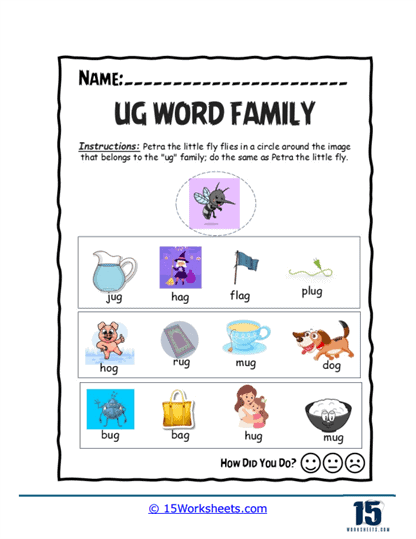
Circle Search
Students circle only the items that belong to the “-ug” family from a mix of images and words. The yes/no decision keeps them focused on details. Repeated exposure sharpens instant recognition. The activity is simple enough for independent use. It makes for a great review page before a quiz.
Bingo Blast
This lively game uses picture bingo cards filled with “-ug” words. As the teacher calls an item, kids search and mark their boards. The social gameplay adds excitement and repetition. Students build quick recognition under light pressure. It’s excellent for whole-class review or literacy parties.
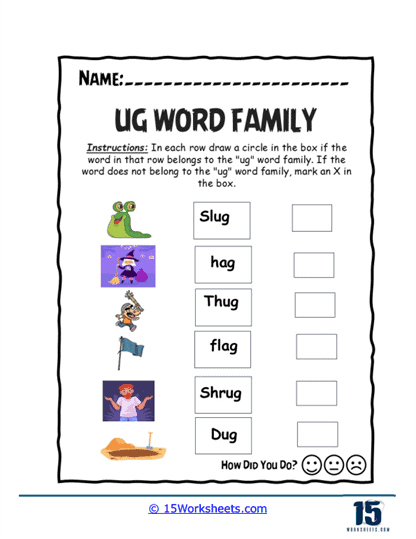
Family Filter
Each row shows an image and a nearby word, and kids decide if it belongs to the “-ug” family. They mark yes or no, sharpening both accuracy and reasoning. The repeated contrasts reinforce generalization skills. Students justify their choices as they go. Teachers can use it for quick formative assessments.
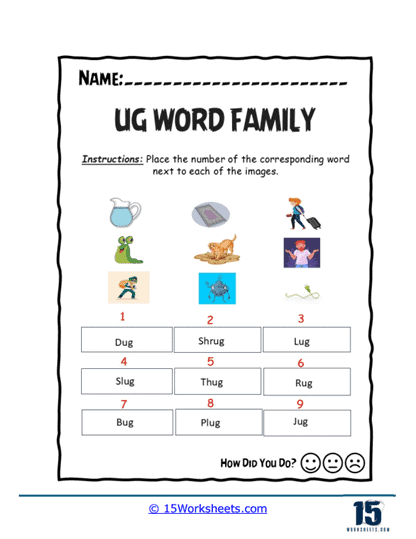
Number Match
Students match images to the correct “-ug” word from a numbered list. This requires scanning, memory, and careful checking. The final product is neat and easy to grade. It reinforces exact spelling and word-picture connections. The simple, structured format supports independent practice.
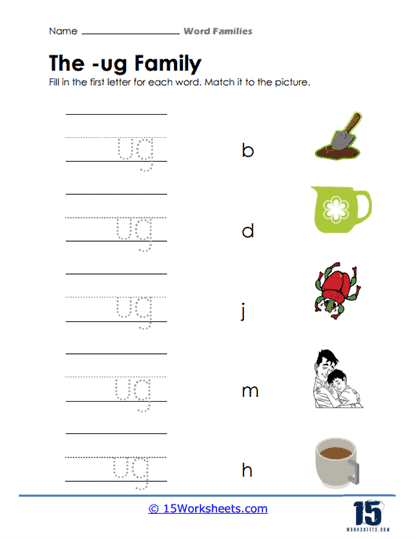
Picture Matching
This worksheet highlights illustrated “-ug” items like a bug, mug, or rug. Students match beginning letters to each image, then complete the word. The activity ties visual association to phonetic sound. Filling in letters supports decoding and spelling fluency. It’s a great hands-on way to introduce the “-ug” family.
What is the -ug Word Family?
The “-ug” word family is made up of short, simple words that all share the ending -ug. The rime includes the vowel “u” and the consonant “g,” which creates a sturdy, satisfying sound. Words like bug, mug, and rug are common examples. By changing just the first letter or blend, you can unlock a whole set of words. This teaches students that reading isn’t about memorizing one word at a time-it’s about spotting patterns.
Words in the “-ug” family cover a range of meanings. Bug and slug are animals, while rug and mug are objects. Hug is a sweet action, while tug is something you do with a rope or toy. This mix of nouns and verbs makes the family rich in vocabulary practice. Kids get to learn words they’ll encounter often in stories, conversations, and even at home.
These words also pop up in everyday life, which helps reinforce learning. You might drink from a mug, sweep crumbs off a rug, or see a bug outside. Friends give a big hug, or a dog might tug on a leash. The regularity of the “-ug” pattern makes it easy to read and spell, while the real-world ties make it meaningful. Mastering the “-ug” family is another big step toward reading independence.
Word List for the -ug Word Family
bug, dug, hug, jug, lug, mug, plug, rug, slug, snug, thug, tug
Example Sentences
The little bug sat on the soft rug.
She gave her friend a big hug and a shiny new mug.
The boy dug a hole and found a slug.
The puppy tried to tug on the heavy jug.
I used a plug to make the lamp snug in the wall.