Ung Word Family Worksheets
About Our -ung Word Family Worksheets
Learning to read becomes much easier when students begin to notice patterns in words. The -ung word family is a great example of how many words share the same ending sound, such as ring, sing, lung, and hung. When students recognize that familiar -ung pattern, they can decode new words more quickly and confidently. Our -ung Word Family Worksheets help young learners explore these patterns through colorful activities, puzzles, and writing practice.

This collection introduces the -ung sound pattern through a variety of engaging exercises. Students might identify which words belong to the word family, match pictures with vocabulary, complete spelling activities, or search for hidden words in puzzles. Each activity reinforces the same spelling pattern while offering a fresh way to practice it. Seeing and using the pattern in multiple formats helps students strengthen their phonics awareness and word recognition skills.

These worksheets also connect phonics practice with familiar vocabulary and everyday experiences. When children see words like ring or sing paired with pictures and interactive activities, the spelling pattern becomes easier to remember. Teachers and parents can use these worksheets during phonics lessons, literacy centers, or at-home reading practice. With repeated exposure and playful activities, students become more confident readers who quickly recognize -ung word family words.

A Look At The Worksheets

Sound Family Spotting: [Word Family Recognition]
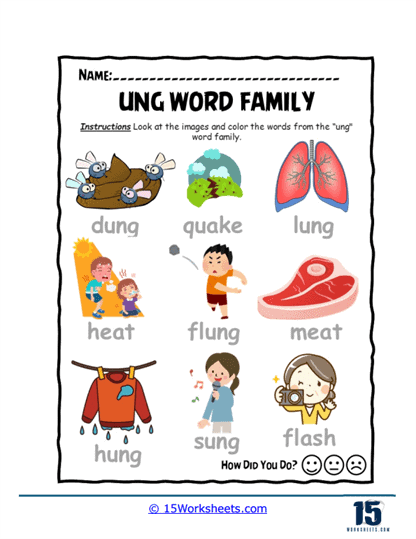
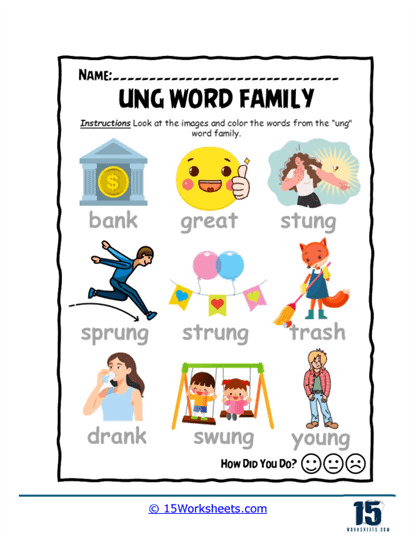
Students explore several illustrated words and decide which belong to the -ung word family. They read each word carefully and color only the ones that share the -ung ending sound, leaving distractors uncolored. This activity encourages students to compare spelling patterns and listen for familiar sounds. It’s an engaging introduction that helps learners begin recognizing the -ung phonics pattern.

Picture Sound Sorting: [Phonics Sorting & Pattern Recognition]
In this worksheet, students examine pictures and the words beneath them to determine whether they belong to the -ung word family. Learners color the correct words and skip the unrelated ones. The illustrations act as helpful clues that support vocabulary understanding. This activity strengthens sound recognition and phonics awareness.

Word Picture Connections: [Word-to-Picture Matching]
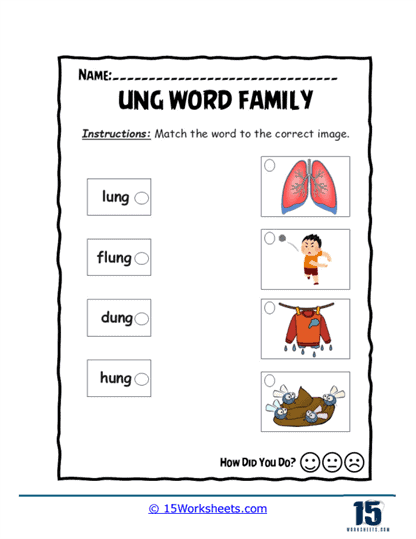
Students match written -ung words with the correct images by drawing lines between the pairs. Words appear on one side of the page while the corresponding pictures appear on the other. Learners must analyze both the text and visuals to make accurate matches. The activity reinforces the connection between spelling patterns and meaning.

Image Match Challenge: [Visual Association & Vocabulary]
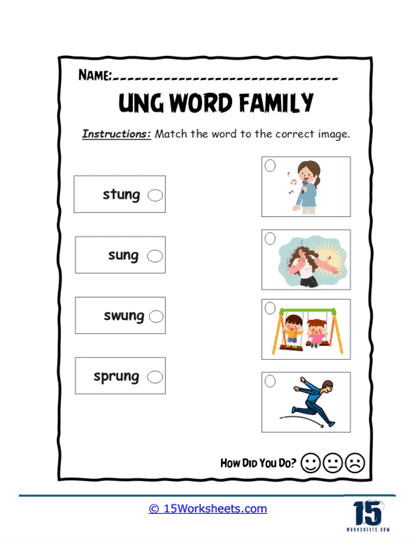
This worksheet provides additional -ung family words for students to match with pictures. Learners carefully examine each illustration before connecting it to the correct word. The activity builds familiarity with the -ung spelling pattern while encouraging close observation. It also strengthens vocabulary recognition and phonics understanding.

Picture Word Writing: [Phonics & Writing Practice]
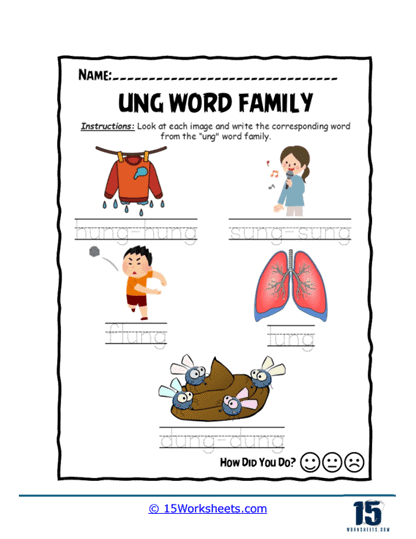
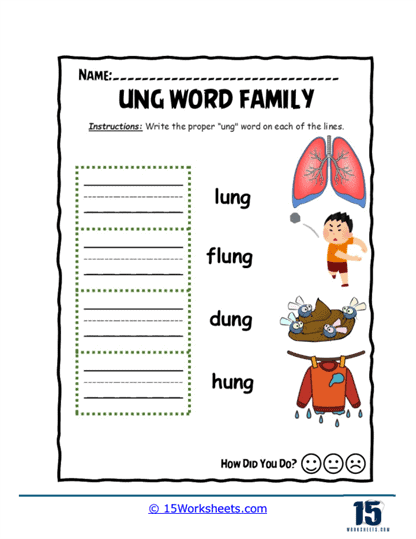
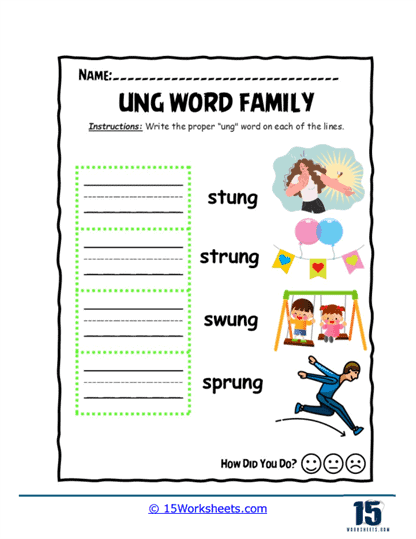
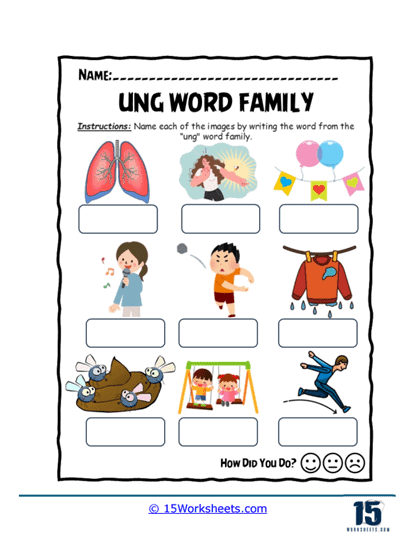
Students observe pictures representing -ung words and write the correct word on the provided lines. Tracing guides help support correct spelling and handwriting. This worksheet blends vocabulary recognition, phonics practice, and writing skills. Writing the words helps reinforce the shared -ung ending pattern.

Sound Pattern Writing: [Sound-to-Spelling Practice]
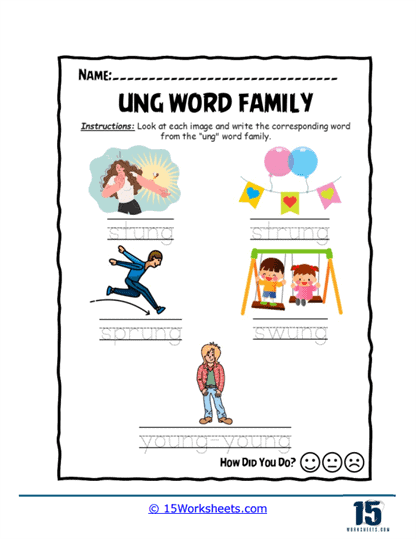
In this activity, students identify pictures and write the corresponding -ung word for each one. The images help guide learners toward recognizing the shared spelling pattern. Students must focus on both the sound and the spelling as they complete the words. This exercise strengthens phonics awareness and spelling confidence.

Picture Puzzle Sorting: [Cut-and-Paste Phonics Activity]
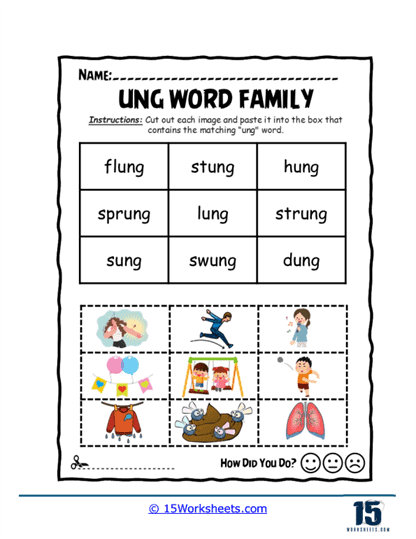
Students cut out pictures and place them in boxes labeled with the correct -ung words. Each image represents a word from the same sound family, encouraging learners to match them correctly before gluing them in place. The puzzle format turns phonics practice into an interactive activity. This worksheet also supports fine motor development.

Missing Sound Builder: [Word Completion & Phonemic Awareness]
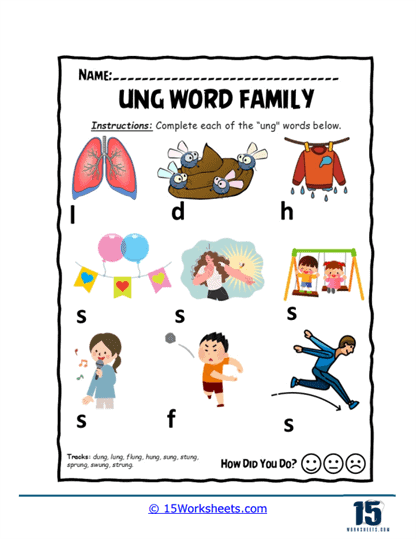
Students complete -ung words by adding the missing ending letters. Pictures and beginning letters help guide them toward the correct spelling. The activity emphasizes recognizing the shared -ung spelling pattern across different words. It encourages independent thinking while strengthening decoding skills.

Word Copy Practice: [Spelling & Handwriting]
Learners practice writing -ung words several times on lined spaces while referencing pictures for meaning. Repetition helps reinforce spelling patterns and improve handwriting. The visual prompts also support vocabulary understanding. This worksheet helps students build spelling memory and writing confidence.

Handwriting Sound Lines: [Vocabulary Writing Practice]
Students copy another set of -ung words onto lined spaces while using pictures as visual prompts. The repeated writing practice strengthens both handwriting accuracy and phonics recognition. Learners become more familiar with the structure and pronunciation of each word. This activity supports early literacy development.

Hidden Word Discovery: [Word Search Puzzle]
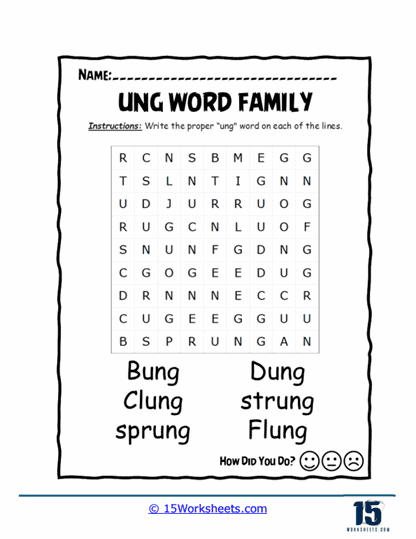
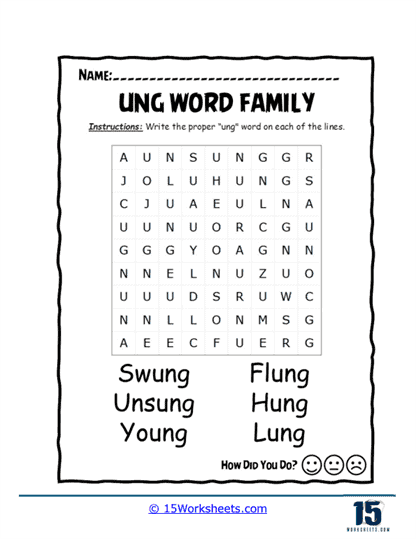
Students search a grid of letters to locate -ung words hidden within the puzzle. A word list beneath the grid helps guide the search. Learners carefully scan rows and columns to find each word. Word searches strengthen visual scanning skills and spelling recognition.

Letter Grid Search: [Word Search & Pattern Recognition]
In this puzzle, students locate hidden -ung word family words inside a letter grid. The activity encourages careful scanning of rows, columns, and diagonals. Finding each word reinforces recognition of familiar spelling patterns. This worksheet strengthens pattern recognition and concentration.

Word Hunt Challenge: [Spelling Pattern Puzzle]
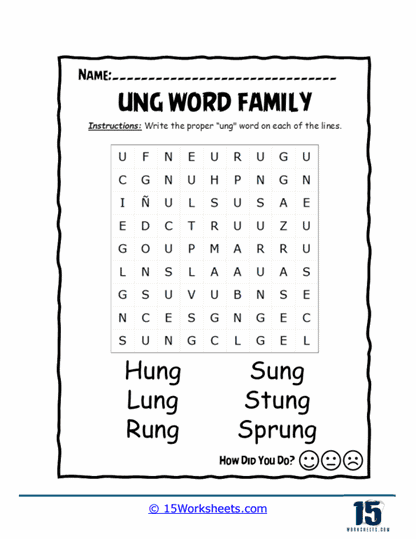
Students explore another word search puzzle filled with hidden -ung words. The target word list helps guide their search as they locate each word in the grid. The puzzle encourages careful observation and problem-solving. It reinforces recognition of the shared -ung ending sound.

Picture Naming Practice: [Vocabulary & Writing]
Students look at pictures and write the matching -ung word on the provided lines. Each illustration helps guide learners toward the correct spelling. The activity combines visual interpretation with phonics-based spelling practice. Writing the words strengthens vocabulary recall and spelling accuracy.

Tracing Word Practice: [Letter Formation & Word Recognition]
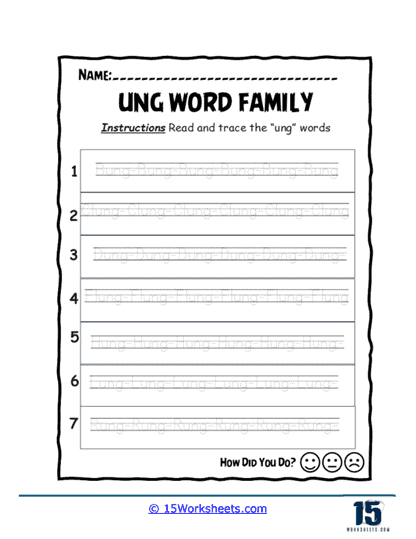
Students trace rows of lightly printed -ung words to practice correct handwriting. Following the letter shapes helps build fine motor control and muscle memory. The repetition also reinforces spelling patterns and word recognition. This tracing exercise supports early writing confidence.

How To Use These Worksheets

Teachers

These worksheets work well when introducing or reinforcing word families during phonics instruction. A teacher might begin by writing a few -ung words on the board-like ring, sing, and hung-and reading them aloud with the class so students hear the shared ending sound. Activities such as Sound Family Spotting or Picture Sound Sorting make great warm-ups before guided reading. Later in the lesson, writing pages and word searches can reinforce the pattern during literacy centers or independent practice.

Substitute Teachers

If you’re leaving plans for a substitute, phonics worksheets like these are easy for students to begin independently. Matching pages and word search puzzles require very little explanation but still keep students practicing reading skills. A substitute could also extend the lesson by asking students to read the -ung words aloud or think of additional words that follow the same pattern. This keeps the class engaged while reinforcing phonics learning.

Homeschoolers

For homeschool families, word-family worksheets provide a simple way to add consistent phonics practice to daily learning. Parents often start by reviewing a few -ung words together, then allow their child to complete a worksheet afterward. Because the activities include puzzles, matching, tracing, and writing, they can easily be spread across several short lessons. This helps keep learning manageable and engaging for younger readers.

Tutors

Tutors can use these worksheets to reinforce phonics patterns that students may still be developing. A helpful strategy is to review the -ung sound pattern first and then complete a worksheet together. After finishing, tutors can ask students to use the words in simple sentences or think of other words that rhyme with sing or ring. This strengthens both reading fluency and vocabulary development.

Parents

Parents who want to support reading at home can use these worksheets as short, focused practice sessions. Completing one page at a time keeps the activity from feeling overwhelming. Parents can also turn the lesson into a quick game by asking children to find -ung words in books, signs, or labels around the house. This helps students notice phonics patterns in everyday reading.

Grandparents

Grandparents often enjoy helping children practice reading in a relaxed way. These worksheets provide an easy starting point for exploring word families together. Reading the words aloud, discussing the pictures, and celebrating correct answers can turn a worksheet into a shared learning moment. Encouragement and conversation often help young readers feel more confident.

How These Worksheets Align With Standards

Word-family activities like these support key early literacy skills that students develop in kindergarten and first grade. When children recognize that many words share the same ending sound, they begin to decode new words more efficiently. Instead of sounding out every letter individually, they learn to recognize familiar chunks like -ung, which helps them read more quickly and accurately.

These worksheets provide repeated opportunities for students to identify, read, write, and recognize word-family patterns. Matching activities strengthen sound recognition, writing exercises build spelling skills, and puzzles encourage students to focus on letter patterns. Together, these activities help reinforce the connection between sounds, letters, and meaning.

Repeated exposure to words such as ring, sing, and hung also helps students build reading fluency and vocabulary recognition. As the spelling pattern becomes familiar, students can decode similar words more easily when they encounter them in books or classroom texts.

Because the worksheets combine phonics practice, handwriting development, and vocabulary learning, they support the foundational reading skills that students need before moving on to more advanced comprehension work.

Standards Supported

Common Core State Standards (CCSS)

  • CCSS.ELA-LITERACY.RF.K.2 – Demonstrate understanding of spoken words, syllables, and sounds
  • CCSS.ELA-LITERACY.RF.K.3 – Know and apply grade-level phonics and word analysis skills
  • CCSS.ELA-LITERACY.RF.1.2 – Demonstrate understanding of spoken words and phonemes
  • CCSS.ELA-LITERACY.RF.1.3 – Decode regularly spelled one-syllable words

Texas Essential Knowledge and Skills (TEKS)

  • TEKS K.2 – Phonological awareness and sound recognition
  • TEKS 1.2 – Decoding and word recognition through phonics patterns
  • TEKS 1.3 – Vocabulary development and word structure

California English Language Arts Standards

  • RF.K.2 – Phonological awareness
  • RF.K.3 – Phonics and word recognition
  • RF.1.3 – Applying phonics skills in decoding words

Florida B.E.S.T. Standards (ELA)

  • ELA.K.F.1 – Foundational phonics and phonological awareness
  • ELA.1.F.1 – Phonics and word analysis skills
  • ELA.1.F.2 – Reading words with common spelling patterns

Frequently Asked Questions

Why is the sound of “u” in the -ung word family sometimes hard for students to identify?

In words like sung or rung, the short “u” vowel sound can sometimes sound slightly different than it does in words like cup. This happens because the /ng/ sound at the end influences how the vowel is pronounced-a phenomenon called co-articulation. The vowel may sound a bit nasalized or blended with the ending sound. Helping students understand that the letter u still represents the vowel sound-even when it sounds slightly different-can make decoding these words easier.

Is “ng” one sound or two in the -ung word family?

In the -ung word family, the letters n and g work together to make a single sound: /ŋ/. This combination is called a digraph, meaning two letters represent one sound. Unlike blends (like st in stop), where both sounds are heard separately, the ng digraph produces one nasal sound formed in the back of the mouth. Teaching students to recognize ng as a unit helps them read and spell -ung words more accurately.

How does the -ung word family help students understand verb changes?

Some common English verbs change to an -ung form when used in certain past-tense or past-participle constructions. For example, sing becomes sung, ring becomes rung, and hang becomes hung. When students become familiar with the -ung spelling pattern, they begin to notice these changes naturally in reading and conversation. This early exposure can make later grammar lessons about verb forms easier to understand.

What are “glued sounds,” and is -ung considered one?

In many structured phonics programs, -ung is sometimes described as a “glued” or “welded” sound. This means the letters are so closely connected in pronunciation that students learn to read them as a single chunk instead of separate sounds. Recognizing chunks like -ung helps students decode words more quickly and improves reading fluency. These worksheets help reinforce that pattern through repeated exposure.

Can -ung words be used to teach rhyming skills?

Yes. The -ung word family is excellent for practicing rhyming because the ending sound stays consistent across many words. Students can easily create rhyme strings such as sung, rung, hung, and lung. Teachers can even challenge students to invent playful nonsense words like vung or zung. This encourages learners to focus on the sound pattern itself, which strengthens phonological awareness and decoding skills.