Um Word Family Worksheets
About Our -um Word Family Worksheets
Learning to read becomes much easier when students start recognizing patterns in words. Our -um Word Family Worksheets introduce young learners to a group of words that share the same ending sound: -um. As students practice with words like drum, gum, plum, and thumb, they begin to notice how similar spelling patterns create predictable sounds. This helps early readers decode new words more confidently because they can rely on patterns they already know.
This collection gives students multiple ways to practice identifying and using -um word family words. Activities include picture matching, word building, writing practice, puzzles, and word searches that make phonics practice feel interactive rather than repetitive. By encountering the same sound pattern across different types of activities, students strengthen their phonics awareness while staying engaged in the learning process. This repeated exposure helps build confidence and reading fluency.
The worksheets also connect phonics patterns with familiar objects and everyday experiences, such as drums, plums, and yummy treats. When children see how word families relate to things they already recognize, reading becomes more meaningful and easier to understand. Teachers and parents can use these activities to support early literacy development while keeping lessons playful and approachable. With regular practice, students begin to recognize -um word family patterns quickly and apply those skills when reading new words.
A Look At The Worksheets
Picture Hunt: [Word Family Recognition]
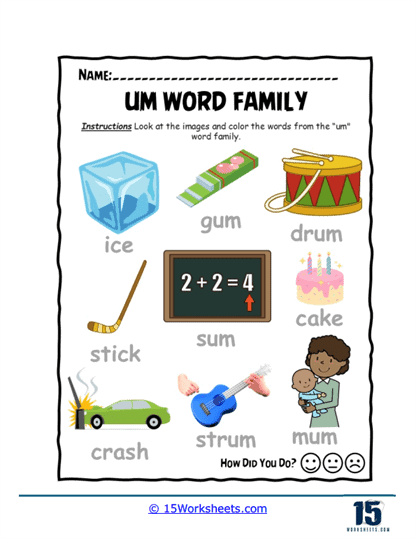
Students examine illustrated objects and determine which words belong to the -um word family. Pictures such as drum, gum, and mum appear alongside distractor images, and learners color only the words that share the same ending sound. This worksheet strengthens phonics awareness and helps children recognize repeating spelling patterns. The activity encourages careful observation while connecting visual clues with sound patterns in words.
Word Sort: [Phonics Sorting & Pattern Recognition]
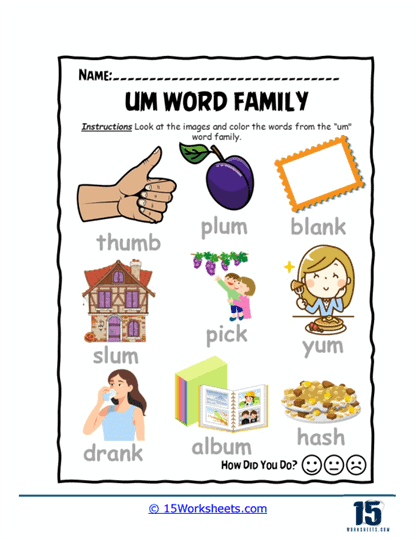
In this worksheet, students review pictures paired with different words and decide which ones belong to the -um word family. Images like plum, thumb, and album appear with unrelated words, prompting learners to evaluate both spelling and picture clues. This sorting activity builds phonemic awareness and classification skills. By comparing word endings, students strengthen their ability to recognize phonics patterns.
Match-Up: [Word-to-Picture Matching]
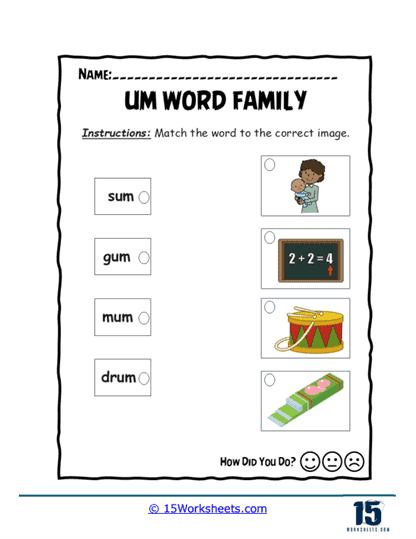
Students match written -um words with the correct pictures by connecting items from two columns. Words like drum and mum must be paired with their corresponding illustrations. The activity requires learners to interpret both text and visual clues. Matching exercises reinforce vocabulary recognition and strengthen the link between spelling patterns and meaning.
Picture Pairing: [Visual Association & Vocabulary]
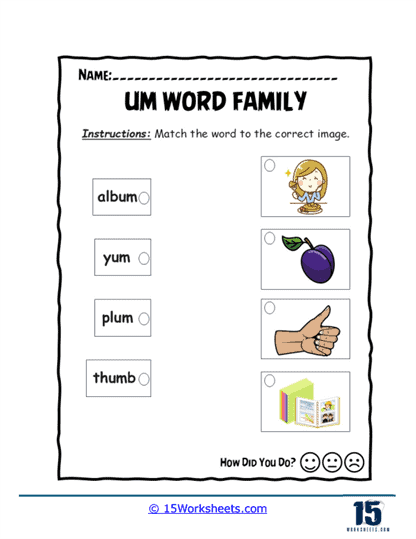
Learners match additional -um family words such as plum, yum, album, and thumb with their corresponding pictures. Students draw lines or mark the correct pairings to show the connection between the written word and its image. This worksheet supports decoding practice while improving visual association skills. The structured matching format helps students build stronger vocabulary recognition.
Writing Practice: [Phonics & Handwriting]
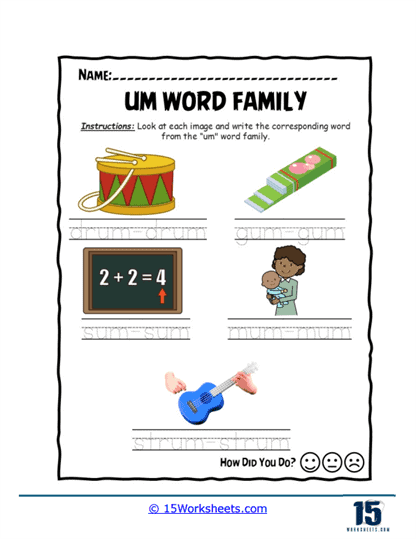
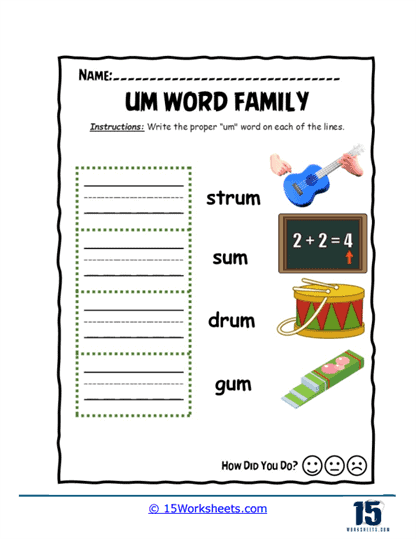
Students look at pictures such as drum, gum, and mum and write the correct -um word on the provided lines. Tracing guides help learners practice forming letters correctly while reinforcing the spelling pattern. The worksheet blends phonics recognition with handwriting development. Writing the words helps strengthen memory of spelling patterns and improves writing accuracy.
Sound Spelling: [Phonics-to-Spelling Practice]
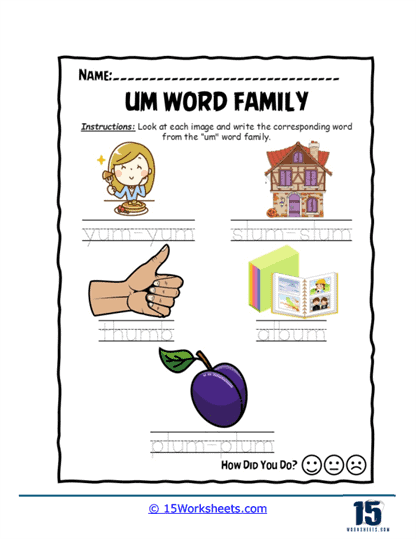
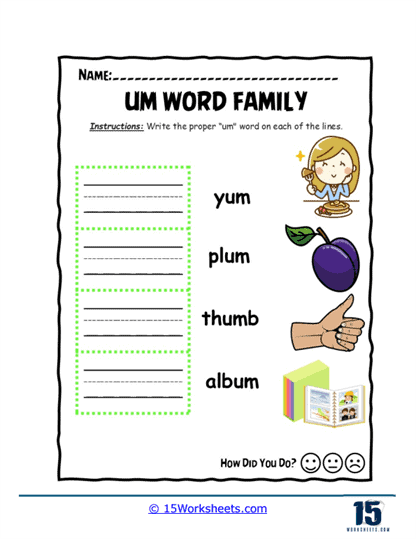
In this activity, students study pictures like yum, slum, thumb, album, and plum and write the matching -um word. Light tracing patterns appear below each blank to guide spelling and letter formation. This worksheet encourages learners to connect sounds, images, and written words. The activity strengthens both phonics recognition and spelling confidence.
Word Puzzle: [Cut-and-Paste Phonics Activity]
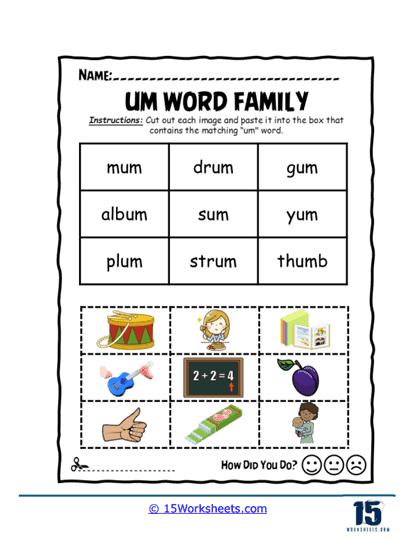
Students cut out pictures representing -um words and place them in boxes labeled with the correct word, such as drum, plum, strum, or thumb. The hands-on puzzle format transforms phonics practice into an interactive activity. This worksheet strengthens fine motor skills while reinforcing word-family recognition. Physical interaction helps make spelling patterns more memorable.
Word Builder: [Word Completion & Phonemic Awareness]
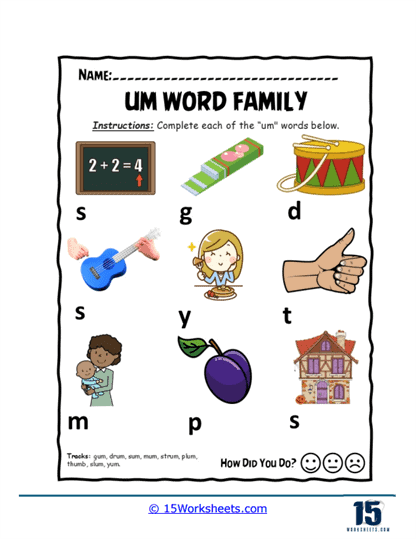
Students complete words in the -um word family by adding the missing ending sound. Each picture provides a clue, while the worksheet includes the beginning letter to guide students. Learners must finish the word by writing the correct ending pattern. This activity helps build phonemic awareness and strengthens decoding skills.
Copy Lines: [Spelling & Handwriting Practice]
This worksheet provides lined spaces where students copy -um words several times. Each word appears with a picture to reinforce its meaning. Repetition helps students become familiar with spelling patterns while practicing handwriting. The structured writing format builds spelling memory and encourages neat letter formation.
Word Lines: [Vocabulary Writing Practice]
Students copy another set of -um words, such as yum, plum, thumb, and album, onto lined spaces while referencing accompanying pictures. The images reinforce vocabulary while students practice writing the words clearly. Repetition strengthens spelling recognition and handwriting habits. This worksheet combines vocabulary development with writing practice.
Word Quest: [Word Search Puzzle]
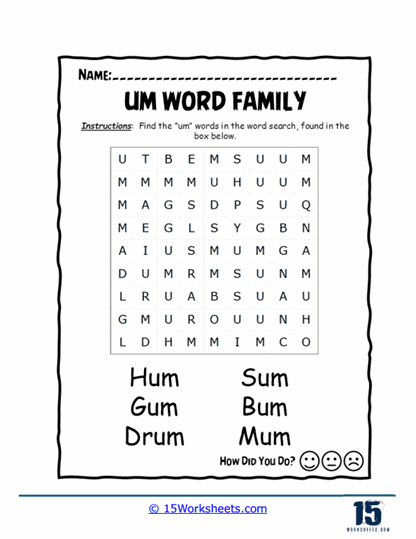
Students search a letter grid to find -um words such as hum, gum, drum, sum, bum, and mum. Words may appear horizontally, vertically, or diagonally, requiring careful scanning. This puzzle strengthens pattern recognition and spelling awareness. Word searches encourage patience and help students recognize familiar phonics patterns.
Sound Seek: [Advanced Word Search]
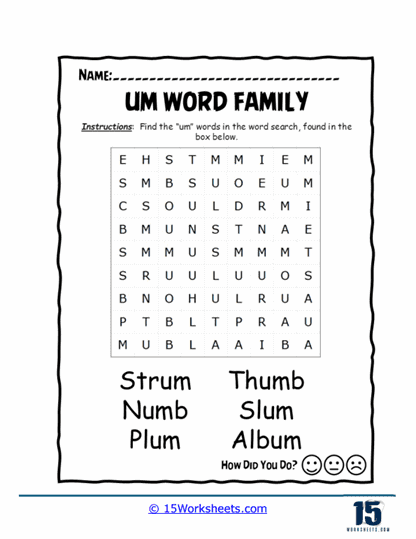
Learners locate longer -um words like strum, numb, plum, thumb, slum, and album hidden inside a puzzle grid. The activity encourages students to analyze letter combinations and spelling structures. This worksheet strengthens visual scanning skills and reinforces familiarity with word family patterns.
Puzzle Hunt: [Extended Vocabulary Search]
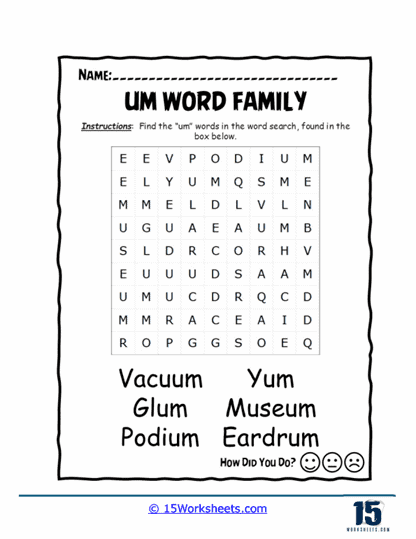
Students find more complex words containing the -um sound, such as vacuum, glum, podium, yum, museum, and eardrum. The puzzle challenges learners to identify familiar sound patterns within longer words. This activity expands vocabulary while strengthening phonics recognition. It also encourages persistence and logical problem-solving.
Picture Naming: [Vocabulary & Writing]
Students examine pictures and write the correct -um word in the blank spaces provided. Each illustration guides learners toward the appropriate spelling. The activity blends vocabulary recall with writing practice. By translating images into written words, students reinforce phonics knowledge and spelling skills.
Tracing Lines: [Letter Formation & Word Recognition]
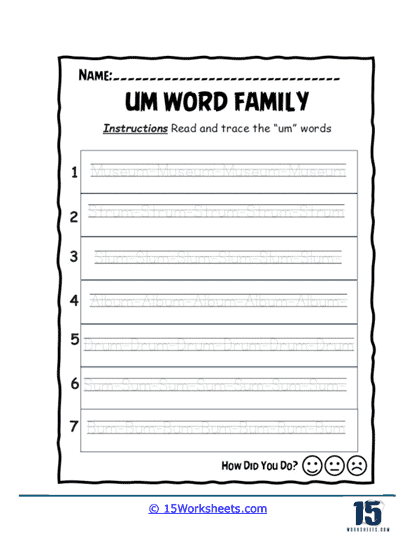
This worksheet asks students to read and trace -um family words across several rows. Each word appears lightly printed so learners can trace over it to practice proper letter formation. Repetition helps students recognize spelling patterns while improving handwriting control. Tracing exercises strengthen fine motor skills and build confidence in early writing.
How To Use These Worksheets
Teachers
These worksheets work well when you’re introducing or reinforcing word families during a phonics lesson. Many teachers use activities like Picture Hunt or Word Sort as a quick warm-up to help students notice the -um sound pattern before moving into guided reading or spelling practice. The mix of puzzles, matching activities, and writing tasks also makes it easy to rotate them through literacy centers so students get repeated practice in different formats.
Substitute Teachers
If you’re leaving plans for a substitute, phonics worksheets like these are helpful because students can usually begin working without much explanation. Activities such as the word searches or matching pages are especially easy for independent work. A substitute can also extend the lesson by asking students to read the -um words aloud or come up with additional words that follow the same pattern.
Homeschoolers
For homeschool families, word-family worksheets are a great way to build consistent early reading practice. Parents often start by reading the -um words together, then letting the child complete one worksheet at a time. Because the activities include coloring, puzzles, and writing, they can easily be spread out over several short lessons instead of one long phonics session.
Tutors
Tutors can use these worksheets to reinforce phonics skills that students may still be developing. A helpful strategy is to begin by reviewing the sound pattern in the -um word family, then guide the student through a worksheet together. Afterward, the tutor might ask the student to think of new -um words or use the words in simple sentences to strengthen understanding.
Parents
Parents looking to support reading at home can use these worksheets as short, focused practice sessions. Completing one page a day keeps the activity manageable and prevents young learners from feeling overwhelmed. Parents can also turn the lesson into a quick game by asking children to spot -um words in books, labels, or signs around the house.
Grandparents
Grandparents often enjoy helping children practice reading in relaxed ways. These worksheets provide an easy starting point for practicing word families together. Reading the words aloud, talking about the pictures, and celebrating correct answers can turn a simple worksheet into a shared learning moment that encourages confidence in early reading.
How These Worksheets Align With Standards
Word-family activities like these play an important role in early reading instruction, especially when students are learning how letters and sounds work together. When children recognize that many words share the same ending pattern, decoding new words becomes easier. Instead of sounding out every letter from scratch, they begin to recognize familiar chunks like -um and apply that knowledge when reading.
These worksheets give students repeated opportunities to identify, read, and write word-family patterns, which supports phonics development and early spelling skills. Activities like matching pictures to words, building words, and tracing spelling patterns all reinforce the connection between sounds, letters, and meaning.
The puzzles and writing tasks also help students develop fluency and word recognition. As they repeatedly encounter words such as drum, gum, and plum, the spelling pattern becomes more familiar. Over time, this repeated exposure helps students read similar words more quickly and confidently.
Because the worksheets combine phonics recognition, handwriting practice, and vocabulary building, they support the foundational reading skills that young learners need before moving on to more advanced comprehension work.
Standards Supported
Common Core State Standards (CCSS)
- CCSS.ELA-LITERACY.RF.K.2 – Demonstrate understanding of spoken words, syllables, and sounds
- CCSS.ELA-LITERACY.RF.K.3 – Know and apply grade-level phonics and word analysis skills
- CCSS.ELA-LITERACY.RF.1.3 – Decode regularly spelled one-syllable words
- CCSS.ELA-LITERACY.RF.1.2 – Demonstrate understanding of spoken words and phonemes
Texas Essential Knowledge and Skills (TEKS)
- TEKS K.2 – Phonological awareness and sound recognition
- TEKS 1.2 – Decoding and word recognition through phonics patterns
- TEKS 1.3 – Developing vocabulary and word structure understanding
California English Language Arts Standards
- RF.K.2 – Phonological awareness
- RF.K.3 – Phonics and word recognition
- RF.1.3 – Applying phonics skills in decoding words
Florida B.E.S.T. Standards (ELA)
- ELA.K.F.1 – Foundational phonics and phonological awareness
- ELA.1.F.1 – Phonics and word analysis skills
- ELA.1.F.2 – Reading words with common spelling patterns
Frequently Asked Questions
Why is the -um word family important for beginning readers?
The -um word family helps early readers move from sounding out each letter individually to recognizing familiar word chunks. Instead of blending /u/ + /m/ every time, students begin to recognize -um as a pattern that appears in multiple words like gum, drum, and plum. This process supports orthographic mapping, where common spelling patterns become stored in long-term memory. As students recognize these patterns faster, their reading fluency improves and decoding new words becomes easier.
Does the -um word family include words like thumb or crumb?
Not exactly. Words like thumb and crumb share the same ending sound (/um/), but they use a different spelling pattern: -umb. For beginning readers, it is usually best to start with simple CVC words like gum or sum. As students become more confident readers, teachers can introduce words like thumb or crumb as exception words or heart words, explaining that English sometimes represents the same sound with different spellings.
How can I use these worksheets for multi-sensory learning?
These worksheets work well when combined with hands-on phonics activities. After completing a page, students might build -um words with magnetic letters, write the words in sand or shaving cream, or tap out the sounds while reading them aloud. Multi-sensory activities engage different parts of the brain and help strengthen the connection between sounds, spelling patterns, and movement. This approach often helps young learners remember new words more easily.
Are these worksheets suitable for students with dyslexia?
Yes. The worksheets emphasize clear phonics patterns and repeated exposure, which aligns with many Science of Reading approaches used in structured literacy instruction. Visual supports like pictures and tracing lines help students connect sounds to letters in a supportive way. The predictable structure of word-family practice also reduces cognitive load, making the activities accessible for students who benefit from systematic phonics instruction.
What is the difference between a word family and a rhyming word?
All words in a word family rhyme, but not all rhyming words belong to the same word family. A word family shares both the same sound and the same spelling pattern, like gum, drum, and plum with -um. Some words may rhyme but use a different spelling pattern-for example, come and some rhyme with hum, but they do not belong to the -um word family. Teaching this difference helps students pay attention to both the sound of a word and how it is spelled.