
Ub Word Family Worksheets




About Our Ub Word Family Worksheets
The ub word family is a great place for early readers to build confidence with short vowel sounds and simple spelling patterns. Words like cub, tub, rub, and sub are easy to say, easy to picture, and show up often in beginning reading materials. Learning to recognize the shared -ub ending helps students decode words quickly and accurately.
This worksheet collection guides learners through the ub word family using a wide range of engaging activities. Students sort, match, write, trace, build, search, and even create stories using ub words. Each worksheet reinforces the same spelling pattern in a new way, helping students truly internalize the sound-spelling connection.
These worksheets are perfect for classroom phonics lessons, literacy centers, small groups, or home practice. Teachers and families can use them to introduce the word family or reinforce skills over time. With consistent exposure and hands-on practice, students strengthen decoding, spelling, and reading confidence.
About Each Worksheet
Word Sort
This worksheet asks students to color only the words that belong to the ub word family. Learners compare similar-looking words while focusing on the shared ending sound. Underwater-themed visuals keep the activity fun and engaging. Students practice careful observation before making choices. It works well as an independent or center activity.
Picture Label
Students write the correct ub word to label each picture shown. Visual prompts support vocabulary recall and spelling accuracy. Learners focus on neat handwriting and correct letter formation. The activity encourages independent word production. It’s great for review or assessment.
Word Writing
In this worksheet, students look at pictures and write the matching ub word on the lines provided. The images represent familiar objects and actions. Learners practice spelling accuracy through writing. Repetition reinforces word recognition. This worksheet supports both phonics and handwriting skills.
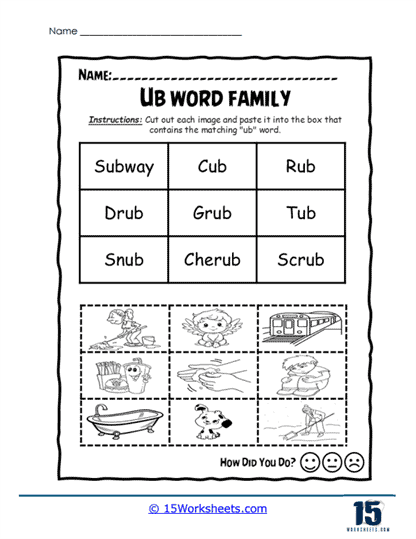
Cut Paste
Students cut out pictures and paste them into boxes with matching ub words. The hands-on format keeps learners actively involved. Correct placement requires careful image analysis. Fine motor skills develop alongside phonics practice. This activity works especially well in literacy centers.
Word Completion
Students fill in missing letters to complete ub words using picture clues. The focus stays on recognizing spelling patterns rather than memorizing whole words. Structured support helps build confidence. Learners practice problem-solving and careful thinking. This worksheet is ideal for emerging readers.
Word Lines
Students write the correct ub word on each line based on the picture shown. The lined format encourages neat spacing and handwriting. Visual cues guide accurate spelling. Learners demonstrate understanding through written practice. This worksheet supports independent writing skills.
Sentence Fill
This worksheet asks students to complete simple sentences using the correct ub word. Pictures provide helpful context clues. Learners connect phonics skills to meaning and comprehension. Selecting the right word builds critical thinking. It’s a strong bridge between decoding and understanding.
Word Match
Students match written ub words to their corresponding images. The activity emphasizes accuracy and visual comparison. Learners apply phonics knowledge in a meaningful way. Correct matches show understanding of both spelling and meaning. This worksheet supports fluent reading development.
Word Search
Students search for ub words hidden in a letter grid. Target words are listed below for reference. Learners scan rows and columns to find familiar patterns. The activity reinforces spelling through repetition. It’s a fun and engaging review option.
Tracing Practice
Students read and trace ub words across handwriting lines. Repetition supports correct letter formation and spelling consistency. Learners build muscle memory through guided practice. The worksheet emphasizes neatness and control. It’s ideal for early writers.
Crossword Challenge
Students complete a crossword puzzle using ub words based on written clues. Learners must match meaning with spelling and puzzle placement. The activity blends phonics with problem-solving. Careful reading is required for success. This worksheet supports vocabulary and logical thinking.
Clue Writing
In this worksheet, students write the correct ub word that matches each written clue. The clues describe familiar ideas and objects. Learners focus on understanding meaning before spelling. Writing responses builds confidence and accuracy. It’s excellent for vocabulary development.
Word Assembly
Students cut and match word parts and images to form complete ub words. The hands-on activity keeps engagement high. Learners actively construct words instead of just identifying them. Attention to detail is key. This worksheet strengthens phonemic awareness.
Story Builder
This worksheet encourages students to write a short story using ub words from a word bank. Learners create complete sentences in a meaningful context. The open-ended format promotes creativity. Students apply phonics skills in real writing. It’s perfect for extending learning.
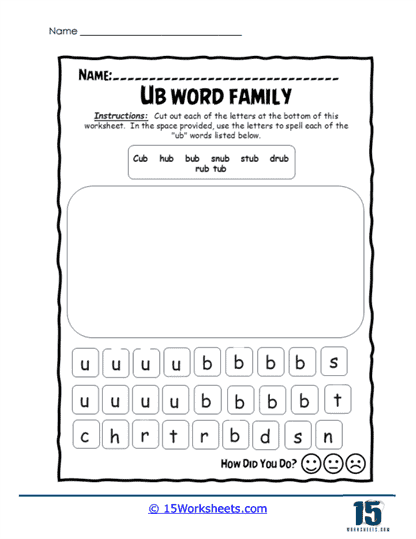
Letter Builder
Students use provided letters to spell each ub word listed. The activity focuses on letter sequencing and word construction. Learners visually organize letters before spelling. This builds problem-solving skills and accuracy. It’s a strong foundation for early literacy.
What is the Ub Word Family?
The ub word family includes words that share the -ub spelling and short vowel sound. When students recognize this pattern, they can quickly decode words without sounding out every letter. Common examples include cub, tub, rub, and sub. These words are simple, concrete, and easy to picture, making them perfect for beginning readers.
Even though ub words look similar, they can have very different meanings. A cub is a baby animal, a tub is a container, and rub describes an action. Learning them together helps students see how spelling patterns stay the same while meanings change. Many ub words function as nouns or verbs, helping build flexible language use.
The -ub pattern appears frequently in early reading books and phonics programs. Its pronunciation is consistent and predictable, which supports decoding confidence. Once students master this word family, they are better prepared to tackle new words with similar patterns. It’s a small but powerful step toward fluent reading.
Word List for the Ub Word Family
cub, rub, sub, scrub, club, and tub
Example Sentences
1. The cub took a bath in the tub.
2. Please rub the soap before you rinse in the tub.
3. The sub swam under the water near the cub.