
Power of Quotients Worksheets

About These 15 Worksheets
The “power of a quotient” rule can feel intimidating at first, but once students see the pattern, it’s surprisingly straightforward. This worksheet collection is designed to help learners master that rule step by step, starting with simple examples and building up to more complex ones. Each page provides practice in distributing exponents across numerators and denominators, making sure students don’t trip up when fractions get involved. With plenty of themed activities, it turns exponent practice from a dry drill into something more engaging.
What makes these worksheets effective is the variety of approaches. Some sheets keep things simple and structured, while others introduce negative exponents, fractional exponents, or even roots. A few sprinkle in puzzles, riddles, or themed adventures to keep students motivated. By mixing challenge levels and formats, the collection ensures that learners practice both accuracy and flexibility with exponent rules.
Beyond just learning a rule, these worksheets prepare students for higher-level math. The power of a quotient shows up in algebra, functions, calculus, and even science classes where exponents and ratios are everywhere. With enough practice here, students don’t just memorize the law-they understand it and feel confident applying it across contexts.
Have a Look Inside Each Worksheet
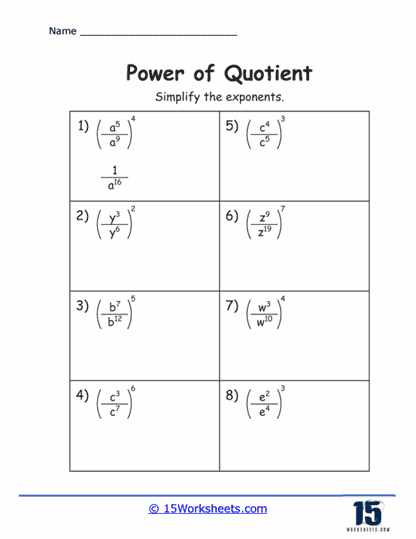
Pinnacle of Powers
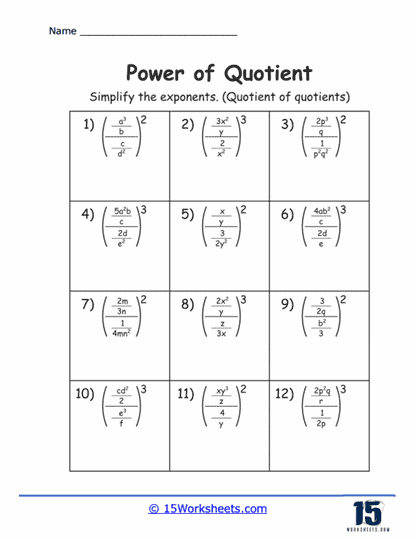
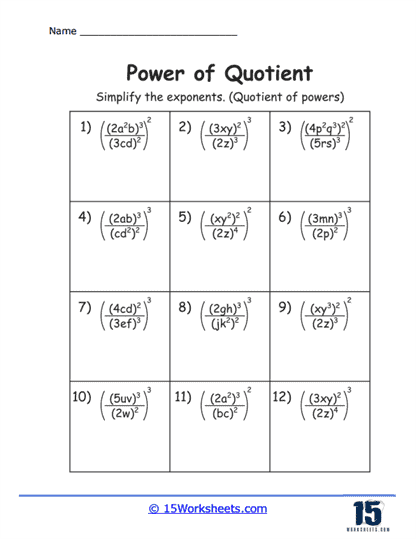
Students practice simplifying quotients raised to exponents. They apply the power of a quotient rule step by step, distributing the exponent to both numerator and denominator. This helps build accuracy with fraction-based expressions. A strong starter worksheet for mastering the basics.
Quotient Lift Off
Learners “launch” into exponent division problems in a space-themed format. They calculate quotients with exponents in both numbers and variables. The theme makes practice feel less dry and more adventurous. Great for engagement alongside skill-building.
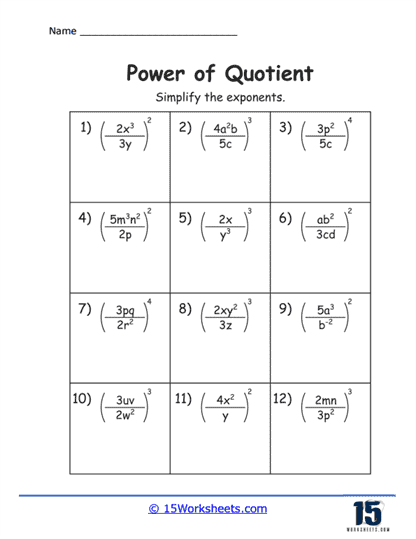
Quotient Conundrums
This worksheet presents trickier problems that test the limits of the quotient rule. Students solve multi-step expressions and watch for negative exponents. It pushes critical thinking and precision. A solid challenge for students who’ve learned the basics.
Exponential Express
Students ride the “express train” of simplifying exponents in quotients. Problems focus on fast, efficient simplification using the rule. Builds speed and fluency with exponent laws. Perfect for timed practice or warm-ups.
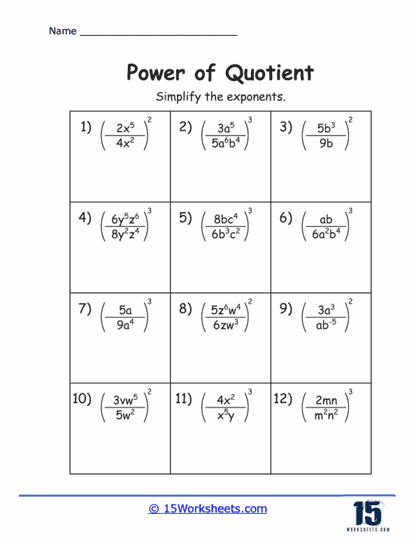
Dividing Dynamite
Learners tackle lively quotient problems designed for repetition and accuracy. The emphasis is on applying the rule to increasingly complex expressions. Builds confidence through consistent practice. A worksheet with plenty of energy.
Invert and Conquer
This activity highlights quotients that involve reciprocals and negative exponents. Students learn to flip bases when exponents are negative. It deepens understanding of exponent flexibility. Excellent prep for algebra and beyond.
Fractional Exponent Forge
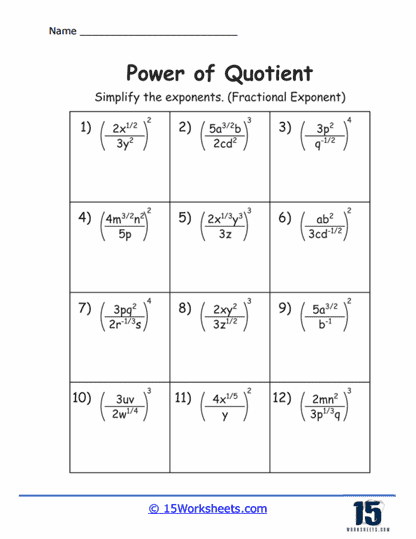
Students practice quotients with fractional exponents. This worksheet blends root concepts with exponent rules. It stretches thinking and supports higher-level math readiness. A key bridge between exponents and radicals.
Navigating the Negatives
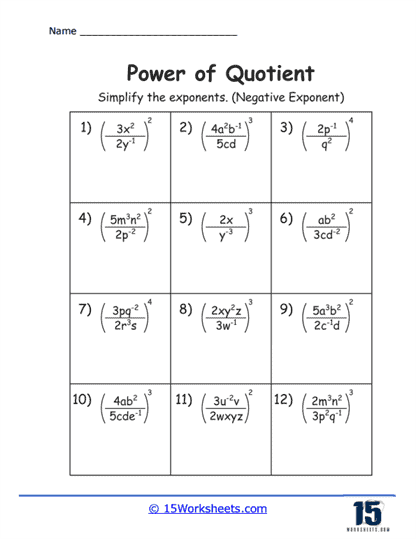
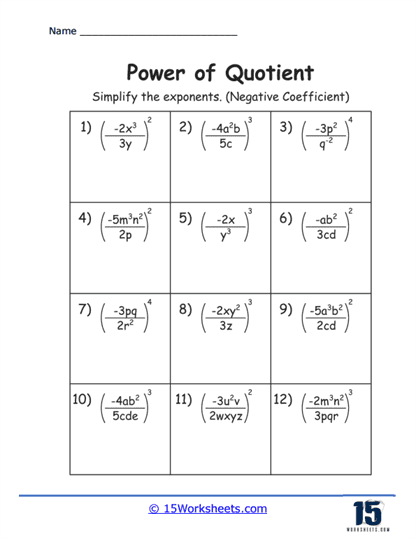
Learners face problems involving quotients with negative exponents. The focus is on rewriting and simplifying carefully. This worksheet strengthens attention to detail and builds confidence with tricky exponent rules. Great for avoiding common mistakes.
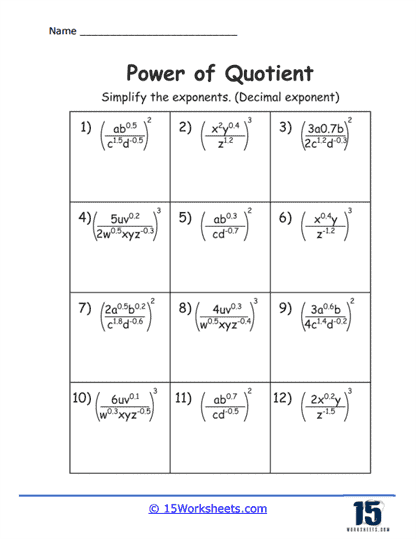
Decimal Dynamics
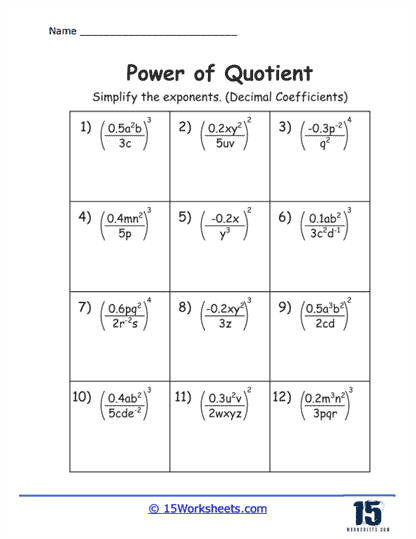
Students work with quotients involving decimals and exponents. It connects exponent rules to non-whole numbers. This expands their flexibility and problem-solving range. A practical step toward real-world applications.
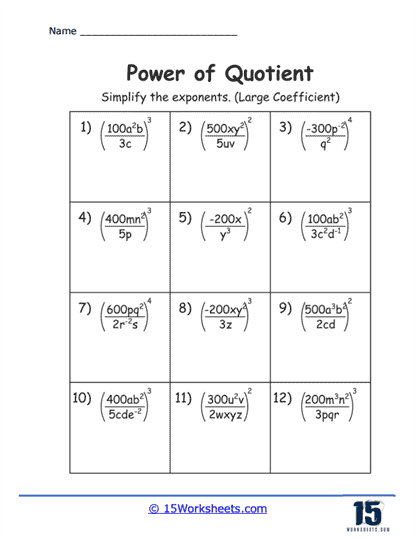
Giant Coefficients
This worksheet adds large coefficients to quotient problems. Students balance big numbers with exponent rules. It encourages neat, organized work. A challenge designed to build stamina and focus.
Deciphering Decimal Exponents
Learners simplify quotients that include decimal exponents. It’s a careful balance of arithmetic and exponent law practice. Helps demystify unusual exponent formats. A useful worksheet for advanced learners.
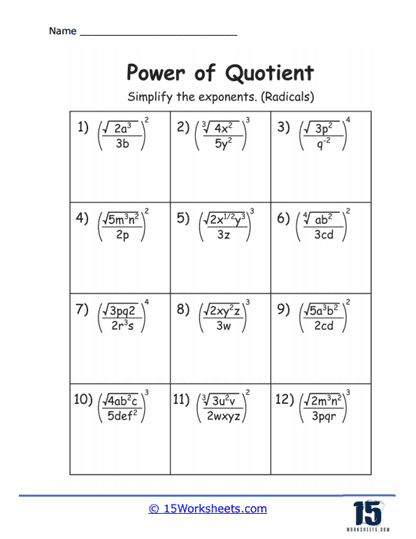
Radical Rulers
Students connect quotient rules with radical expressions. They rewrite and simplify expressions involving roots and exponents. It bridges the gap between two major math topics. Perfect for showing how exponent laws apply everywhere.
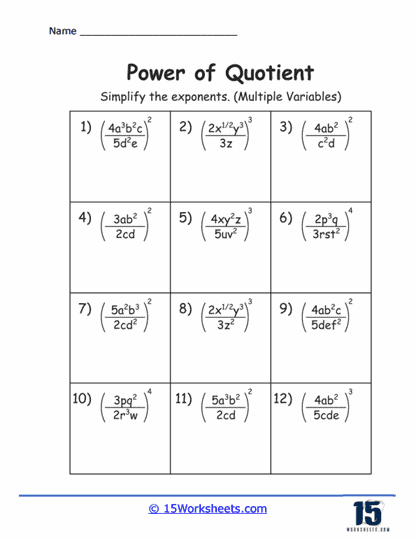
Division Dynamics
This worksheet emphasizes step-by-step simplification of quotient problems. It builds systematic thinking and accuracy. Learners gain confidence in applying the rule repeatedly. Great for structured practice.
Riddle of Ratios
Students solve quotient problems presented as math riddles. It turns practice into a puzzle-like activity. The format encourages persistence and problem-solving. A fun, engaging way to reinforce the rule.
Quotient Quest
Learners go on a “quest” through progressively harder quotient problems. Each correct solution leads them further along the path. Builds mastery through incremental challenges. A motivating way to wrap up quotient practice.
What Is The Quotient Property Rule?
The Power of a Quotient Rule is a fundamental principle in the algebra of exponents, which provides a method for simplifying expressions where a quotient (a division of two numbers or expressions) is raised to an exponent. This rule is crucial for both simplifying complex algebraic expressions and solving exponential equations efficiently. Understanding and applying the Power of a Quotient Rule can significantly enhance one’s ability to work with powers and roots in various mathematical contexts.
The Principle of the Power of a Quotient Rule
The rule states that when a quotient is raised to an exponent, you can apply the exponent to both the numerator and the denominator separately. Mathematically, it is expressed as:
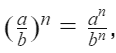
where a and b are any real numbers (with b not equal to zero), and n is an exponent. This means that the power distributes over both the numerator and the denominator of the fraction.
This rule works because of the fundamental principles of exponents, which include the rule that multiplying powers of the same base allows you to add their exponents, and dividing them allows you to subtract the exponents. When you raise a quotient to a power, essentially, you are multiplying the quotient by itself multiple times, which according to exponent rules, means you apply the power to each component of the quotient.
Example – Numerical Bases
Consider the expression (2/3)4.
According to the Power of a Quotient Rule, you can apply the exponent of 4 to both the numerator 2 and the denominator 3 separately, which simplifies the expression to:
24 / 34
Calculating each part gives us – 24 = 16 and 34 = 81
This tells us that (2/3)4 = 16/81
This example demonstrates how the rule simplifies the expression into a more manageable form, especially useful when dealing with larger exponents or more complex numbers.
When is the Quotient Property of Exponents Used In Real Life?
This property allows for the simplification of expressions where one power is divided by another of the same base, has practical applications in various real-life scenarios. While the abstract mathematical principle might seem distant from daily concerns, its applications permeate several fields, including finance, computer science, engineering, and science. Understanding how this property is used can illuminate the relevance of seemingly esoteric mathematical rules in practical contexts.
Finance and Investment Calculations
In finance, the Quotient Property of Exponents can be used to calculate compound interest rates over different periods or to adjust financial models for inflation or deflation over time. For example, when comparing the effective annual rates of different investment options, financial analysts might use the quotient property to simplify the expressions for easier comparison and decision-making.
Computing and Data Storage
In the realm of computer science, especially in data storage and processing, the Quotient Property is used to calculate file sizes, memory allocation, and data transfer rates. When optimizing algorithms or computing operations that involve exponential growth of data (such as in databases or network traffic analysis), this property helps in simplifying the calculations, leading to more efficient data management and resource allocation.
Engineering and Physics
Engineers and physicists often deal with scales and measurements that span vast exponent ranges, from the incredibly small to the astronomically large. The Quotient Property of Exponents aids in converting between units of measurement, especially when dealing with quantities measured in powers of ten (such as in the metric system). For example, converting between gigawatts and megawatts, or nanometers and micrometers, involves simplifying expressions using the Quotient Property.
Scientific Concentrations and Dilutions
In chemistry and biology, when working with solutions’ concentrations or dilutions, the Quotient Property is applied to calculate the final concentration of a solution after it has been diluted or concentrated. This involves mathematical operations that directly utilize the principles behind the Quotient Property, especially when the concentration changes involve exponential factors.
Logarithmic Scales
Logarithmic scales, which are used in measuring the intensity of earthquakes (Richter scale), the loudness of sound (decibels), and acidity or alkalinity (pH levels), inherently apply the Quotient Property of Exponents. These scales transform the vast range of possible values into a more manageable form, using the principles of exponents and their quotients to represent large variations in a compressed, easily understandable format.