
Theme vs. Summary Worksheets
About Our Theme vs Summary Worksheets
Many students can tell you what happened in a story, but identifying what a story means is often a bigger challenge. Our Theme vs Summary Worksheets help learners understand the important difference between summarizing events and identifying a story’s deeper message. Through a variety of reading comprehension activities, students learn that a summary focuses on key plot details, while a theme communicates a lesson, insight, or universal truth. These exercises encourage readers to move beyond surface-level understanding and think more deeply about literature.
This collection approaches the topic from several engaging angles. Some worksheets ask students to classify statements as themes or summaries, while others guide them through identifying themes, gathering evidence, writing summaries, analyzing conflicts, and tracing how messages develop throughout a story. Students also work with graphic organizers, Venn diagrams, true-or-false activities, and literary analysis prompts. The variety helps reinforce the distinction between what happens in a story and what readers are meant to learn from it.
Understanding the difference between theme and summary is a key part of strong reading comprehension. These skills help students analyze literature more thoughtfully, support interpretations with evidence, and communicate their ideas clearly in writing. By practicing both concepts together, learners become stronger readers who can recognize not only the events of a story but also the meaningful lessons hidden within them. These worksheets provide valuable tools for developing critical thinking, literary analysis, and effective communication skills.
About Each Worksheet
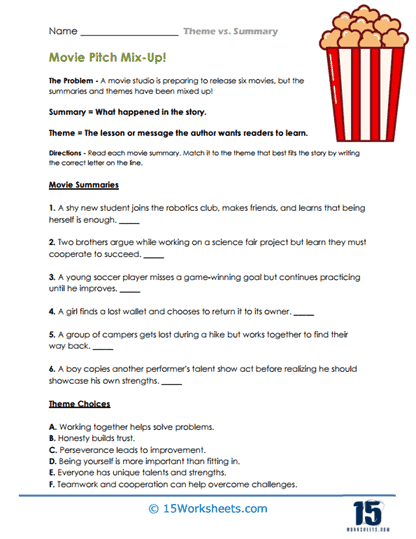
Movie Messages
Students connect short movie plots with the lessons those stories teach, turning literary analysis into an engaging matching activity. It’s a fun way to discover that the most important part of a story isn’t always what happens-it’s what readers learn from it.
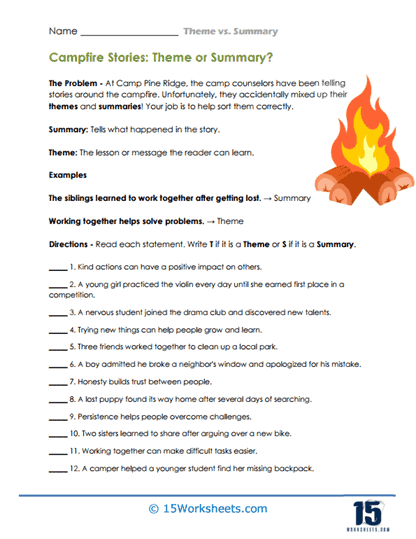
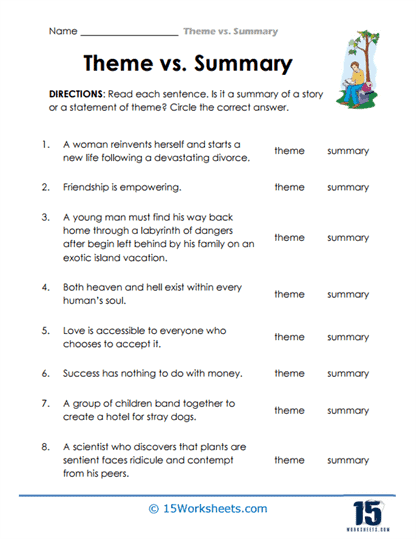
Campfire Connections
This worksheet challenges students to decide whether statements describe themes or summaries. The repeated practice helps learners sharpen their understanding of the differences between story events and life lessons.
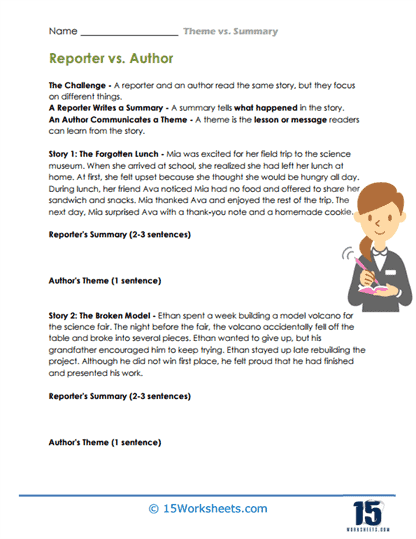
Reporter’s Lens
Students wear two hats in this activity: reporter and literary analyst. First they summarize what happened, then they uncover the deeper message hiding behind the events.
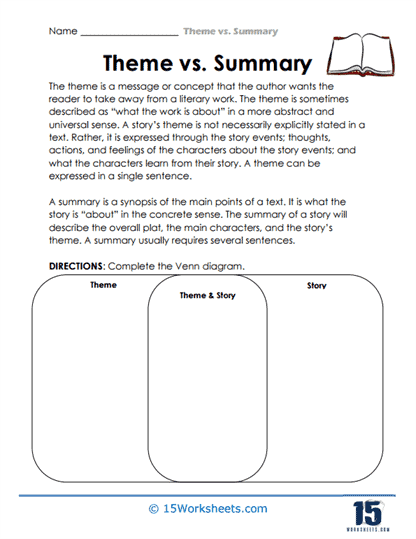
Story Compare
A Venn diagram helps students visually organize the similarities and differences between themes and summaries. The graphic format makes abstract literary concepts much easier to understand and remember.
Theme Tracker
This worksheet asks students to classify statements and determine whether they represent a theme or a summary. Careful reading becomes essential as learners look for clues hidden within the wording.
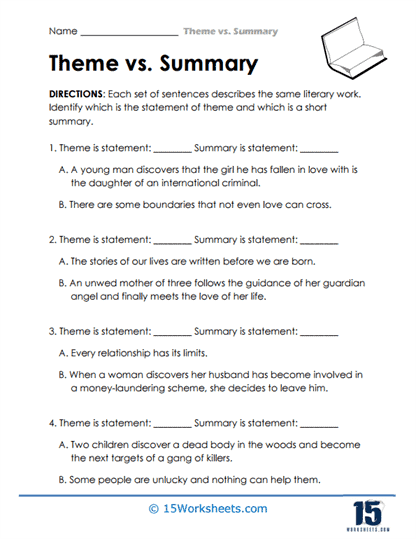
Literary Detectives
Students compare pairs of statements and decide which one reflects a theme and which one reflects a summary. The detective-style approach encourages close analysis and thoughtful reasoning.
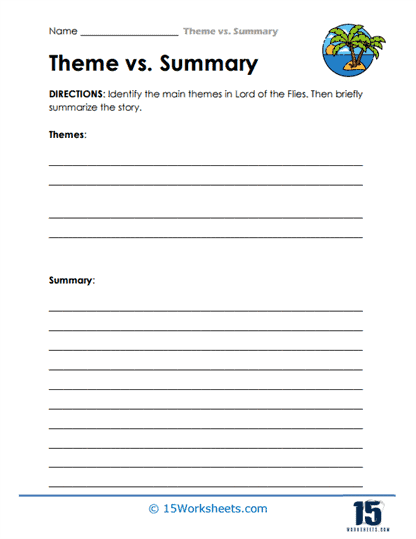
Island Insights
This activity asks students to identify themes and then create a concise summary of a literary work. The combination helps learners see how both concepts work together while remaining distinctly different.
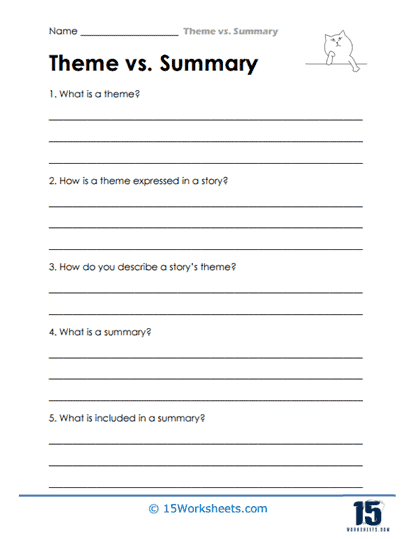
Theme Foundations
Students answer open-ended questions that explore the purpose and characteristics of themes and summaries. Writing explanations in their own words helps build a deeper and longer-lasting understanding.
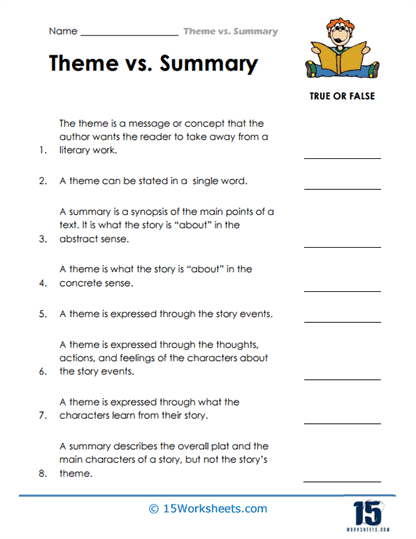
Truth Check
This true-or-false activity challenges students to separate literary facts from misconceptions. It’s a quick but effective way to reinforce important concepts and build confidence.
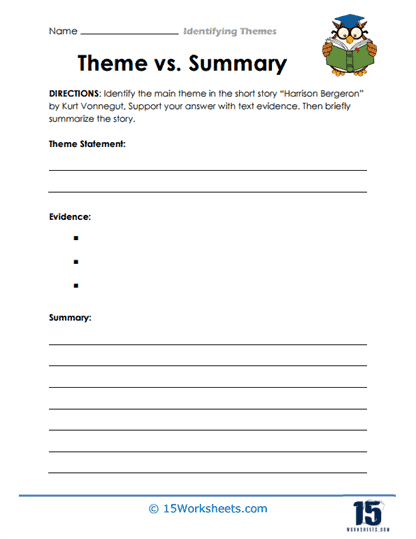
Evidence Explorer
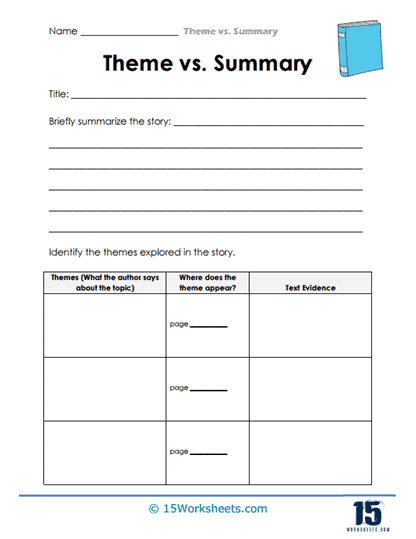
Students go beyond identifying themes by supporting their ideas with textual evidence. The worksheet encourages readers to back up their interpretations with proof rather than guesswork.
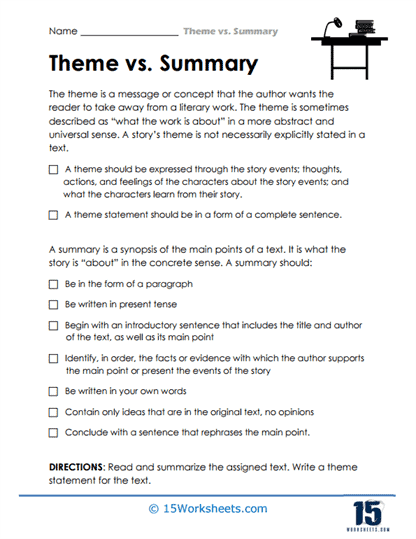
Summary Blueprint
This organizer provides students with a clear roadmap for identifying themes and writing strong summaries. The structured format makes literary analysis feel much more manageable.
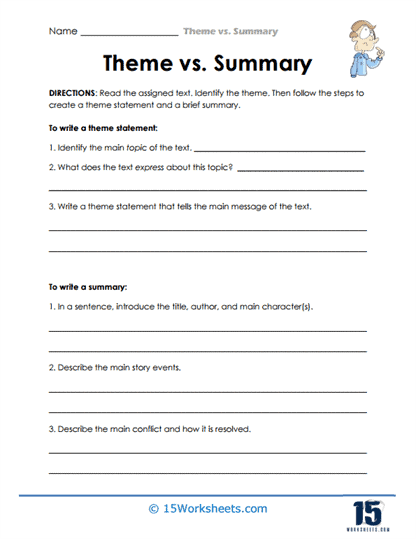
Guided Themes
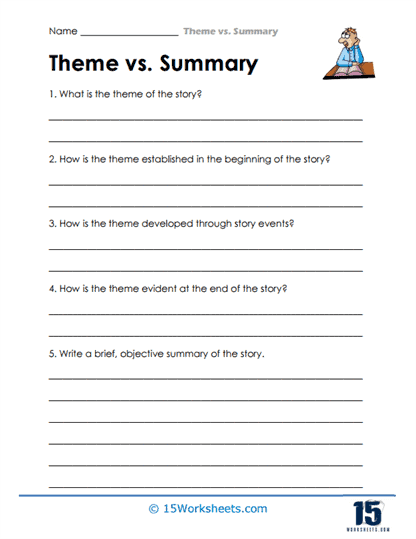
Step-by-step questions guide students through the process of finding a theme and summarizing a story. The scaffolded approach helps learners build confidence while developing independence.
Theme Threads
Students trace how a theme develops throughout an entire story, from beginning to end. The activity reveals how authors weave important messages into key events and character experiences.
Story Structure
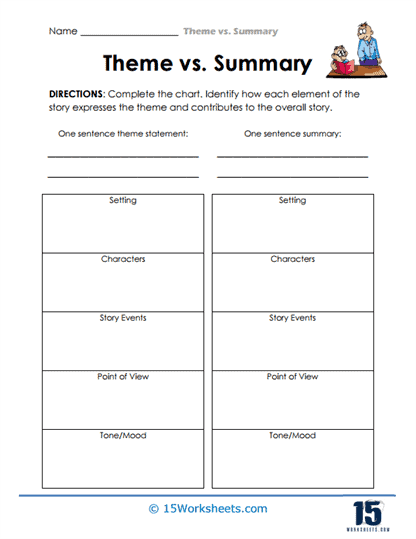
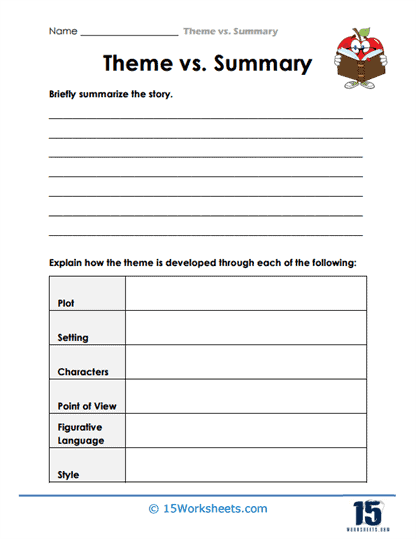
This worksheet explores how characters, settings, plot, tone, and point of view contribute to both theme and summary. Students gain a broader understanding of how different literary elements work together.
Conflict Connections
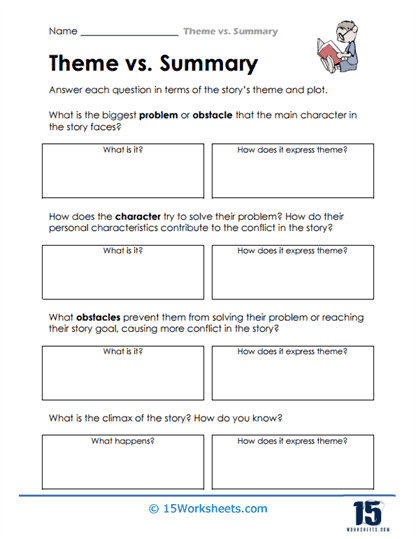
Students examine how character struggles and conflicts contribute to a story’s message. The activity highlights the important role challenges often play in revealing themes.
Evidence Maps
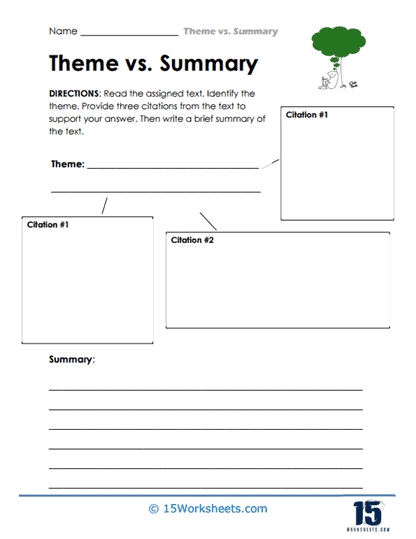
This worksheet combines theme identification with evidence gathering and summary writing. Students practice supporting their ideas with specific details while staying focused on the text.
Theme Builders
Students analyze how multiple literary elements contribute to a story’s overall message. The activity encourages deeper thinking about how authors intentionally develop themes.
Theme Tracker Pro
This comprehensive organizer brings together summaries, themes, evidence, and text analysis in one place. Students finish with a complete picture of how story events and deeper meanings connect.
What is the Difference Between Theme and Summary?
A summary tells readers what happened in a story. It focuses on the most important events, characters, conflicts, and outcomes without including every detail. Summaries are objective and stick to the facts of the plot. Their purpose is to provide a clear and concise overview of the story’s main events.
A theme, on the other hand, explains the deeper meaning or message of a story. Themes are often lessons about life, human nature, relationships, perseverance, honesty, friendship, or other universal ideas. Unlike summaries, themes are not limited to one specific story. Instead, they express broader truths that can apply to many different situations and experiences.
Understanding the difference between theme and summary helps students become stronger readers and literary thinkers. While summaries focus on what happened, themes focus on what it means. Skilled readers learn to use story events, character actions, and conflicts as clues that reveal the author’s message. By identifying both summaries and themes, students gain a more complete understanding of literature and develop stronger analytical and comprehension skills.