
Capacity Worksheets
About These 15 Worksheets
The term, “capacity”, refers to the ability of a container to hold substances, most commonly liquids like water, oil, or juice. This concept is vital for students as it lays the groundwork for understanding volume, measurements, and more advanced mathematical concepts. Capacity worksheets are specially designed instructional tools that help students comprehend and practice this idea.
These worksheets were created to teach and reinforce the concept of capacity. They contain exercises and activities to help students identify, measure, compare, and convert capacities of different containers. Generally, they use standard units of measure like milliliters (ml), liters (l), gallons, pints, or cups.
About Each Worksheet
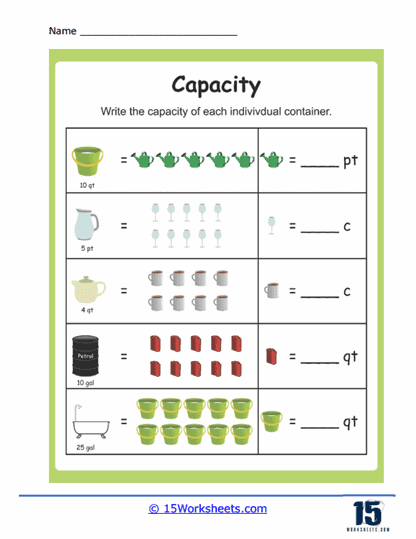
Container Capacity
Students explore how large and small containers relate to one another by figuring out equivalent capacities across gallons, quarts, pints, and cups. The activity turns liquid measurement into a fun puzzle where kids can visualize how smaller units combine to fill larger containers.
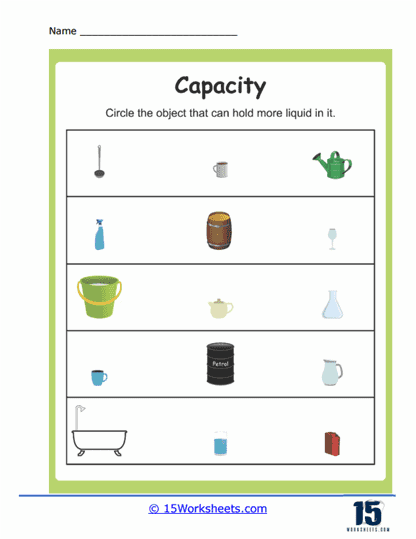
Holds More Liquid
This worksheet challenges students to compare pairs of objects and decide which one could hold more liquid. The familiar household items make the activity feel relatable while helping children strengthen their estimation skills.
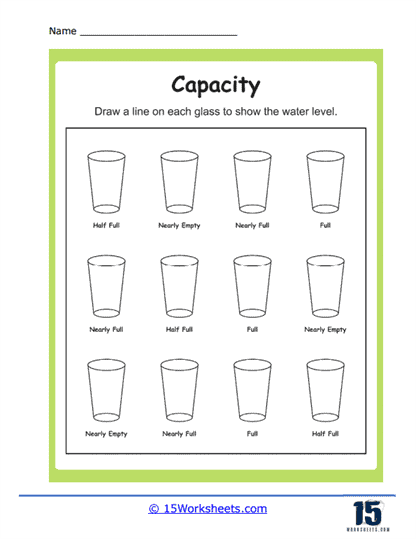
Glass Level
Students draw water levels inside glasses to match descriptions like “half full” or “nearly empty,” making fractions feel much more visual and interactive. It’s a creative way to connect measurement concepts with everyday experiences kids already understand.
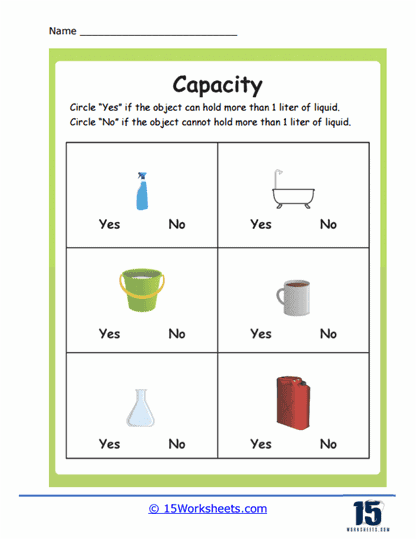
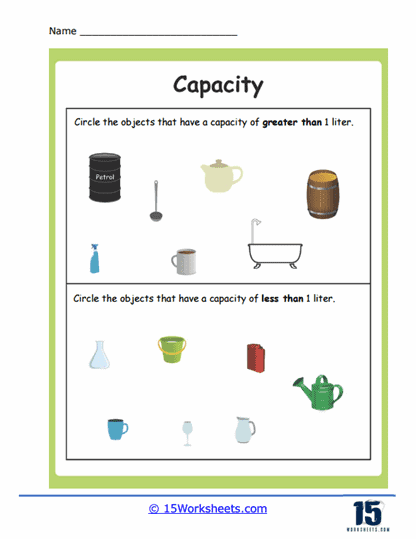
More or Less Than 1L
Kids examine different containers and decide whether each one can hold more than one liter of liquid. The quick yes-or-no format keeps students engaged while sharpening their understanding of metric capacity.
Greater or Less Capacity
This worksheet has students sort containers by whether they hold more or less than one liter, encouraging careful observation and logical thinking. The variety of object sizes helps learners build stronger intuition about volume in real-life situations.
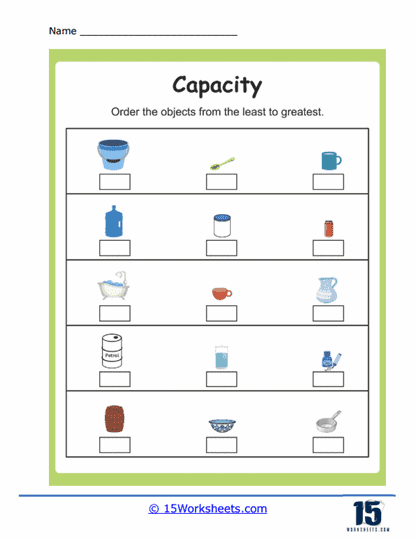
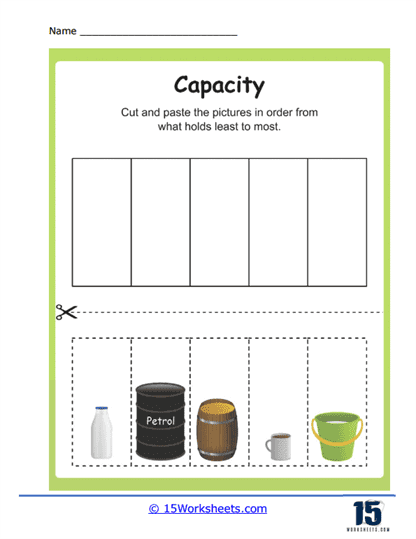
Ordering Capacity
Students rank different objects from the smallest capacity to the largest, almost like organizing a “liquid size contest.” The sequencing activity strengthens comparison skills while giving kids practice thinking critically about volume.
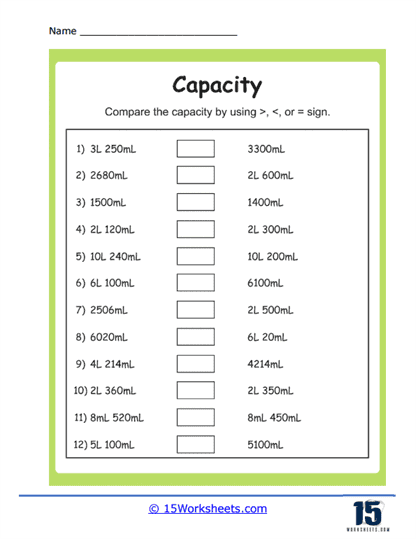
Comparing Capacity
Learners compare measurements in liters and milliliters using greater than, less than, and equal signs. The worksheet mixes conversion practice with comparison skills to create a more challenging and rewarding math activity.
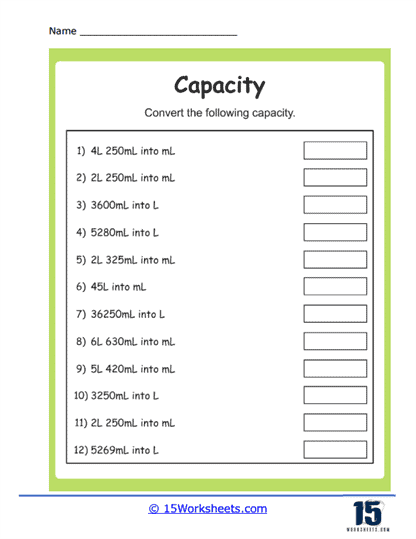
Convert Units of Capacity
This worksheet gives students hands-on practice converting between liters and milliliters using simple metric relationships. The repeated conversions help kids become more comfortable switching between units with confidence.
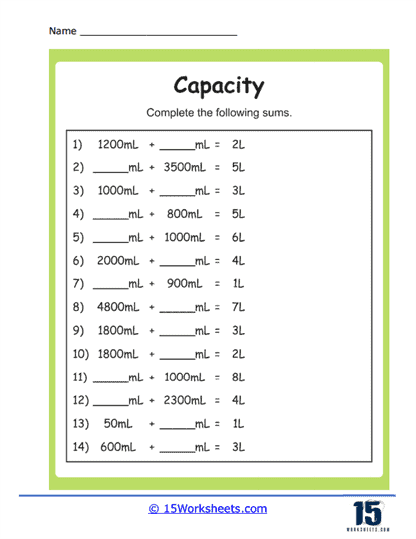
Sums of Volumes
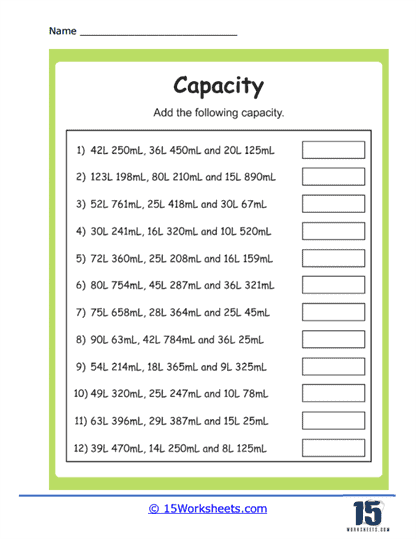
Students add together different liquid volumes to calculate total capacities in milliliters. The activity combines arithmetic and measurement in a practical way that feels useful instead of repetitive.
Subtract Volume
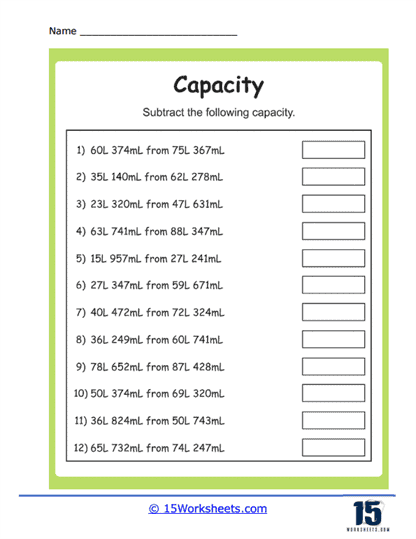
This worksheet helps students practice subtraction using measurements of liquid volume. By working with milliliters in real-world style problems, learners strengthen both their math fluency and understanding of capacity.
Estimate Capacity
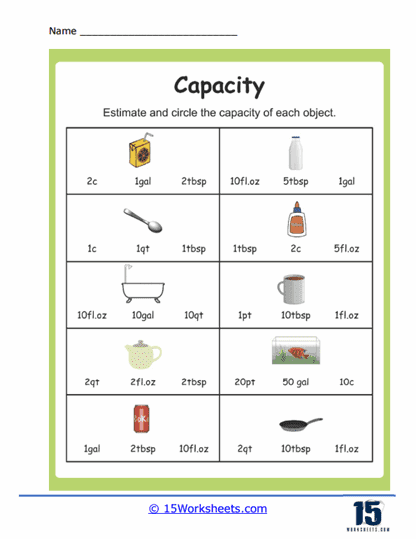
Students estimate the capacities of common objects by choosing the most reasonable measurement from several options. The wide range of household items keeps kids curious while helping them develop stronger real-world measurement instincts.
Comparison Math Sentences
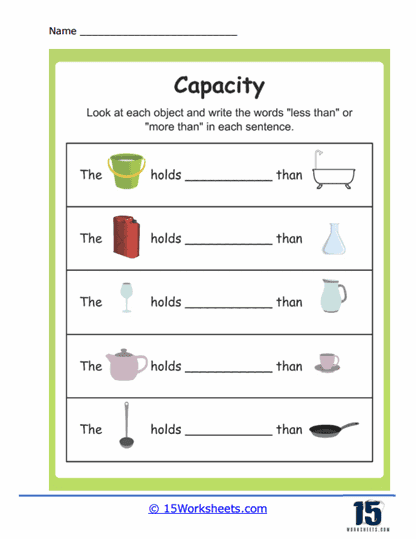
This activity asks students to complete sentences comparing the capacities of different containers using phrases like “more than” and “less than.” It blends measurement practice with language skills in a way that feels simple and approachable.
Cut and Paste Capacity
Students cut out pictures of containers and arrange them from least capacity to greatest capacity for a hands-on learning experience. The interactive format adds movement and creativity while reinforcing comparison and sequencing skills.
Algebraic Capacity
This worksheet introduces students to missing-number equations involving liters and milliliters. It combines capacity measurement with algebra-style thinking, helping learners practice logical problem-solving in a fresh way.
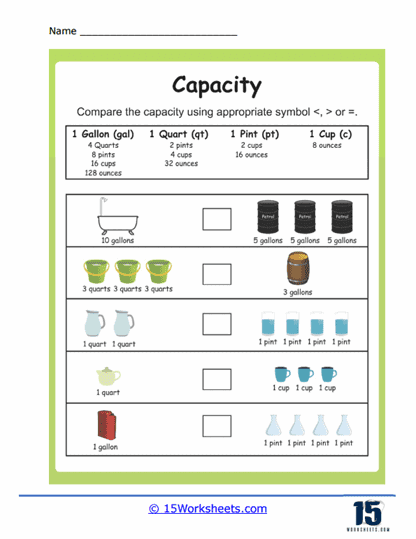
Comparing Containers
Students use customary measurement units like gallons, quarts, pints, and cups to compare the capacities of different containers. The visual reference chart makes it easier for learners to understand how the units relate to one another.
What Is Capacity?
Capacity is the measure of how much a container can hold-most often referring to liquids, but it can also apply to anything that fills space, like grains, air, or even abstract things like data. At its core, capacity is about potential. It asks: If I were to fill this cup, jug, or tank to the brim, how much would it take? It’s not about what is currently inside, but what could be inside-the full extent of what something can hold. This distinction is small but profound, especially when teaching young learners. It shifts the focus from observation (“what is”) to possibility (“what could be”), which is a powerful way to stretch not only their math skills but their thinking.
Mathematically, capacity is measured using units like liters (L) and milliliters (mL) in the metric system, or gallons, quarts, pints, and cups in the customary system. But it’s more than just conversions and comparisons. Teaching capacity involves developing an intuitive sense of volume-learning to estimate, to compare, to visualize. It helps students understand the world around them in more tangible ways: why a tiny medicine bottle and a giant milk jug have vastly different roles, or how much water it really takes to fill a swimming pool. Capacity opens up conversations about conservation, fairness, even engineering. It’s a topic that bridges the physical and mathematical, helping students not just do math, but see it-and feel it-in action.