
Squaring Numbers Worksheets
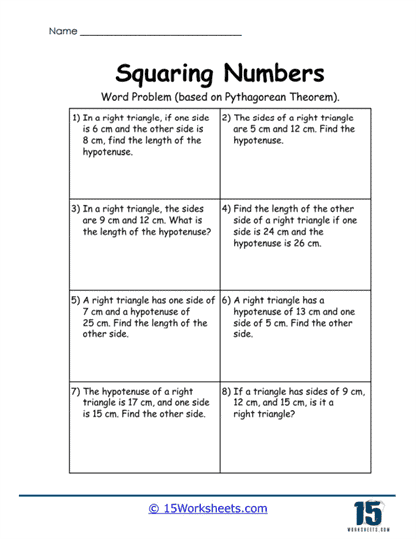
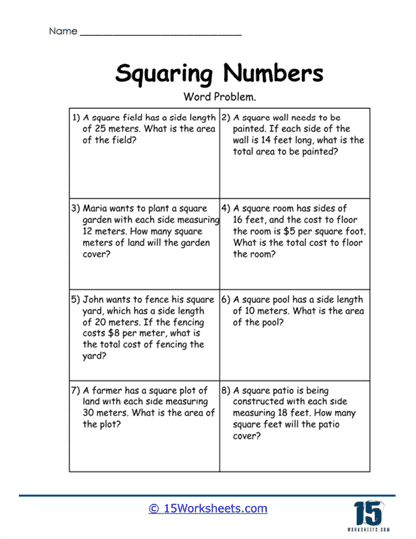
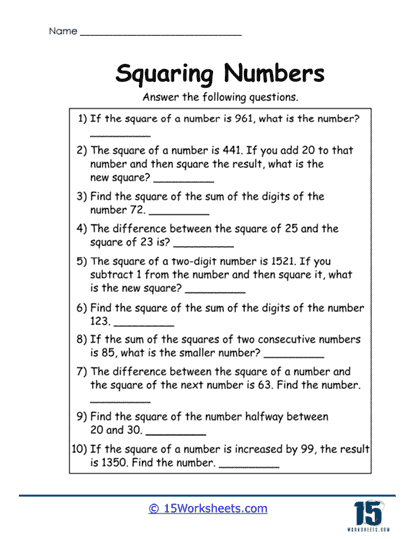
All About These 15 Worksheets
Squaring numbers is one of those math skills that shows up in so many places, but it can easily feel intimidating if students don’t get enough practice. This worksheet collection takes that fear away by giving kids lots of different ways to approach squaring-from small, simple numbers all the way up to fractions, negatives, and even big double-digit challenges. Instead of tossing all the “tricky stuff” at them at once, the worksheets gently build skills step by step, so confidence grows right alongside accuracy.
What makes these worksheets especially handy is how they mix straightforward calculation with discovery. Students don’t just “do the math”-they start to see the hidden patterns: why squaring an even number always gives you another even, why squaring a negative actually flips it positive, or how decimals can shrink results while big numbers make them explode. These little aha-moments are where math starts to feel less like memorization and more like solving puzzles.
And honestly, squaring numbers is one of those quiet power skills that sneaks into almost every corner of math and science. Whether it’s calculating the area of a room, figuring out speed in physics, or decoding the Pythagorean theorem, squares are everywhere. The more comfortable kids are with them now, the easier those bigger concepts will feel later. Think of these worksheets as training wheels for algebra, geometry, and beyond-except a lot more fun than wobbling on a bike!
Have a Look Inside Each Worksheet
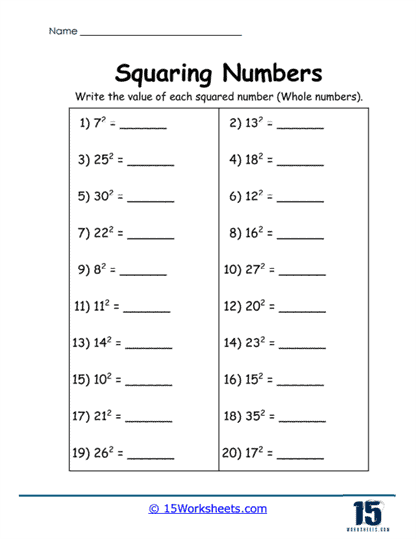
Square Practice
Students practice squaring whole numbers (e.g. 5², 12², etc.). It builds confidence in basics before moving to more complicated versions. Strengthens understanding of what “square” means in numbers. Helps form foundational fluency in multiplication and number sense.
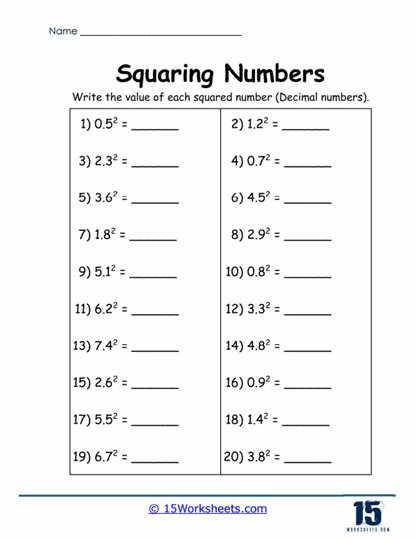
Decimal Squares
Here students work on squaring decimal numbers (for example, 3.6² or 0.25²). It requires careful handling of decimal points and accuracy. Gives practice with decimal arithmetic and precision. Supports learning how to extend whole-number skills to more complex number types.
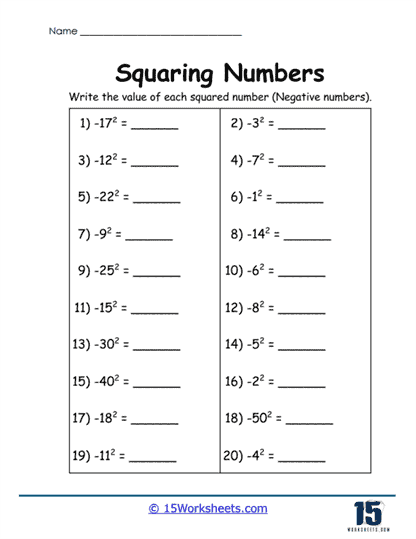
Negative Squares
Students square negative numbers like (-7)², (-12)², etc. They see explicitly that squaring a negative yields a positive result. Reinforces sign rules in algebra. Helps reduce confusion about negatives when applying exponent rules.
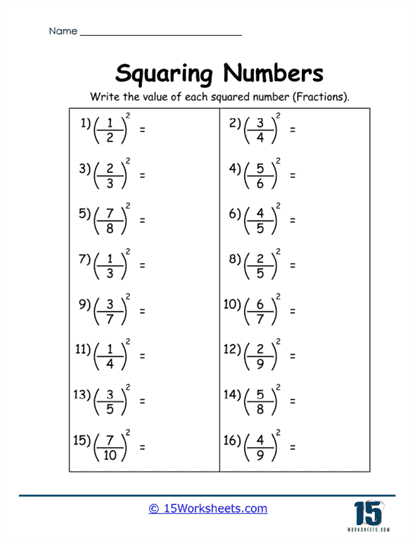
Fraction Squares
This worksheet gives fractions to square (e.g. (½)², (3/4)²). Students also practice simplifying the resulting fractions. Deepens fraction arithmetic skills. Builds connections between fraction operations and exponents.
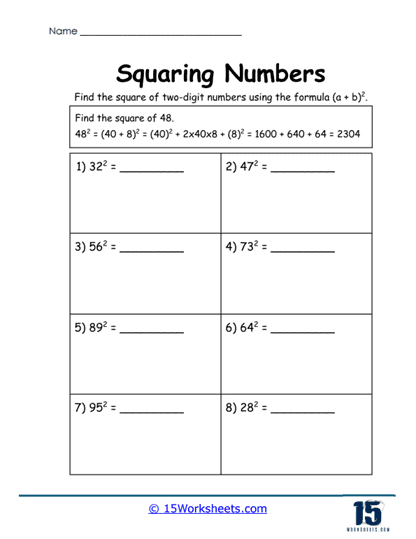
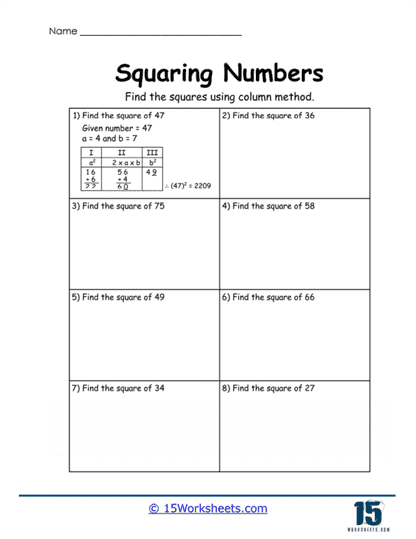
Double-Digit Squares
Students square larger whole numbers that have two digits (e.g. 25², 47²). Demands more from multiplication skill and handling larger results. Helps with speed and accuracy on more challenging values. Prepares for algebraic manipulation and higher-level math.
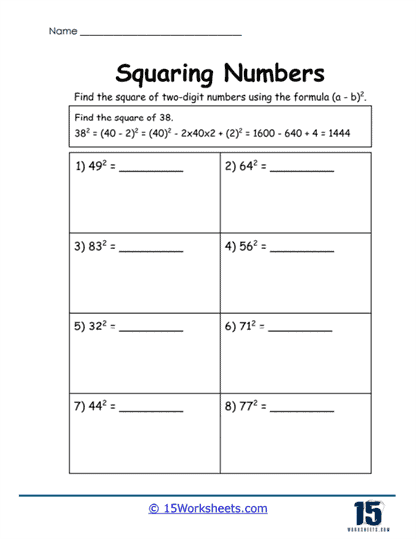
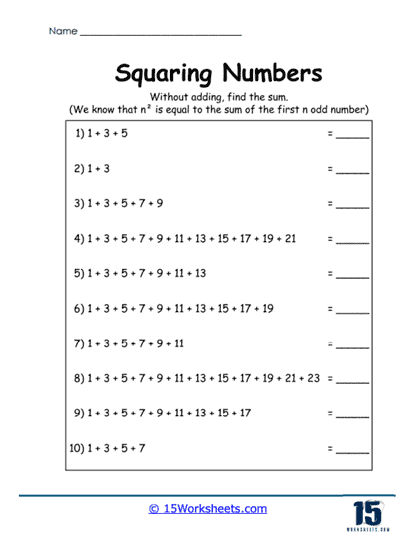
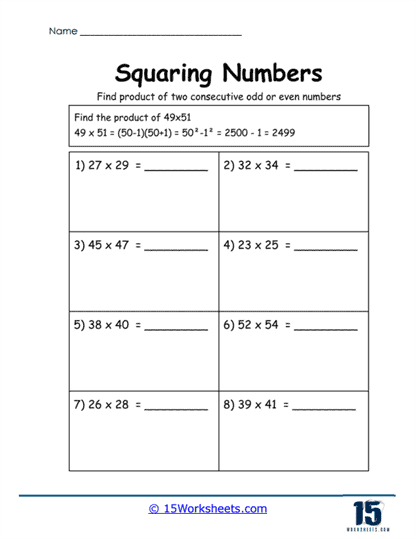
Difference Squares
Probably students compare difference between squares, or maybe find squares then compute differences. Encourages both squaring skills and subtraction/comparison. Builds reasoning about how squares grow. Helps understanding of numeric patterns and relationships.
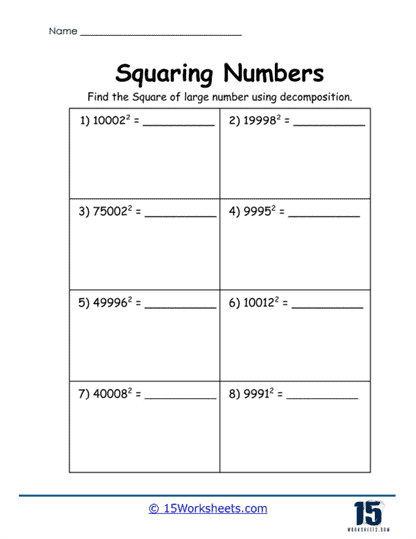
Big Number Squares
Works with squaring very large numbers (e.g. 1,000² or even larger). Helps students learn decomposition or step-wise strategies. Builds stamina for large computations. Strengthens understanding of place value and scaling.
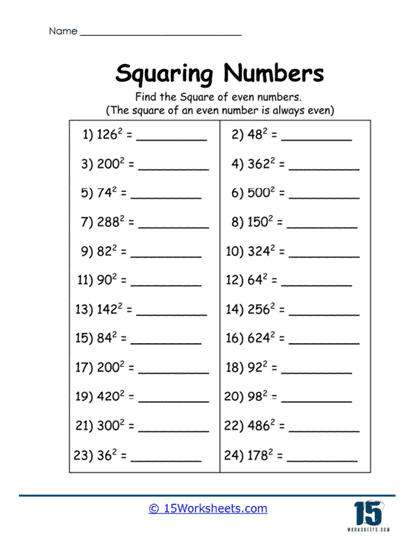
Even Squares
Students square even numbers (e.g. 2, 4, 10, etc.). Might look for patterns (e.g. squares of evens always even, etc.). Helps students notice patterns and properties of even numbers under squaring. Reinforces parity properties (even/odd) and number-theory thinking.
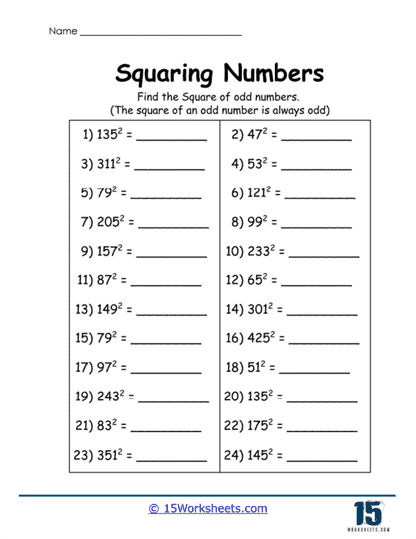
Odd Squares
Similar, but with odd numbers: students square odd numbers, observe that result remains odd. Builds pattern recognition and parity understanding. Helps with noticing rules and consistency in math. Supports logic and algebra readiness.
Sum Squared
Students probably take sums and then square them (e.g. (a + b)²). This adds a level of algebraic thinking and might involve expansion or calculation after sum. Encourages thinking about formulas like (a + b)² = a² + 2ab + b², though maybe in numeric form first. Helps bridge arithmetic to algebraic expressions.
Squared Simplicity
Likely simpler mixed squaring tasks: whole numbers, maybe small decimals, or mixed easy types, to build confidence. Good for review and reinforcing basics. Helps solidify core skills. Supports accuracy and speed without overwhelming complexity.
Decimal Squaring
Very similar to Decimal Squares, though might include tasks like squaring decimals that result in more decimal places. Focus on precision and handling decimal placement. Helps deepen comfort with decimal operations and squaring. Preps for real-world contexts with decimals (money, measurement, etc.).
Negative Square
Like “Negative Squares” but maybe a variant (different layout or difficulty). Reiterates that negative squared is positive. Builds error checking and sign discipline. Helps reduce common mistakes in algebraic work.
Fraction Squares Worksheet
Another variant focusing on fractions: squaring different kinds of fractions, maybe more complex ones or requiring simplification. Reinforces much of above but with more exposure. Helps students get fluent with fraction-exponent work. Strengthens understanding of fraction multiplication and simplification.
Double Digit Power Worksheet
Here students likely square (or possibly raise to other powers) double-digit numbers. Heavier computation. Good challenge for students ready for more advanced arithmetic. Helps with mental or paper multiplication methods. Supports transition toward algebraic powers beyond squares.
What is Squaring a Number?
Squaring a number is a mathematical operation where a number is multiplied by itself. In simpler terms, it means taking the product of a number with itself. The result of squaring a number is called its square. For example, squaring 3 would mean multiplying 3 by 3, which equals 9.
If you have a number denoted by x, then squaring x is written mathematically as:
x2 = x times x
This operation is called “squaring” because the area of a square with side length x is also x2, which gives this operation its geometric interpretation.