
Scientific Notation Worksheets
All About These 15 Worksheets
Scientific notation might sound like something cooked up in a secret math laboratory, but it’s really just a clever shortcut for writing very large and very small numbers. Instead of filling a page with endless zeros, students learn how to use powers of ten to keep numbers neat, tidy, and much easier to work with. This collection of worksheets introduces scientific notation step by step, helping learners understand how decimals, exponents, and place value all work together. Whether students are just starting out or need extra practice, these activities make the topic feel much more approachable. Before long, giant galaxy distances and tiny microscopic measurements won’t seem nearly as intimidating.
These worksheets are designed to help students build confidence through a variety of engaging practice styles. Some activities focus on converting numbers into scientific notation, while others challenge students to expand numbers back into standard form or solve real-world problems using exponential notation. There are comparison tasks, arithmetic exercises, matching games, and notation hunts that keep practice from feeling repetitive. Students get to sharpen their observation skills, strengthen their understanding of exponents, and improve their accuracy with decimals along the way. The mix of activities keeps learners active and curious while steadily reinforcing important math concepts.
Scientific notation is used everywhere from astronomy and engineering to medicine and computer science, so these worksheets connect math to the real world in exciting ways. Students discover how scientists describe the size of atoms, how astronomers measure the distance between planets, and how engineers work with extremely large calculations. Learning scientific notation also helps students become stronger problem-solvers because they practice analyzing patterns and managing numbers efficiently. These worksheets encourage learners to think like mathematicians and scientists while still keeping the experience fun and manageable. It’s a great way to show students that math isn’t just about numbers on a page-it’s a powerful tool for understanding the world around them.
About Each Worksheet
Rewrite Rally
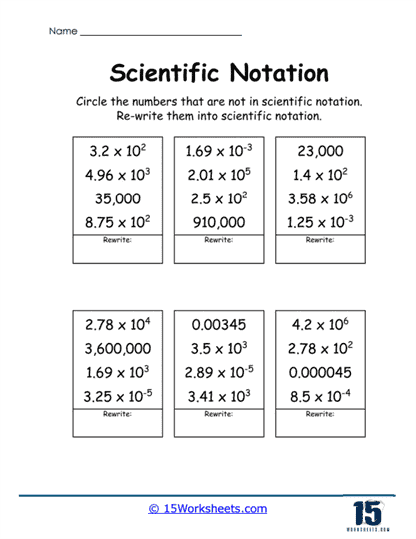
This worksheet turns students into scientific notation editors as they search for numbers that need fixing and rewrite them correctly. Learners practice moving decimals, choosing the right exponents, and making sure every number follows proper notation rules. The variety of large and tiny numbers keeps students thinking carefully about each conversion instead of relying on guesswork. It works wonderfully as independent practice, homework, or even a quick classroom challenge between partners. By the end, students will feel like scientific notation referees calling out formatting fouls with confidence.
Word Problem Wonders
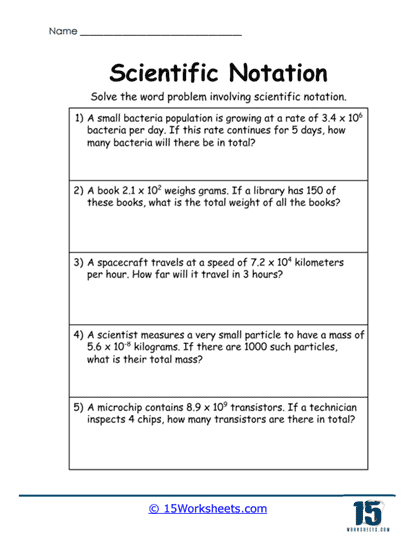
Students dive into real-world situations involving giant distances, tiny particles, and fast-growing numbers while solving scientific notation word problems. This worksheet blends reading comprehension with math skills, encouraging students to pull important information from each scenario before calculating answers. The practical examples help learners see why scientific notation matters outside of textbooks and quizzes. It’s a great activity for connecting math class to science lessons or STEM projects at home. Solving these problems makes students feel like real scientists tackling important discoveries.
Notation Hunt
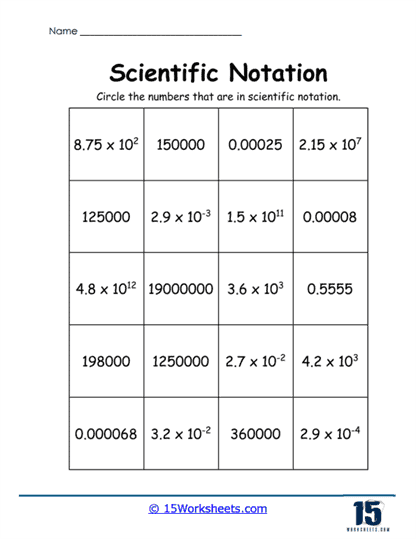
This worksheet transforms scientific notation practice into a mathematical scavenger hunt packed with careful observation. Students scan through grids of numbers to identify which ones are written correctly in scientific notation and which ones are imposters. The activity strengthens attention to detail while reinforcing the exact formatting rules students need to remember. Teachers can use it as a warm-up, review game, or quick assessment to test notation recognition skills. It’s like giving students a magnifying glass and turning them loose in a world of sneaky exponents.
Notation Numbers
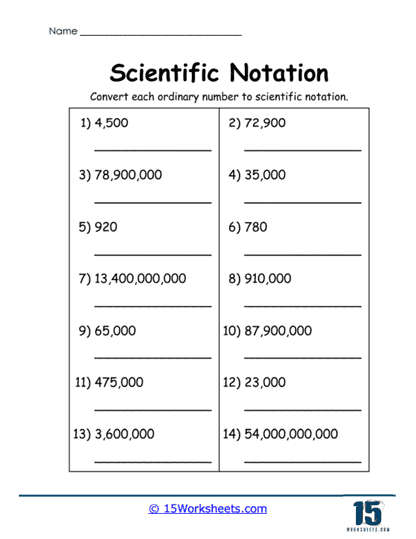
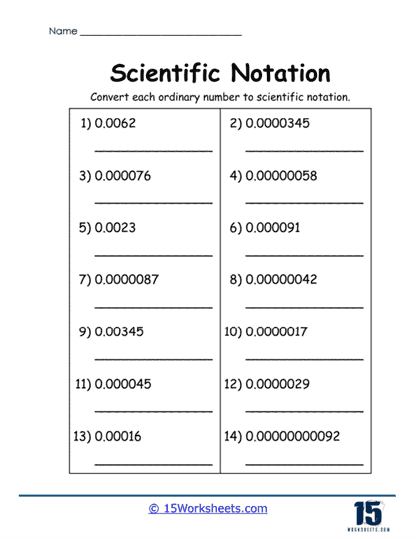
Students practice converting ordinary numbers into scientific notation while working with values that range from enormous to microscopic. The exercises help learners understand how exponents and powers of ten simplify complicated-looking numbers. With repeated practice, students become quicker and more comfortable spotting decimal movement patterns. This worksheet fits nicely into classroom review sessions or extra practice at home before a test. By the end, students may start looking at giant numbers and thinking, “That’s way easier in scientific notation.”
Tiny Transformations
This worksheet focuses on tiny decimal values and teaches students how negative exponents help keep small numbers manageable. Learners practice rewriting near-zero numbers into scientific notation while strengthening their understanding of place value and powers of ten. The repeated exposure to very small quantities helps students become more confident with negative exponents. It’s especially useful for supporting science units involving measurements, chemistry, or microscopic data. Students finish the activity feeling like experts at shrinking giant strings of decimals into neat little expressions.
Expand to Standard
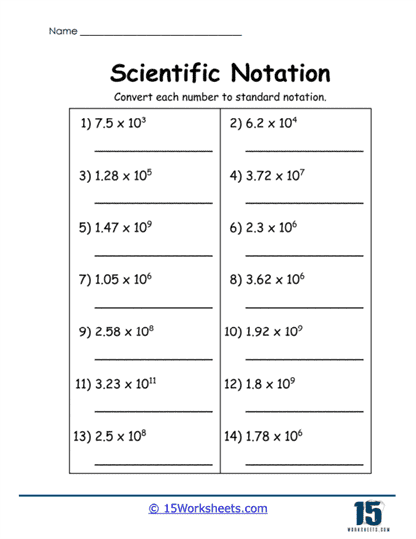
Students reverse the scientific notation process by expanding numbers back into their full standard form. This worksheet gives learners lots of practice moving decimal points correctly and understanding how exponents affect magnitude. Working through the exercises helps students build flexibility between compressed and expanded number formats. Teachers can use it as a balanced companion to conversion worksheets or as targeted exponent practice. By the end, students will be confidently stretching scientific notation back into ordinary numbers like mathematical accordion players.
Micron Numbers
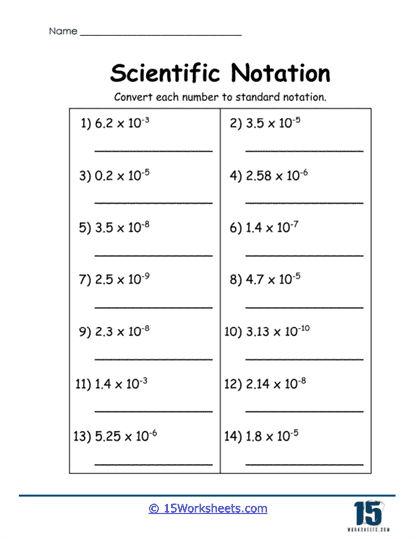
This worksheet helps students practice expanding scientific notation with negative exponents into standard decimal form. Learners carefully work through tiny values while improving their accuracy with decimal placement and powers of ten. The variety of problems encourages students to slow down, think critically, and avoid common exponent mistakes. It’s a helpful activity for reinforcing concepts used in science, technology, and engineering lessons. Students may even start appreciating how much work one little decimal point can do.
Notation Mastery
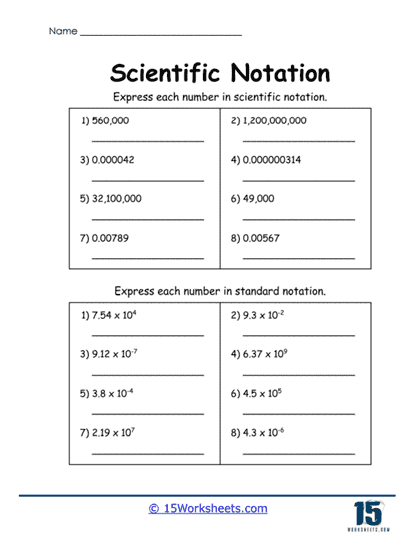
This worksheet gives students a full scientific notation workout by combining conversions in both directions. Learners switch between standard form and scientific notation while practicing with numbers of different sizes and complexities. The back-and-forth structure helps students build fluency and confidence with notation rules. It works well as a review packet, skill assessment, or extra challenge for students ready to level up. Completing it feels a bit like earning a black belt in scientific notation.
Comparison Calculations
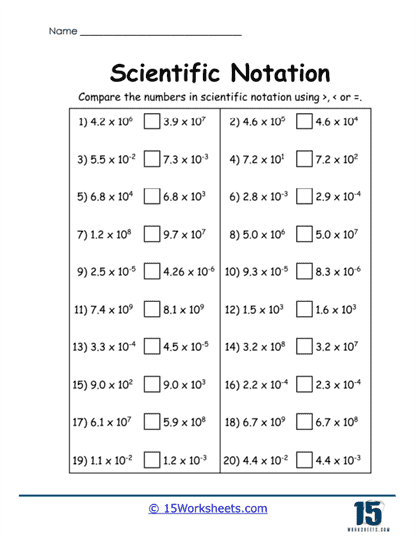
Students compare scientific notation expressions using greater than, less than, or equal to symbols without converting everything into standard form. The activity sharpens number sense by encouraging learners to analyze exponents and coefficients carefully. Students begin recognizing number magnitude patterns much faster through repeated comparison practice. This worksheet is perfect for quick classroom drills or partner discussions about mathematical reasoning. By the end, learners will be sizing up exponential numbers faster than contestants in a math showdown.
Sum and Notation
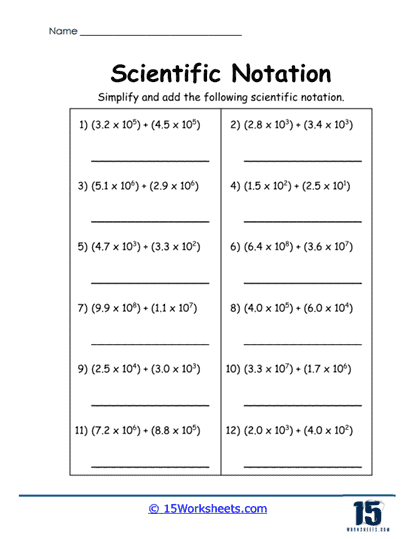
This worksheet introduces students to adding numbers written in scientific notation while reinforcing exponent rules along the way. Learners practice combining values carefully and simplifying answers into proper notation format. The repetition helps students become more comfortable performing arithmetic with powers of ten. Teachers can use it as guided practice before moving into more advanced scientific calculations. It’s a fun reminder that even enormous numbers can cooperate nicely when organized correctly.
Subtracting Powers
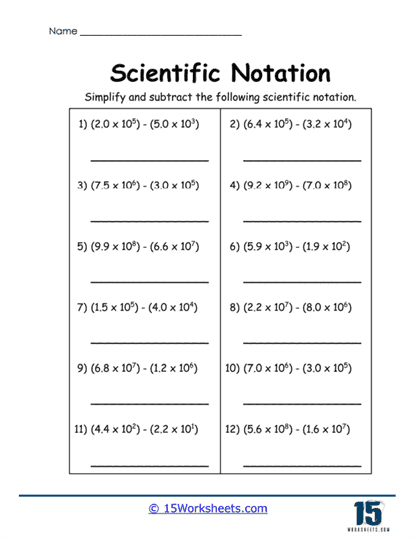
Students strengthen their scientific notation skills by practicing subtraction problems involving exponential expressions. The exercises require careful alignment of exponents and thoughtful simplification to maintain accurate notation. This worksheet encourages precision and helps students avoid common calculation mistakes with decimals and powers of ten. It works nicely as classroom practice or as reinforcement during algebra and science units. By the final problem, students will feel much more prepared to tackle tricky subtraction challenges involving giant or microscopic numbers.
Multiplying Magnitudes
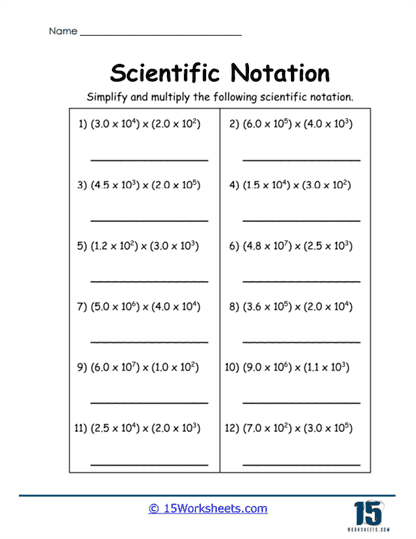
This worksheet focuses on multiplying scientific notation expressions while applying exponent laws correctly. Students practice multiplying coefficients, combining exponents, and simplifying final answers into proper notation form. The exercises help learners understand how scientific notation makes large calculations far more manageable. It’s an excellent activity for strengthening algebra readiness and STEM problem-solving skills. Students may even start feeling like human calculators as they multiply massive quantities with ease.
Division Decisions
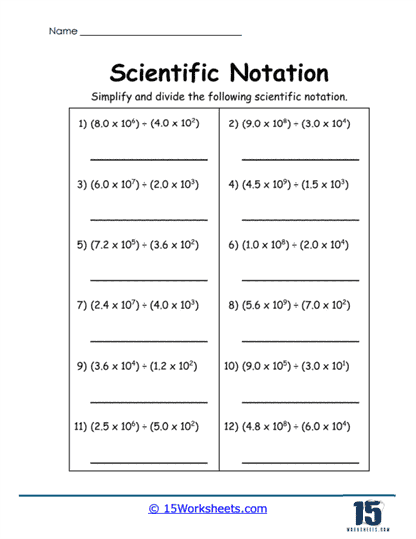
Students work through division problems involving scientific notation while sharpening their understanding of exponent subtraction rules. The exercises guide learners through simplifying quotients and maintaining proper scientific notation formatting. Repeated practice helps students build confidence when handling complicated-looking exponential expressions. This worksheet works well as independent practice, review work, or preparation for advanced algebra concepts. By the end, dividing enormous numbers won’t seem nearly as scary anymore.
Exponential Simplifiers
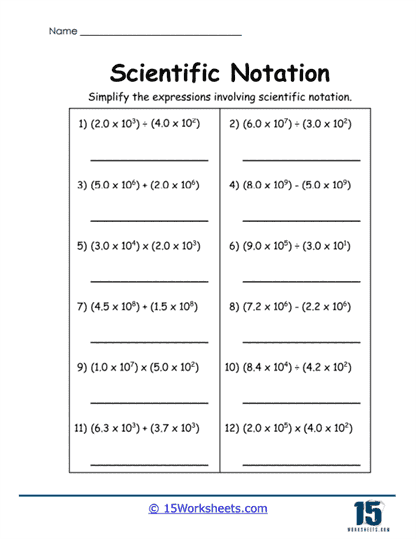
This worksheet mixes addition, multiplication, and simplification tasks to give students broad practice with scientific notation operations. Learners apply exponent rules across a variety of problem types, helping them strengthen both accuracy and flexibility. The combination of operations keeps students alert and encourages deeper understanding instead of memorization. It’s a strong review tool for classrooms or extra enrichment for students who enjoy math challenges. Completing the worksheet feels a little like solving an exponent puzzle marathon.
Number Match
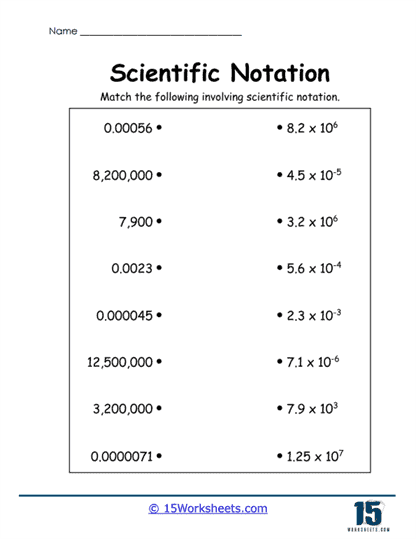
Students match standard form numbers with their scientific notation equivalents in this engaging pairing activity. The exercise helps learners recognize relationships between decimal placement, powers of ten, and notation structure. Working through different number sizes strengthens both conversion skills and overall number sense. Teachers can use it as a partner game, independent review, or quick assessment activity. It’s a satisfying way for students to connect matching numbers like a mathematical memory game.
What is Scientific Notation?
Scientific notation is a clever math system used to write extremely large or extremely small numbers in a shorter and easier form. Instead of writing a number with a mountain of zeros, scientists and mathematicians use powers of ten to simplify everything. For example, the number 5,000,000 can become 5 × 10⁶, which is much faster to read and write. Tiny numbers work the same way, except they use negative exponents to show very small values. It’s basically math’s way of cleaning up messy numbers and making them easier to manage.
People use scientific notation all the time in science, medicine, engineering, astronomy, and technology. Astronomers use it to describe the enormous distances between stars and planets, while scientists use it to measure microscopic particles too small to see with the naked eye. Computers, laboratories, and even weather forecasting systems rely on scientific notation to handle huge amounts of numerical data efficiently. Without it, calculations involving giant or tiny values would become confusing very quickly. Scientific notation helps professionals save time, reduce errors, and communicate information clearly.
Learning scientific notation also supports bigger math and problem-solving skills that students will use for years. It strengthens understanding of place value, exponents, multiplication, division, and number patterns all at once. Students also practice thinking logically and carefully analyzing how numbers change when decimals move. These skills transfer directly into algebra, chemistry, physics, computer science, and many other subjects. Best of all, scientific notation teaches students that math can be both practical and surprisingly satisfying when numbers finally start behaving themselves.