
Synonyms Worksheets

All About These 15 Worksheets
This set of 15 worksheets is all about helping students deepen their vocabulary by learning not only what synonyms are, but how and when to use them. The activities mix recognition, classification (synonym vs antonym), creative description, and writing tasks so that students see synonyms in different contexts-not just matching. Visual and interactive features like coloring, bolding, and pictures keep the work interesting and help reinforce meaning more memorably. Over time, students become more flexible with language, better at choosing the right word for what they want to say.
The variety of tasks-yes/no, match, circle, write, describe-ensures that different learning styles are supported (visual, auditory, kinesthetic). Some worksheets are more playful (Colorful Circles, Describe Each Picture), others more rigorous (More Precise, Use It In A Sentence), so students can gradually move from recognition toward expressive, precise vocabulary. The set also fosters critical thinking: deciding between synonym vs antonym, choosing the best fit, using words in context.
Overall, mastering synonyms helps students write more richly, avoid repetition, and read more deeply. It improves reading comprehension, since knowing synonyms allows kids to understand meaning even when words are new. It also boosts writing skills, because being able to pick varied and precise words gives voice and clarity. These worksheets empower learners to become more articulate, confident communicators.
Have a Look Inside Each Worksheet
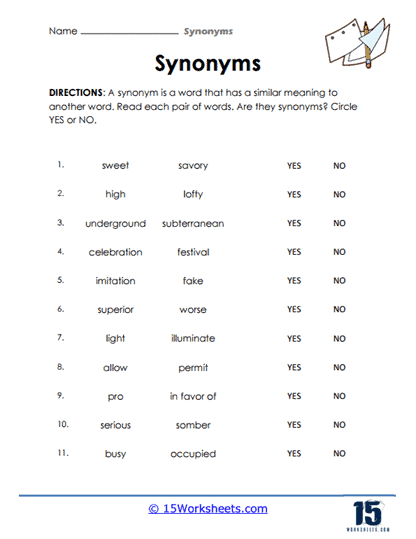
Yes Or No
Students are shown pairs of words and must decide “yes” if they are synonyms, or “no” if they are not. This helps build the ability to instantly recognize word meaning relationships. It encourages thinking about meaning rather than just memorizing words. It also lays groundwork for more subtle vocabulary distinctions later on.
Synonym Or Antonym?
Learners are given words and must pick whether a given pair is a synonym (same meaning) or antonym (opposite meaning). This sharpens both synonym and antonym understanding side by side. It helps reinforce contrasts in meaning. Students become more precise in their word usage.
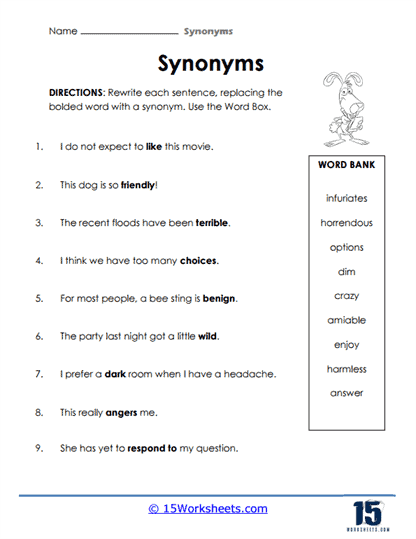
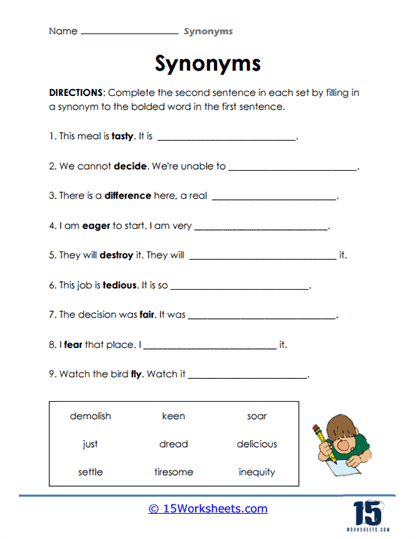
The Word Bank
Students receive a “bank” of words to choose synonyms from, matching them to target words. This supports active vocabulary expansion by exposing students to multiple synonym options. It practices reading comprehension and word choice. Helps with choosing the best synonym in context.
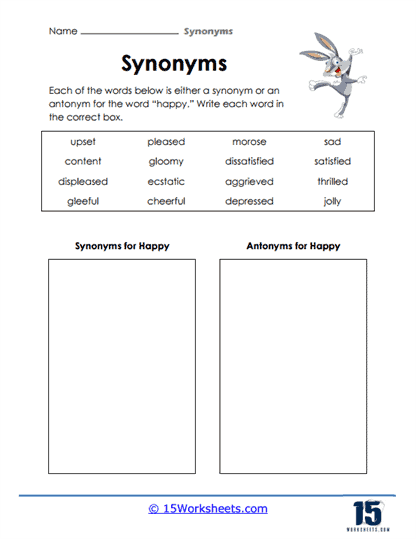
Synonyms And Antonyms For Happy
This worksheet focuses on finding synonyms and antonyms for the word “happy.” Students think about both similar and opposite meanings. It helps with nuanced understanding of how mood or emotion can be expressed. Encourages creative thinking and richer vocabulary.
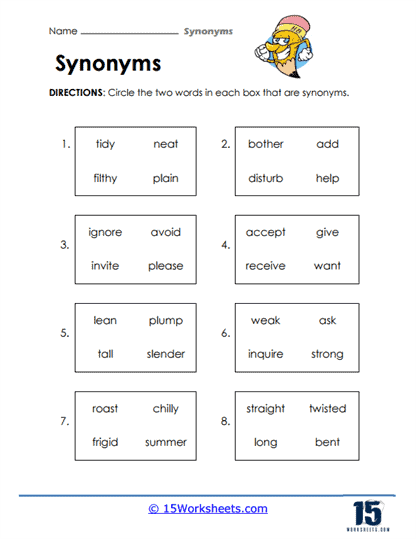
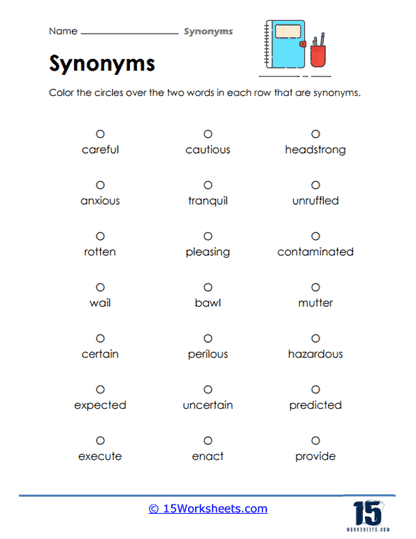
Circle Two
Given several options for each word, students must circle two synonyms. This adds a bit more challenge: they can’t just pick one but need to think about more than one matching meaning. It fosters comparison among words. Also reinforces careful reading and selection.
Colorful Circles
Students use colored circles around words or options that ask for synonyms. The color component adds visual engagement. It helps differentiate correct choices in a fun way. Makes synonym practice feel more game-like.
Bolded Words
In this worksheet, certain words are bolded, and students likely must find synonyms for those bolded words. Focuses attention on specific target vocabulary. Helps students practice identifying which words need replacement. Builds skill at pinpointing key adjectives/nouns in sentences.
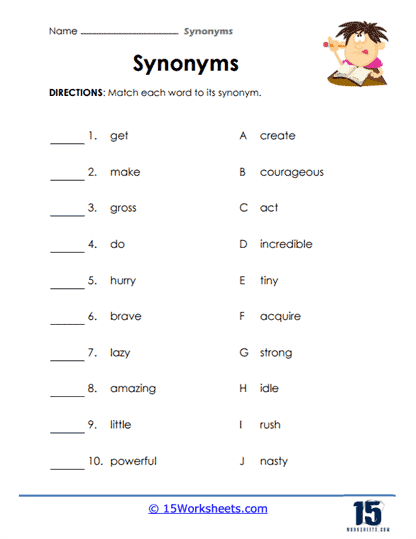
Matching The Words
Students match words with their correct synonyms. Straightforward matching tasks that reinforce recognition of meaning equivalence. Encourages students to draw connections among words. Helps cement new vocabulary.
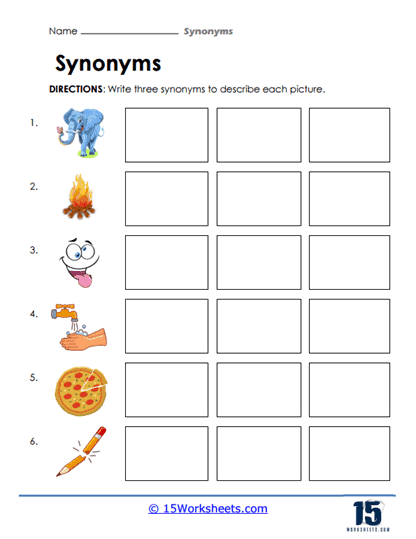
Describe Each Picture
Learners see pictures and are asked to use synonyms to describe what they see. This ties visual imagery to language use. Pushes students beyond basic vocabulary toward richer description. Builds deeper word knowledge and expressive language.
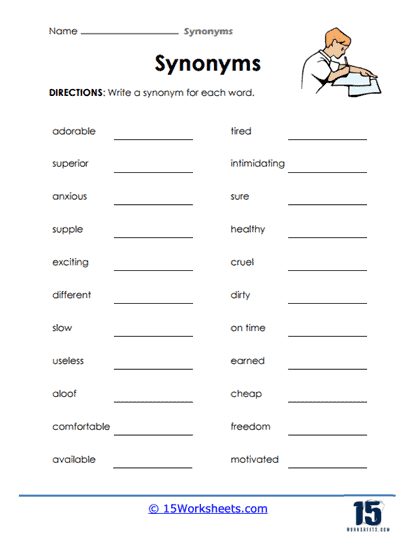
Write The Synonym
Students are given a word, perhaps in a sentence or standalone, and must write its synonym. This pushes from recognition to production. Boosts spelling and vocabulary recall. Supports expressive writing and word flexibility.
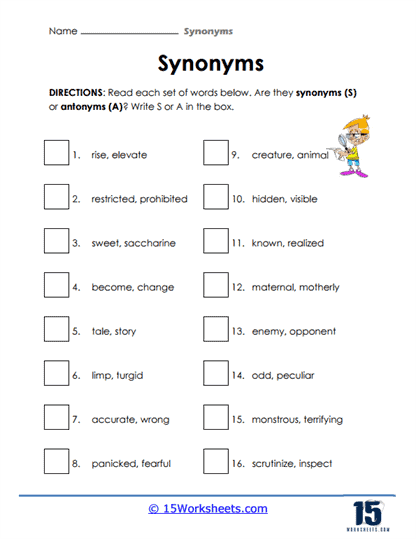
S Or A?
Students decide whether a word pair is a Synonym (“S”) or an Antonym (“A”). It’s a quick-decision task to reinforce meaning relations. Helps build speed of recognition. Good for assessment or warm-up routines.
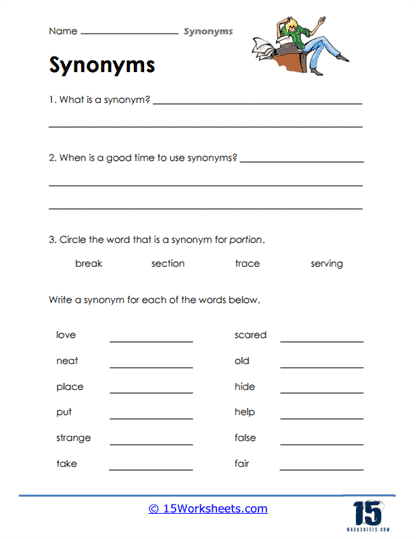
What Is A Synonym?
This worksheet includes definition or examples, asking students to identify or explain what synonyms are. Helps formalize understanding of the term. Supports metacognitive skills (thinking about thinking). Assists in making sure students know not just how but what synonyms are.
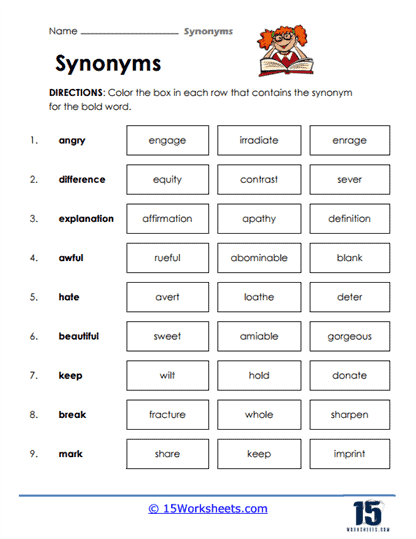
Color The Box
Options are placed in boxes, and students color the box containing the synonym. Another visual strategy, helping students notice correct choices. Makes the work more interactive and fun. Reinforces selection and decision skills.
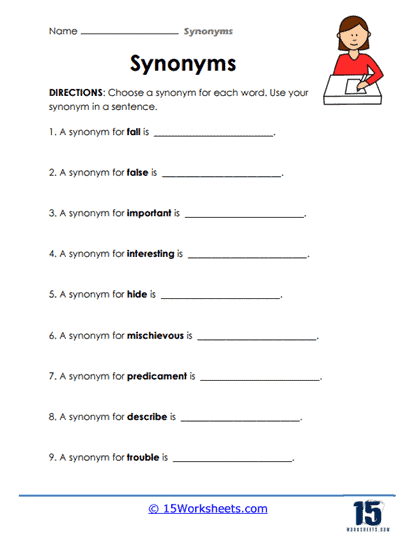
Use It In A Sentence
Students choose or write a synonym and then use it in a sentence. This connects meaning with context. It improves both vocabulary and writing skills. Helps students see how synonyms are used in real sentences.
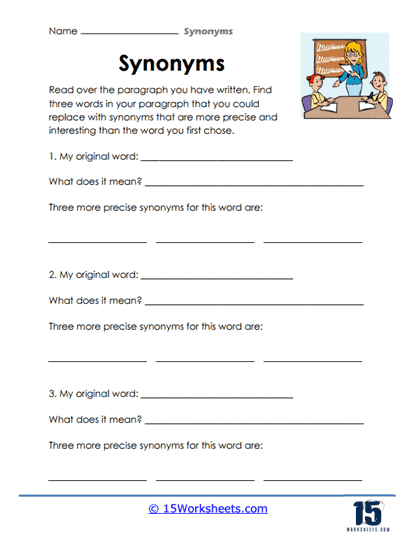
More Precise
Given perhaps vague or general words, students are asked to pick more precise synonyms. Encourages critical thinking about nuance, tone, and appropriateness. Helps move students toward more vivid, exact language. Supports writing clarity and expression.
What Are Synonyms?
Synonyms are words that have the same or nearly the same meaning as another word. For example, instead of saying big, you could say large, huge, or gigantic-all of them give a similar idea. Synonyms make our language more flexible and interesting, so we don’t have to use the same word over and over again. They also help us choose the word that feels “just right” for the sentence we’re writing.
Understanding synonyms is important because it builds vocabulary and helps improve both reading comprehension and writing. If you know that happy can also be expressed as joyful or cheerful, then you’re more likely to understand what an author means in different contexts. It also lets you adjust your own speech and writing to sound more descriptive, formal, or casual depending on what you need.
These worksheets make synonyms fun to learn by mixing matching games, coloring activities, and sentence writing. With enough practice, students get comfortable swapping in new words naturally. That not only makes their vocabulary richer but also makes reading and writing a whole lot more enjoyable.
Examples of Synonyms
Here’s one word with four synonyms to show how it works:
Happy → Joyful, Cheerful, Glad, Content
Big → Large, Huge, Enormous, Massive
Fast → Quick, Rapid, Speedy, Swift