
Sort By Shape Worksheets

About These 15 Worksheets
Sorting by shape is one of the first big steps kids take in building their early math and observation skills. This collection of worksheets gives learners plenty of chances to recognize, compare, and group both 2D and 3D shapes. From circles and rectangles to cones, prisms, and even “wild” shapes, the variety keeps the practice fresh and exciting. Each page encourages kids to sharpen their visual discrimination skills while making connections between geometry and the real world.
The worksheets also branch out into real-life examples, asking children to spot shapes in everyday objects. Whether it’s recognizing that a box is a cube or that a coin is a circle, kids see how math isn’t just on paper-it’s all around them. This real-world link keeps students engaged and shows them the usefulness of their new skills. As they sort, classify, and compare, they also build early vocabulary and logical thinking.
Best of all, the collection balances simplicity with challenge. Beginners can practice with basic circles, triangles, and squares, while more advanced learners work with prisms, pentagons, and star shapes. The creative themes make sure the practice feels like a game instead of a drill. By the time they finish, kids will feel more confident spotting shapes both in class and in their everyday adventures.
Have a Look Inside Each Worksheet
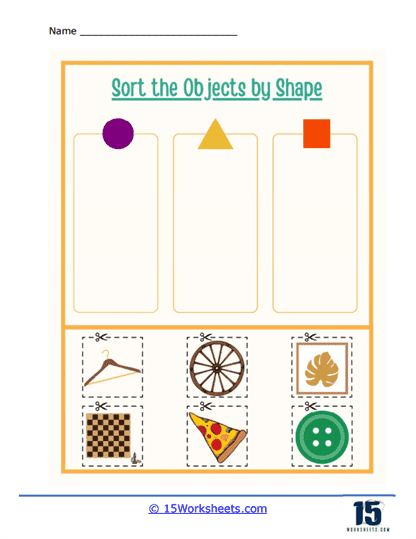
Circle, Triangle, Square
Kids practice sorting basic 2D shapes into their matching groups. They get to recognize circles, triangles, and squares quickly. The activity builds early geometry and classification skills. It’s a simple, colorful way to reinforce shape recognition.
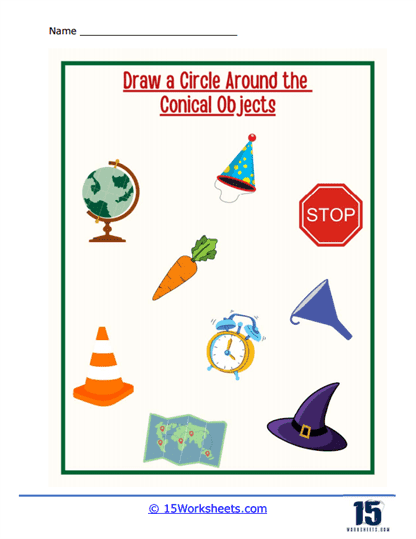
Conical Objects
Learners identify everyday objects shaped like cones. They sort items such as ice cream cones, traffic cones, or party hats. This connects real-world visuals with geometry concepts. It makes shape learning practical and relatable.
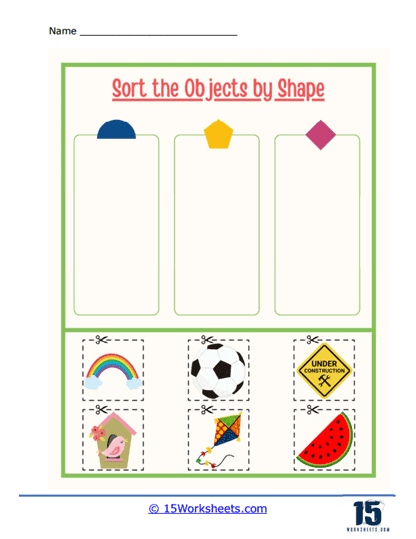
Arch, Pentagon, Diamonds
Students work with slightly less common shapes like arches, pentagons, and diamonds. They sort objects into the right categories. This expands their shape vocabulary beyond the basics. It’s a great way to challenge observation and thinking skills.
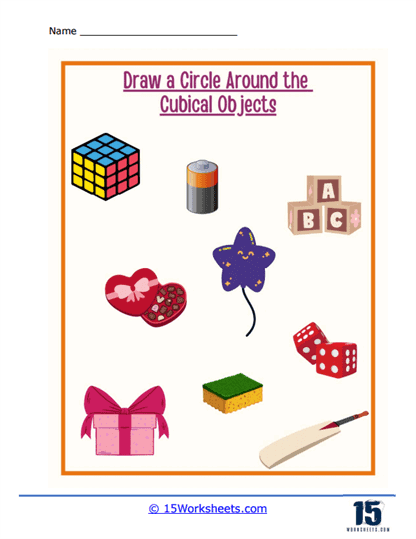
Cubical Objects
This worksheet focuses on 3D cube-shaped items. Children identify and group things like dice or boxes. It strengthens understanding of spatial forms. The activity ties geometry to familiar everyday objects.
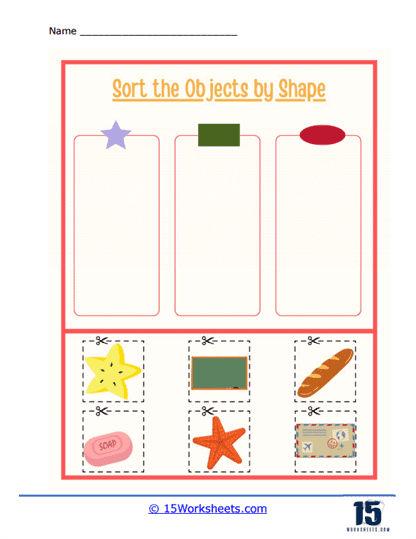
Star, Rectangle, Oval
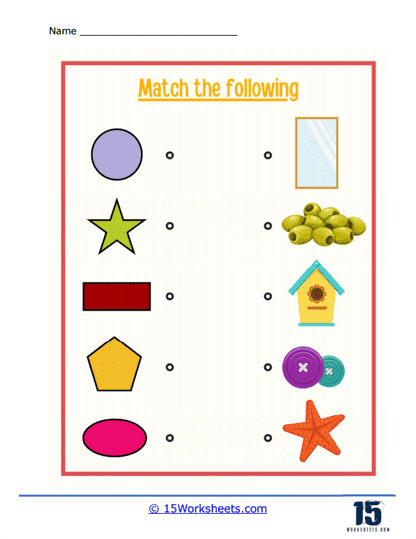
Kids practice sorting stars, rectangles, and ovals into their correct groups. The worksheet introduces a mix of simple and decorative shapes. Learners sharpen attention to detail. The fun star designs make the page more engaging.
Rectangular Object Sort
Students identify and sort objects that have a rectangular shape. They learn to spot rectangles in common items. The activity helps build shape recognition in real-life contexts. It shows that rectangles are everywhere once you start looking.
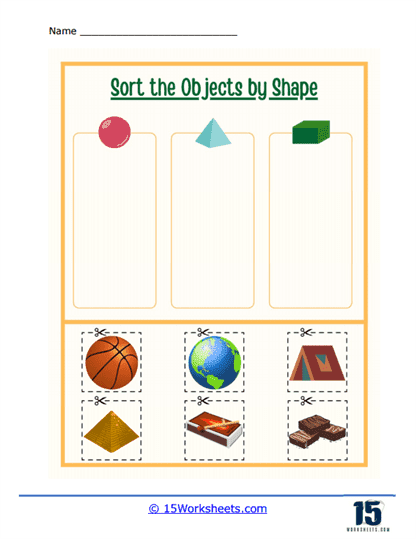
3-D Shapes
This worksheet introduces sorting three-dimensional figures like spheres, cubes, and pyramids. Children group the shapes by type. It builds early geometry skills and spatial awareness. The mix of 3D forms makes the task more challenging and fun.
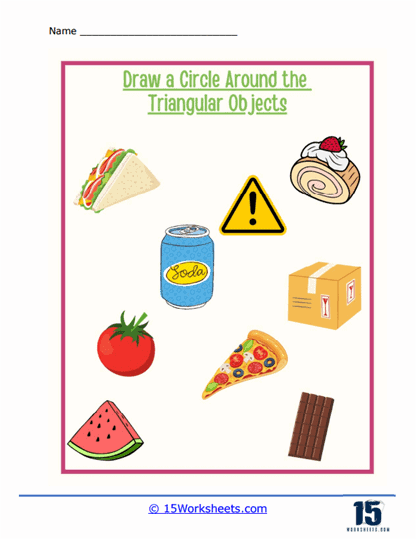
Triangular Objects
Learners find and sort real-world objects shaped like triangles. They practice identifying three-sided shapes in practical examples. The activity makes math more concrete. Kids get excited when they recognize triangles in everyday life.
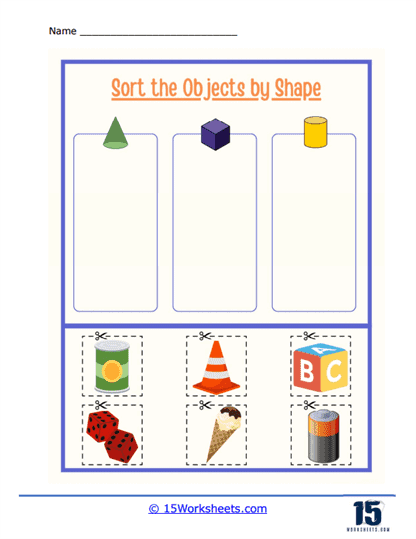
Sphere, Prisms, Cubes
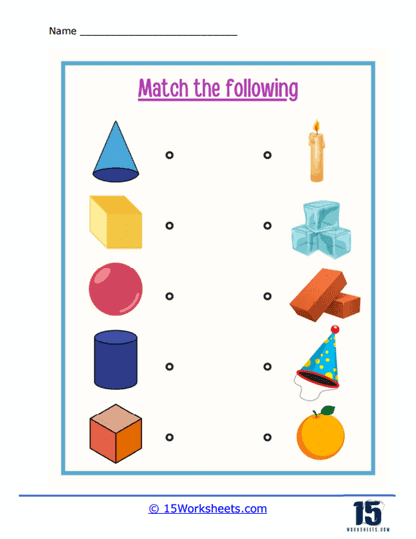
Students sort different 3D objects into categories: spheres, prisms, and cubes. They get to compare similarities and differences between forms. The activity strengthens classification skills. It’s a hands-on introduction to solid geometry.
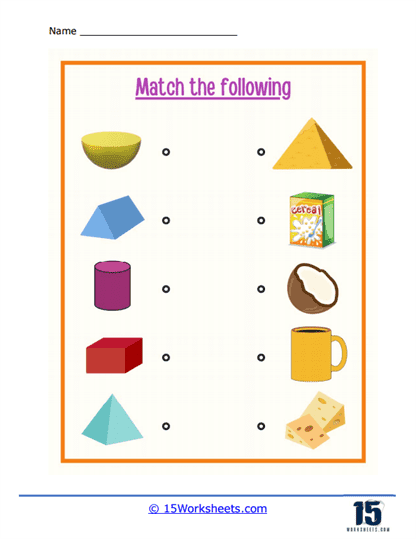
Real Objects to Shapes
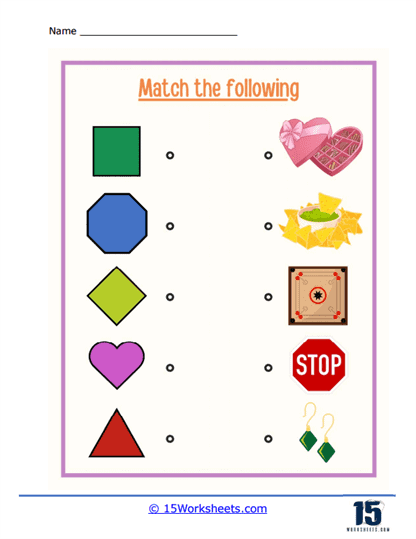
Kids match real objects with their corresponding shapes. This worksheet helps bridge abstract geometry with everyday things. It reinforces recognition and association. The real-life angle makes learning feel meaningful.
Real World Sorts
Learners look at groups of everyday objects and sort them by shape. The activity emphasizes that shapes aren’t just drawings but part of daily surroundings. It builds critical observation skills. Kids see math woven into the world around them.
Outlines of Shapes
Students practice sorting based on just the outlines of shapes. It trains their eyes to recognize shapes even without details. The activity strengthens visual discrimination. It’s a great step toward more abstract geometry.
Wild Shapes
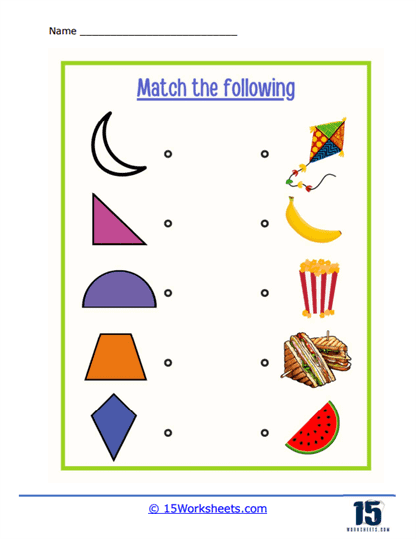
This worksheet mixes familiar and unusual shapes for sorting. Kids get practice identifying both standard and “wild” forms. The quirky designs keep things playful. It pushes learners to pay closer attention.
3-D Real World Sorting
Children identify 3D shapes in real objects and sort them into groups. They see spheres, cubes, and prisms in everyday items. The activity ties math directly to reality. It builds confidence in recognizing solid shapes outside the classroom.
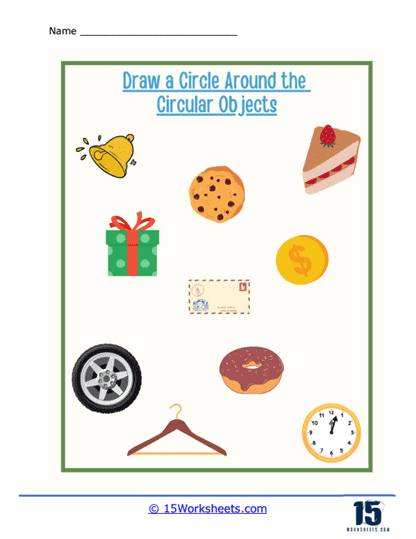
Circular Objects
Learners focus on spotting and sorting objects shaped like circles. From clocks to coins, the theme makes shape sorting relatable. The activity reinforces one of the most common and important shapes. It’s a perfect worksheet for beginners.
Sorting 2D Shapes: What Makes Them Different?
When we look at 2D shapes, it can feel like there are so many to remember-squares, triangles, circles, hexagons, and more. But the good news is that we can sort and group shapes by looking at their properties. These are the features that make each shape special.
Here are some of the most useful properties to look at:
1. Number of Sides
The number of sides is one of the easiest ways to sort shapes.
A triangle has 3 sides.
A square has 4 sides.
A hexagon has 6 sides.
If you count the sides, you can quickly see which shapes belong together.
2. Length of Sides
Some shapes have sides that are all the same length, while others don’t.
In a square, all 4 sides are equal.
In a rectangle, opposite sides are equal, but not all sides are the same.
This helps us tell squares and rectangles apart, even though both have 4 sides.
3. Angles
The corners, or angles, also matter.
A right angle is a “square corner” like the ones in a rectangle.
A triangle can be sorted into right-angled, acute (all small angles), or obtuse (one large angle).
4. Curved or Straight Sides
Not all shapes are made of straight lines!
A circle has no straight sides at all-just one continuous curve.
An oval (or ellipse) is also curved, but stretched out.
5. Symmetry
Some shapes can be folded in half so both sides match perfectly. These are called lines of symmetry in shapes, and they help us understand how balanced a shape is.
For example, a square has 4 lines of symmetry,
while an equilateral triangle has 3.
A circle has even more-you can fold it through the center in many ways and still get matching halves!