
Missing Subtrahends Worksheets

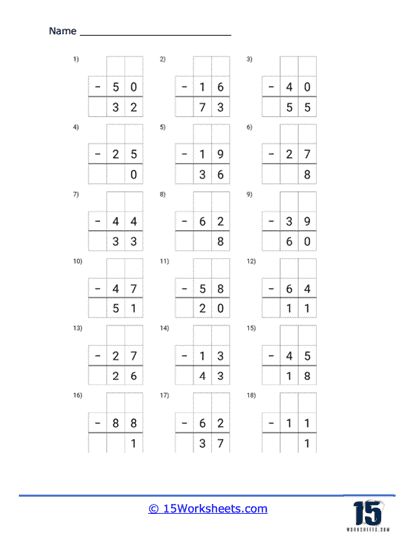

About These 15 Worksheets
These worksheets give students the chance to deepen their subtraction skills by solving equations where the subtrahend-the number being taken away-is the unknown. From single digits up to three-digit numbers, and spanning many formats like flashcards, grids, and blocks, they scaffold the skill in manageable steps. This variety keeps students engaged and helps them practice both initial understanding and arithmetic fluency.
Starting with simple one-digit problems, the activity moves steadily into more complex territory, including multi-digit calculations and different visual layouts. Formats like flashcards are great for speedy recall, while grids and blocks provide structure and focus. Ultimately, these activities build both speed and accuracy in a thoughtful, layered progression.
These worksheets also support algebraic thinking-students learn to view subtraction as a balancing equation, whether they’re filling in a missing number or verifying that their answer works. That understanding carries into more advanced math later on. It’s subtraction that teaches both strategy and confidence.
Each of the sheets will present subtraction equations in different formats. For instance, you might see equations like ? – 5 = 9 or 12 – ? = 6. The missing number, known as the subtrahend, is represented by a question mark or a blank space. Your task is to figure out what number should replace the question mark to make the equation correct.
Have a Look Inside Each Worksheet
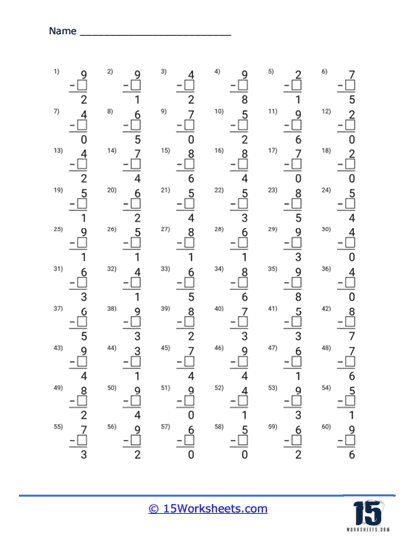
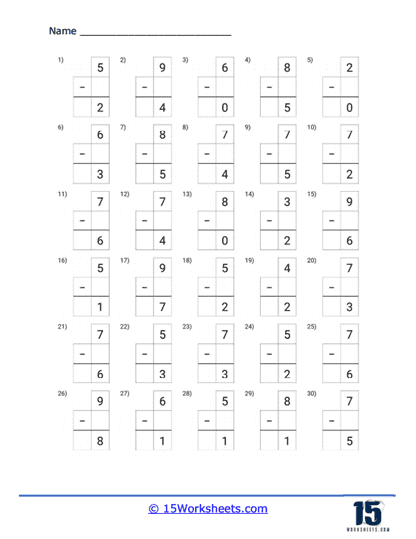
1-Digit Missing Subtrahend
Students solve simple subtraction problems like ? − 5 = 9, finding which single-digit number makes the equation true. This helps them practice both subtraction and the idea of missing numbers. It’s a gentle introduction to thinking of subtraction as an equation to balance.
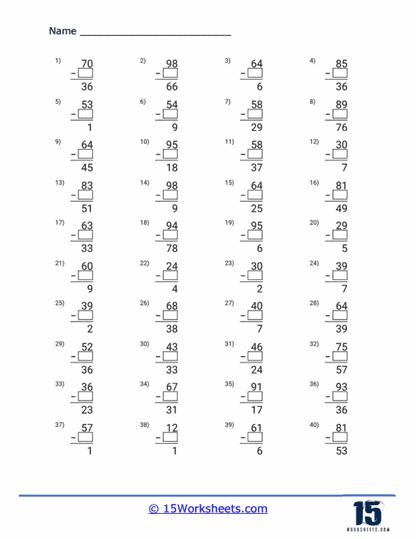
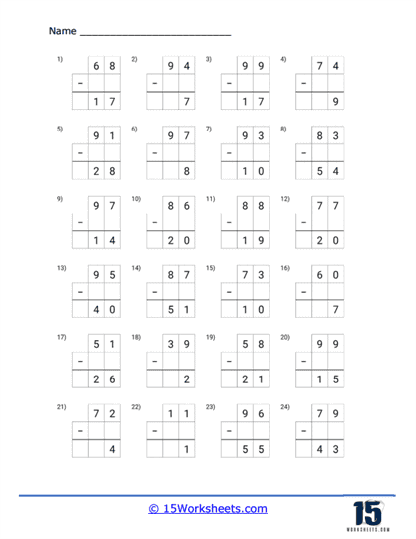
2-Digit Missing Subtrahend
Here, learners work with two-digit subtraction problems where the subtrahend is missing. Students apply place-value thinking and sometimes regrouping to determine the correct subtrahend. It deepens their understanding of multi-digit subtraction.
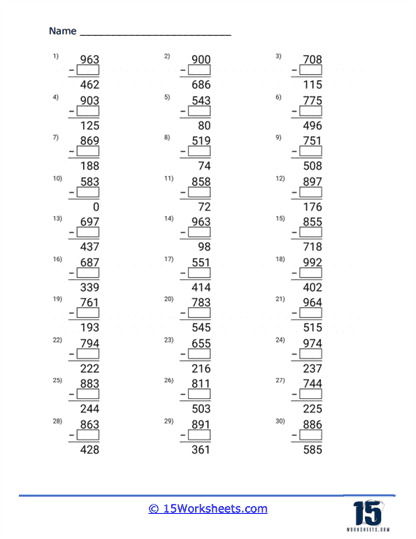
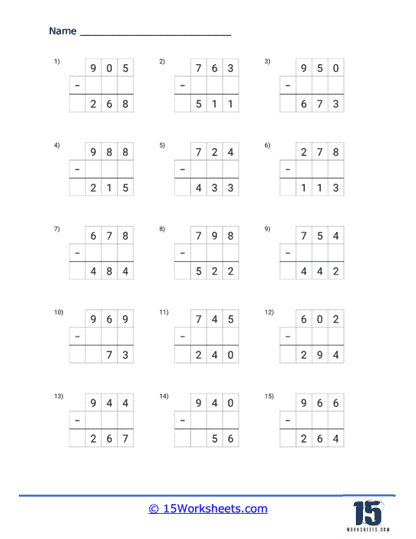
3-Digit Missing Subtrahend
This worksheet raises the complexity by using three-digit equations with a missing subtrahend. Students must manage larger place-value positions-hundreds, tens, and ones-to correctly find the missing number. It builds confidence with multi-digit subtraction and forming thoughtful strategies.
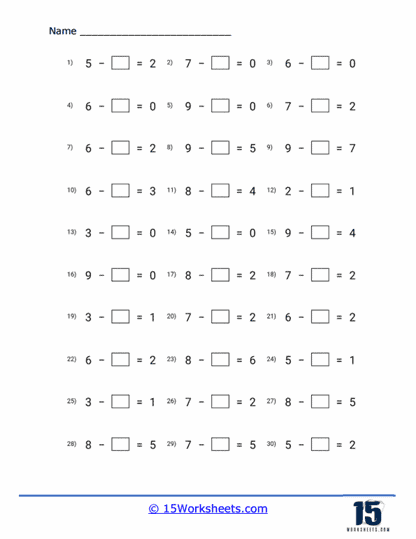
Horizontal Single-Digit
Equations are arranged horizontally (e.g., 8 − ? = 3) using single-digit numbers. The format is familiar and accessible for early learners focusing on quick mental calculation. It’s a smooth step from vertical formats to horizontal layout fluency.
Horizontal Double-Digit
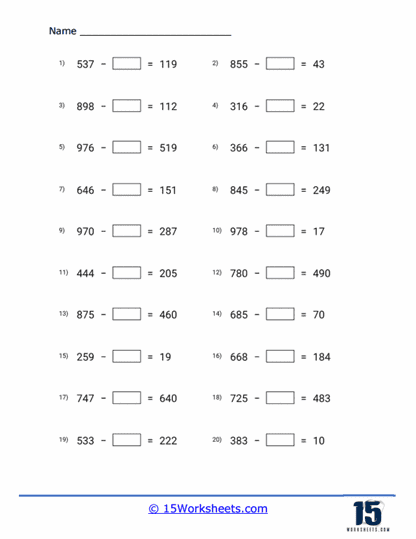
Students see horizontal subtraction problems like 45 − ? = 28, so they must mentally calculate or write out what’s missing. It reinforces place-value subtraction skills and flexible thinking about number relationships. This format also helps transition from paper-based to mental math.
Horizontal Triple-Digit
These horizontally formatted problems feature three-digit numbers, providing extra challenge. Students work out what number needs to be subtracted from a larger three-digit number to result in another three-digit number. It builds both fluency and confidence in handling bigger numbers under different layouts.
1-Digit Subtrahend Flashcards
Flashcard-style problems present subtraction problems missing the subtrahend with single-digit numbers. These are great for quick drills or timed practice to build automaticity. Repeated exposure helps students internalize subtraction facts.
2-Digit Subtrahend Flashcards
Similar in flashcard format but focusing on two-digit subtrahends, these support fast recall with slightly higher difficulty. Students practice quickly recognizing and calculating what number is missing. It sharpens both accuracy and speed.
3-Digit Subtrahend Flashcards
Here, students use flashcards presenting three-digit subtraction problems with missing subtrahends. These are ideal for advanced drills and strengthening mental subtraction strategies. They prepare students for more complex arithmetic fluency.
1-Digit Subtrahend Grids
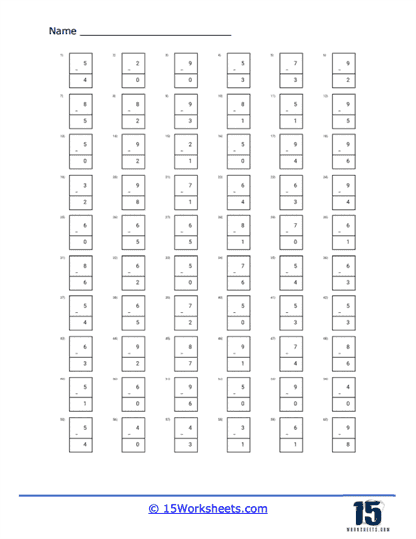
This worksheet lays out a grid of subtraction problems with missing single-digit subtrahends. The grid format supports pattern recognition and lets students practice many problems in a structured space. It’s excellent for concentrated focus and repetition.
2-Digit Subtrahend Grids
In a grid layout, this worksheet features two-digit subtraction problems missing subtrahends. The grid provides a clear structure for solving multiple problems in sequence. It reinforces multi-problem practice in a visually organized way.
3-Digit Subtrahend Grids
The grid format is used here for three-digit subtraction problems with missing subtrahends. Students get structured practice with more challenging numbers. It builds endurance and consistent strategy application.
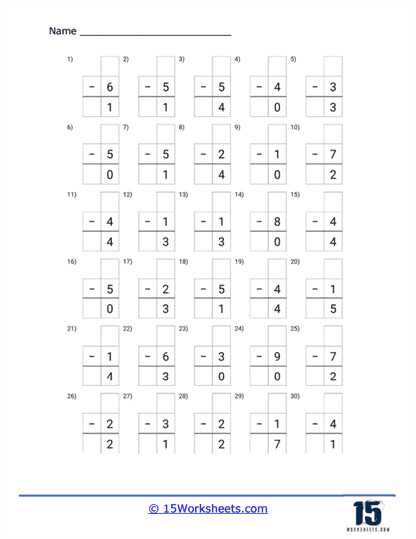
1-Digit Subtrahend Blocks
This worksheet uses block formats-perhaps with grouped visuals-for single-digit missing subtrahends. It adds visual support and structure for students as they work through problems. The visual format helps keep attention and organization strong.
2-Digit Subtrahend Blocks
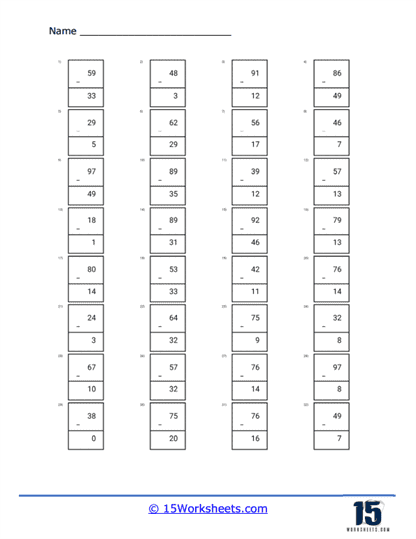
Block-style problems present two-digit subtraction equations with missing subtrahends in a clear, contained layout. This scaffolded presentation helps learners manage more complex place-value work. It’s visually neat and supports precision.
3-Digit Subtrahend Blocks
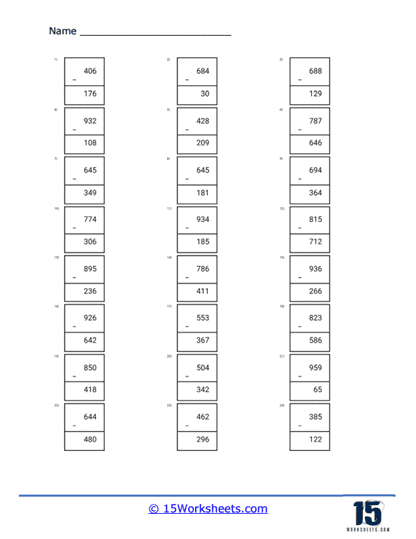
Here, three-digit missing subtrahend problems appear in block formats to guide the student’s attention. The layout helps zoom in on each place-value position within a tidy structure. It supports careful work and reduces visual clutter.
How Do You Solve Missing Subtrahends Problems?
To solve these worksheets effectively, there are a few steps you can follow:
Step 1) Identify the known numbers – Look for the numbers that are given in the equation. In the example ? – 5 = 9, you know that the difference is 9 and one of the numbers being subtracted is 5.
Step 2) Determine the missing number – To find the missing subtrahend, you need to think about what number, when subtracted from the other known number, would result in the given difference. In this case, you would subtract 5 from the missing number and get 9. So, the missing subtrahend is 14.
Step 3) Check your answer – After finding the missing subtrahend, you should verify your solution by substituting it back into the original equation. In this example, replace the question mark with 14 and perform the subtraction – 14 – 5 = 9. If the equation is correct, the difference should match the given value.
These worksheets are valuable for practicing subtraction skills, enhancing mental math abilities, and strengthening problem-solving techniques. By engaging with these worksheets, you can sharpen your deductive reasoning and critical thinking skills, as well as reinforce your understanding of subtraction concepts.
It’s important to remember that practice is key to mastering any skill. By regularly working on this skill, you will gradually become more comfortable and proficient in solving missing subtrahend equations. Don’t be discouraged if you encounter difficulties at first; with time and practice, you’ll improve your ability to solve these types of problems.
To make the most of these worksheets, it can be helpful to review subtraction principles, such as the subtraction algorithm and the concept of borrowing/regrouping when subtracting multi-digit numbers. Additionally, exploring real-life examples where subtraction is applied, such as calculating change or solving word problems, can help you see the practical significance of these skills.
What Are Different Terms In Subtraction?
Understanding these terms is important for comprehending subtraction equations and performing calculations accurately. Here are the key terms used in subtraction:
Minuend – The minuend is the number from which another number is being subtracted. It is the larger number in a subtraction equation. For example, in the equation 10 – 3 = 7, the minuend is 10. Finding this value is the goal of all of the worksheets that are found above.
Subtrahend – The subtrahend is the number that is subtracted from the minuend. It is the smaller number in a subtraction equation. In the example above, the subtrahend is 3.
Difference – The difference is the result or answer obtained when one number is subtracted from another. It represents the distance or gap between the minuend and the subtrahend. In the equation 10 – 3 = 7, the difference is 7.
Putting it all together the parts of subtraction look like this:
| 10 | – | 3 | = | 7 |
| Minuend | Operation | Subtrahend | Equals | Difference |