
Skip Counting By 3s Worksheets
About These 15 Worksheets
Skip counting by 3s might sound like a simple math trick, but it’s actually the foundation for understanding multiplication, division, and even fractions down the road. These worksheets turn what could be boring drills into creative, themed activities-pirates searching for treasure, owls being built, elephants grouped together, and even snowmen hopping along. Kids get plenty of practice filling in number gaps, tracing number patterns, and using number lines, all while strengthening their number sense. The mix of visuals and repetition helps children really lock in that “add three each time” rhythm, making the math both memorable and fun.
Another bonus? The variety keeps kids on their toes. One sheet may be about hearts or stars, while the next asks them to trace paw prints or help ducks waddle along in groups of three. This stops practice from feeling repetitive and instead makes it feel like a little adventure each time. With themes that tap into animals, holidays, and everyday objects, skip counting practice sneaks in under the disguise of play.
By working through these worksheets, students get more than just number practice-they start to see math patterns all around them. Whether it’s noticing how eggs come in dozens (divisible by 3) or how chairs get set up in rows for an assembly, these activities build a sense of how counting by 3s connects to real life. They’ll also feel more prepared for multiplication facts later, since “3, 6, 9…” will already be second nature.
Have a Look Inside Each Worksheet
Apple Packs
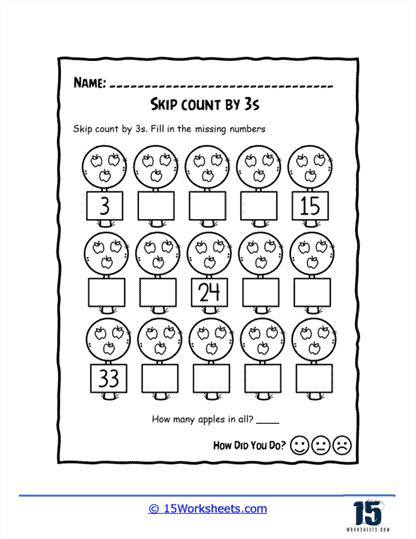
This worksheet uses images of apple packs to help students skip count by 3s, reinforcing the pattern visually. Kids are asked to group apples (or count packs) in sets of three, then continue the sequence. It practices both counting and grouping skills in a fun way. Helps students see how 3-by-3 counting works in a concrete real-life way relating to objects.
Counting Eats
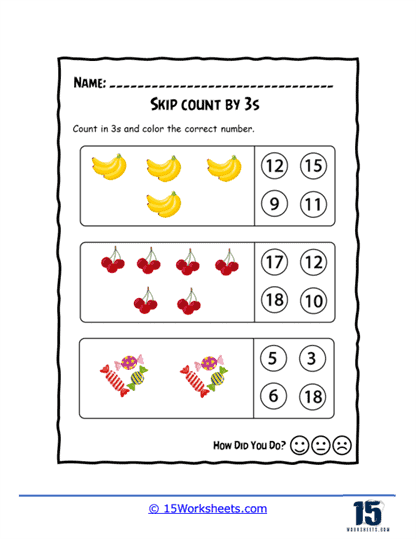
In Counting Eats, learners skip count by 3s using food or eating themed items. It likely involves counting items shown, then continuing the pattern (3, 6, 9, …). Key skills: recognizing patterns, sequencing numbers, connecting skip counting with tangible items. Supports number sense and seeing how counting by 3s applies to everyday things like snacks.
Ship to Treasure
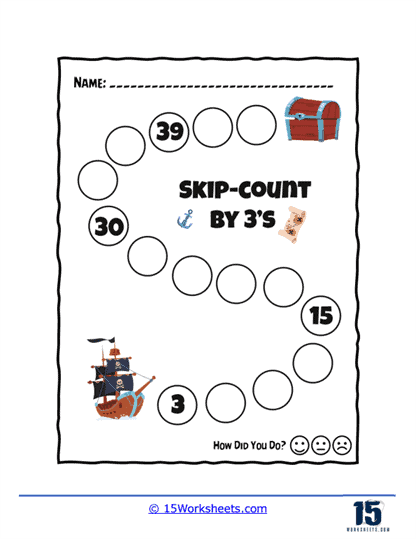
This one has a treasure-hunt or pirate theme. Students probably move along a path from ship to treasure, counting by 3s at each step. They’ll need to fill in missing numbers or hop along a number line or path. Skills: boosting skip counting, number sequencing, understanding spatial layout. The theme makes it engaging and helps anchor abstract counting in a playful scenario.
Fill the Gaps
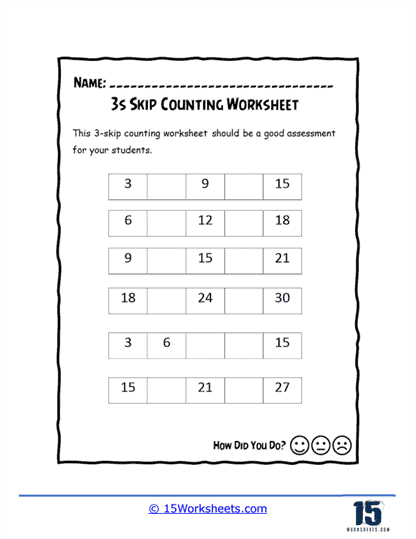
Here, some numbers in the sequence are missing and children fill them in while counting by 3s. For example, something like 3, __, 9, __, 15, etc. Strengthens recognition of what comes next in a 3-by-3 sequence. Supports pattern awareness and logical thinking. Also helps with attention to detail and helps children internalize the interval of “+3”.
Snowman Skips
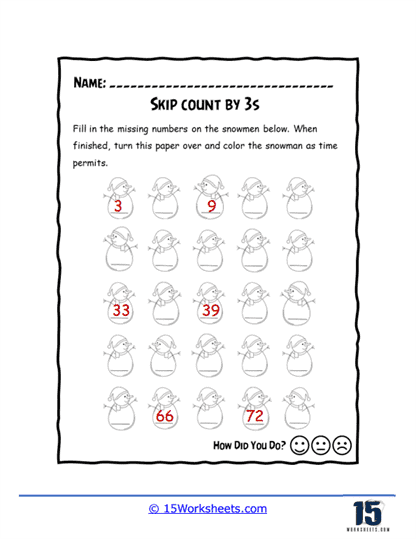
Snowman imagery is used to make skip counting by 3s more seasonal or fun. Likely uses snowmen or parts of snowmen to count by 3s or fill missing numbers. Helps students make connections between the visual theme and counting pattern. Practices skip counting in a lighthearted, visually appealing setting.
Make the Owl
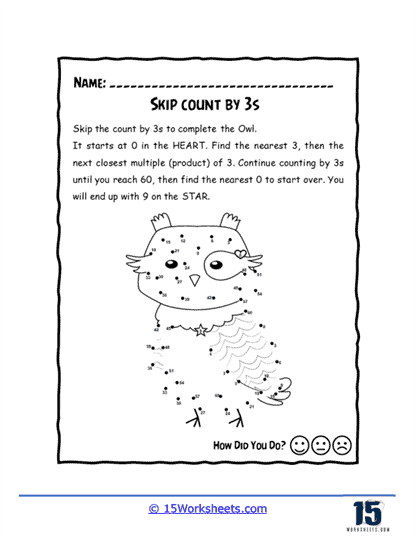
Probably involves building or assembling an owl, using groups of three (maybe owl parts or shapes) to reinforce counting by 3s. Encourages children to count, group, and also practice fine motor or matching skills. Key skills: grouping + pattern + counting. Helps students see how skip counting by 3s can be applied in more creative, craft-y tasks.
Groups of Elephants
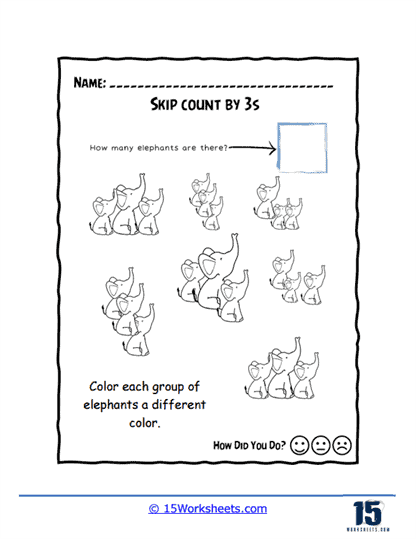
Uses elephant imagery to form groups of three, or counting elephants in sets of three. Children count up by 3s and possibly fill in missing numbers. Good for visual learners and making abstract numbers more concrete. Reinforces grouping, skip counting, pattern recognition.
Numberline 3s
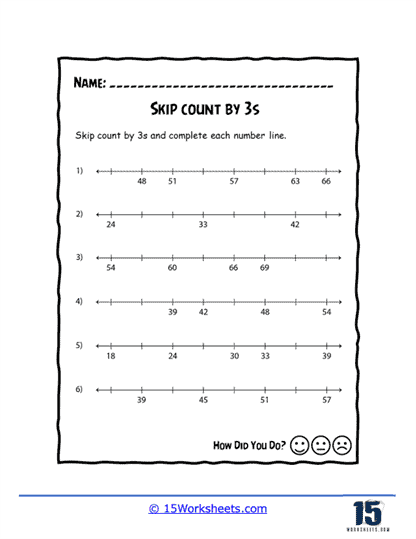
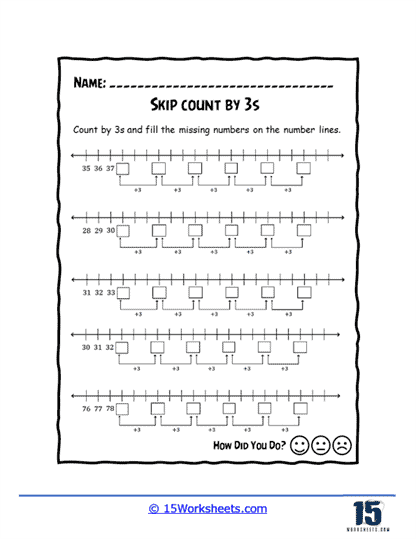
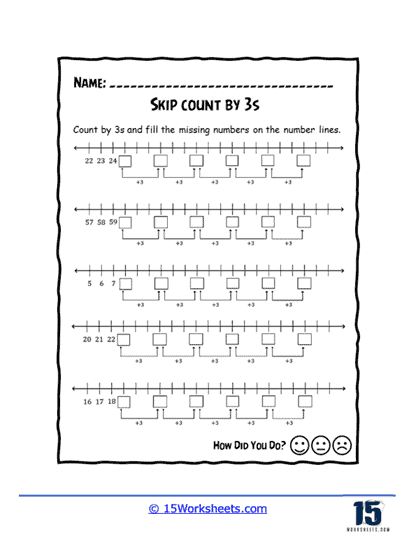
Uses a number line to show skip counting by 3s. Students move from point to point on the line, likely marking 3, 6, 9, etc. Helps children understand addition intervals and spatial progression of numbers. Builds strong number sense of where numbers sit relative to each other. Also helps with understanding linear patterns and sequence continuity.
Skip Count 3s Review
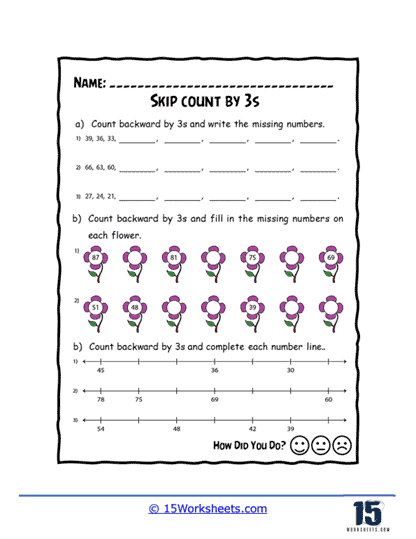
This is more of a mixed or cumulative review worksheet. Probably includes various formats: fill in missing, maybe skip counting forward, maybe backward, etc., all focusing on 3s. Purpose is to reinforce learning after earlier practice. Key for retention and ensuring students really “get it”. Helps connect different ways skip counting by 3s might show up.
On the Line
Likely a variation of number line activity: counting by 3s along a line, maybe with missing numbers or jumps. Helps with spatial and sequential thinking. Strengthens understanding of number intervals and pattern consistency. Also helps students see how skip counting “moves” forward on a number line.
Below Lines
Could be a format where students see sequences above a line or figure and must write/count numbers below. Or fill missing numbers “below” given markers. Emphasis on completing patterns visually aligned. Helps with reading sequences and ensuring correct sequencing. Helps with alignment, order, pattern consistency.
Content Hearts
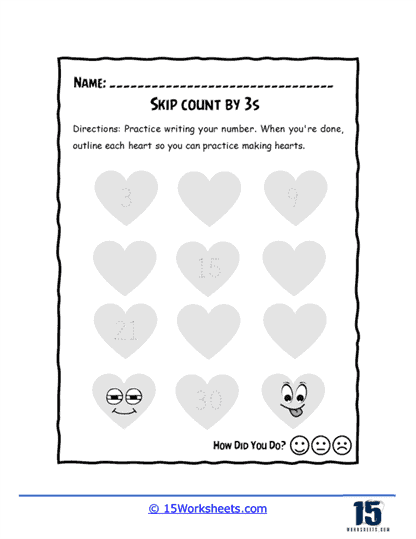
Probably heart shapes with numbers inside or hearts arranged in patterns to help count by 3s. Decorative/visually engaging. Helps with skip counting in more creative, aesthetically pleasing tasks. Supports pattern recognition, counting fluency, maintaining sequence.
Skipping the Stars
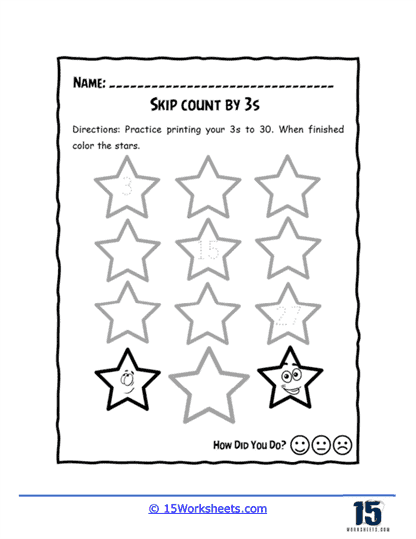
Uses stars or star shapes in patterns to help students skip count by 3s. For example, stars grouped or shown in lines, with missing numbers to fill. Helps with counting, pattern detection, sequencing. Also fun and motivating for students.
Tracing Paws
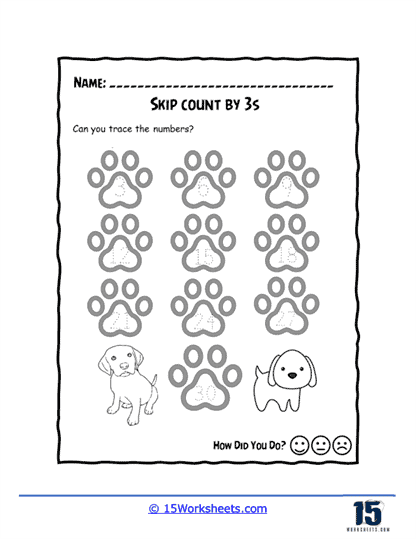
Likely has paw-prints or animals with paws, perhaps kids trace the sequence, or trace numbers in a skip count by 3s pattern. Good for fine motor skills and reinforcing number order. The tracing adds a kinesthetic element (writing as well as seeing). Helps children internalize the shapes of numbers and the skip count pattern together.
Ducking Along
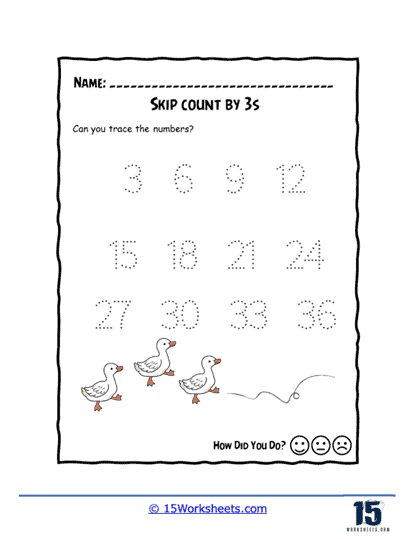
Probably themed around ducks or waterfowl marching or moving along counting by 3s. Could be a path or sequence with duck shapes. Helps in making the practice light-hearted. Reinforces counting in steps of 3, pattern recognition, and order.
Why Skip Counting by 3s Matters
Skip counting by 3s is simply counting forward by taking steps of three each time: 3, 6, 9, 12, 15, and so on. It feels like hopping along a number line with bigger leaps instead of moving one space at a time, which makes it both efficient and fun. Kids love the sense of speed and pattern that comes with it, almost like they’ve discovered a math shortcut.
But the real value is that this exercise builds deep number sense. Every time students practice counting by 3s, they’re strengthening their understanding of multiplication, division, and even fractions-without formally tackling those topics yet. It trains the brain to see patterns in numbers, makes solving larger problems less intimidating, and even helps with everyday situations like splitting snacks evenly or noticing time intervals. Instead of rote memorization, kids develop a rhythm that becomes second nature, which makes future math skills feel more natural and less overwhelming.
That’s why these worksheets are so helpful: they turn practice into playful, themed challenges that kids actually want to complete. By working through elephants, snowmen, treasure hunts, and number lines, students aren’t just learning to count by 3s-they’re building confidence, fluency, and the kind of flexible math thinking that lasts. The repetition, variety, and fun themes ensure that the skill sticks, setting them up for smoother success in multiplication and beyond.