
Skip Counting By 10s Worksheets
About These 15 Worksheets
These worksheets help students practice counting by tens-a skill that builds number sense and understanding of number patterns. Many of the worksheets use fun visuals and themes (rockets, puppies, stars, orchards, etc.) to keep students engaged while filling in missing numbers, following sequences, or matching patterns. They often combine numerical practice with creative design, making skip counting feel more like a game or story.
The variety in these worksheets means students aren’t doing the same kind of problem over and over; some worksheets focus on filling gaps in number lines, others might involve matching sequences, connect-the-dots, or following paths. This gives learners a chance to apply skip counting in different ways, reinforcing their mastery and helping avoid boredom. Also the themed contexts make it feel more real and fun.
Beyond just learning to say “10, 20, 30…,” skip counting by tens primes students for other math concepts, like place value, addition, multiplication, and understanding the number line. When children can jump by tens confidently, they have tools for faster mental math and easier understanding of how numbers grow. It builds a foundation for many later math skills.
Have a Look Inside Each Worksheet
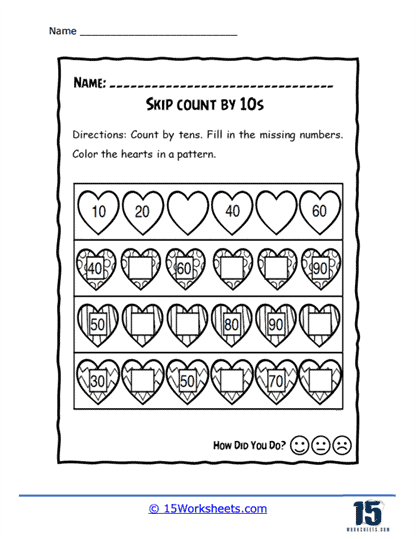
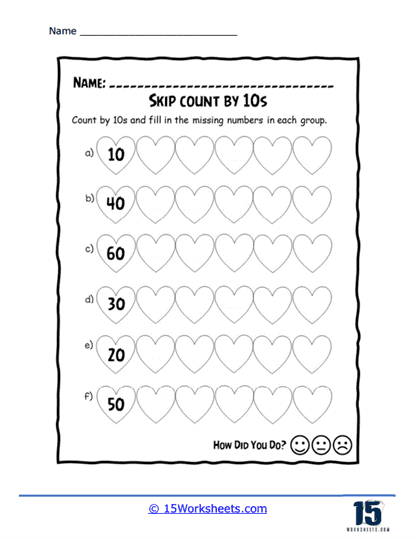
Heart of the Matter
This worksheet has students skip count by tens while filling in missing numbers in sequences. It promotes recognizing numerical patterns and strengthens confidence with larger leaps in counting. Also encourages attention to detail.
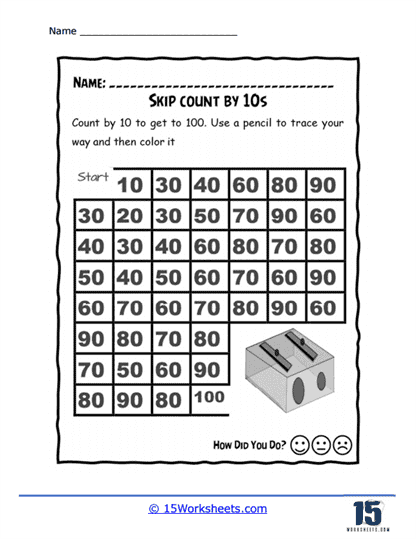
Get to the Sharpener
In this activity, students follow a path or a series of steps that involves skip counting by 10s (maybe like a maze or journey). It helps with visual tracking as well as number sequence skills. Makes skip counting feel like an adventure rather than just numbers.
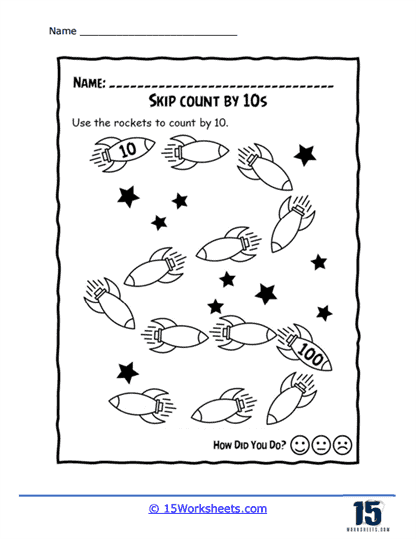
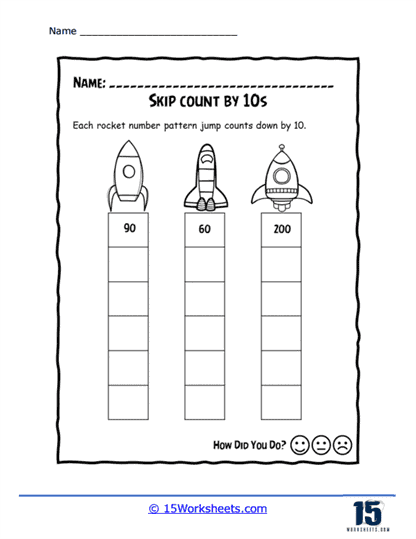
Rocket Counts
Features a rocket or space theme to motivate students while they count by tens. The theme adds fun, turning the counting task into something imaginative. Reinforces the jump-by-10 pattern in a dynamic setting.
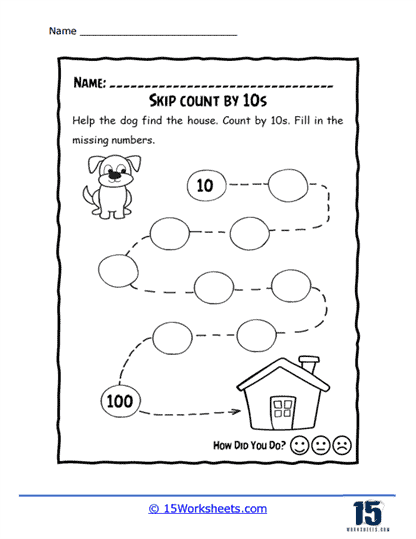
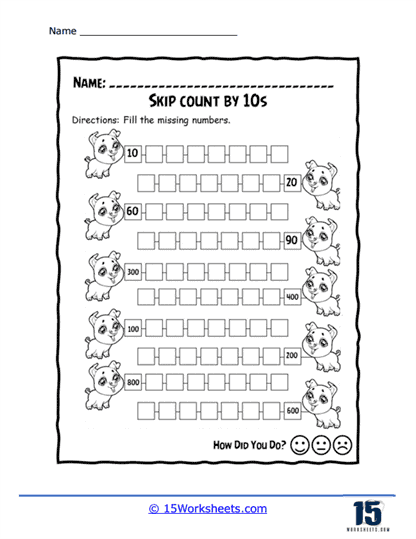
Doggie Go Home
Probably involves a dog or puppy-themed path or worksheets with objects/steps for “doggie to go home” all using counts of 10. Helps students practice skip counting by 10s in context. Also fosters engagement through friendly imagery.
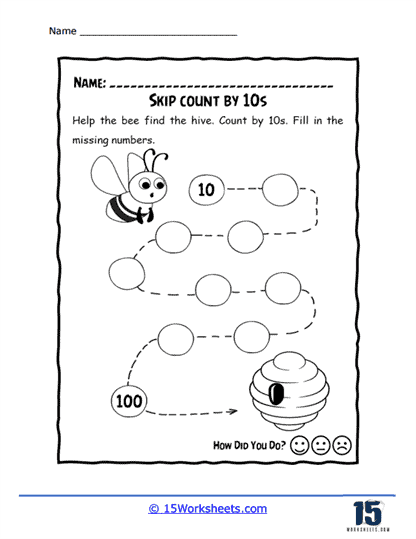
Find the Hive
Likely bee/hive themed, counting by tens to locate or fill a hive. Visual-based learning with patterns. Encourages precision in recognizing sequences.
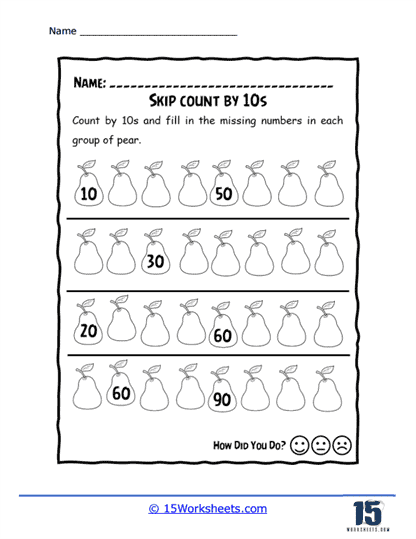
Pear Problems
Works counting by 10s with pears or fruit involved. Maybe includes word problems or fill-in gaps. Helps mixing skip counting with problem solving.
Heart Throb
Probably uses heart imagery, maybe patterns or sequences tied to hearts and skip counting. Offers visual appeal to keep interest high. Reinforces regular increments of 10 in colorful, thematic way.
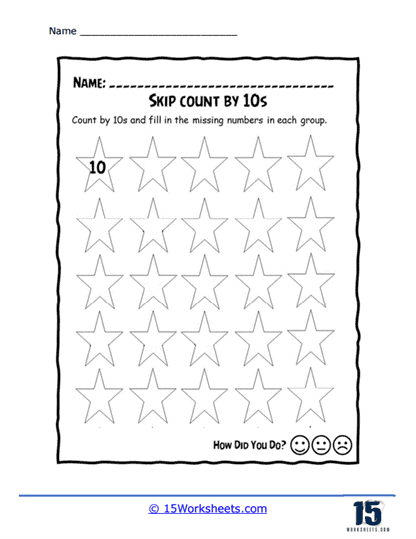
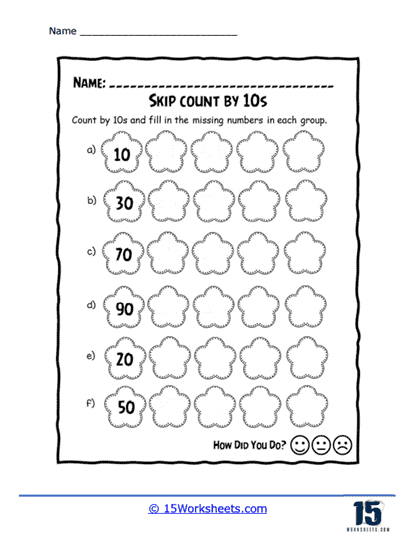
Skipping Stars
Stars are involved; students skip count by 10s across stars, maybe counting stars, filling in missing stars, etc. Encourages counting forward in tens with visual pattern recognition.
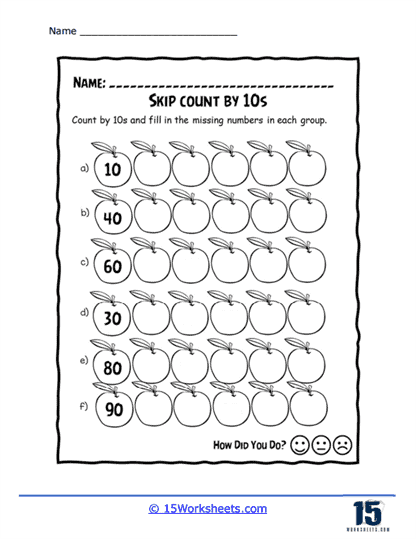
To the Orchard
An orchard or fruit scenario, possibly picking fruit in quantities of ten. Good for blending skip counting with real-world or nature themes. Helps students see counting in groups.
Cookie Filling
Could involve cookies in sets of ten, counting how many cookies, maybe filling trays in tens. Helps making concrete the abstract idea of skip counting. Enhances counting + possibly simple operations.
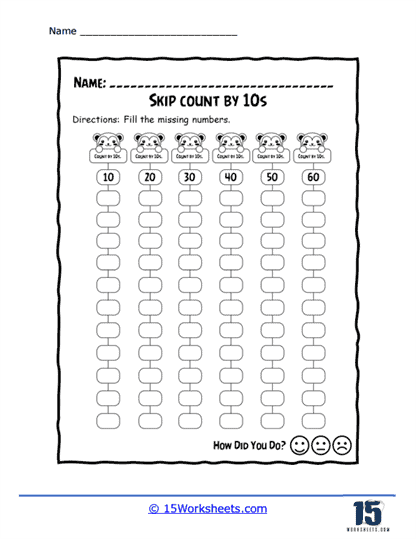
Bear 10 Skips
Probably uses bears or teddy-bear figures illustrating counts of ten. Might have ten-step jumps illustrated. Great for visualizing jumps in the number line by tens.
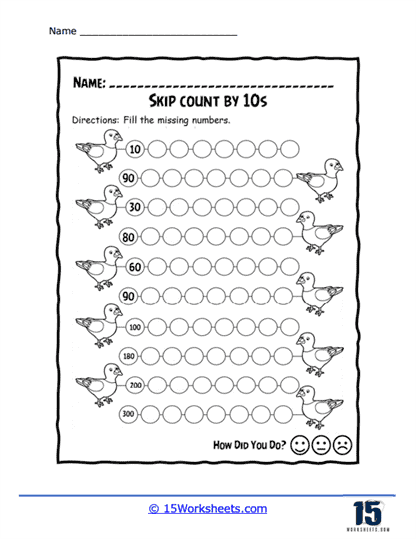
10 Quacks
A playful title, likely ducks/quacks; counting by 10s up to or around 100. Helps reinforce skip count in a whimsical context.
Puppy Passes
Maybe involves puppies passing a finish line or going through obstacles, all tied to counting by tens. Adds movement or narrative to counting tasks. Makes the process more lively.
Blast Off Skips
Space or rocket blast off theme; skip counting by tens to launch or countdown. Encourages forward counting and possibly backwards if included. Adds drama.
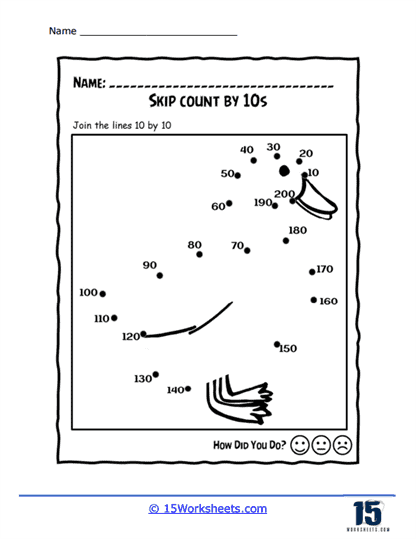
Join The Dots Duck
A join-the-dots activity where dots are numbered by tens, and connecting them reveals a duck. Reinforces skip counting plus motor skills. Also fun reward at the end (picture emerges).
How to Practice Skip Counting By 10s
Skip counting by 10s is more than just a basic mathematical skill; it’s a building block that helps students develop a strong sense of numbers, enhances mental math capabilities, and lays a solid foundation for multiplication and division. Mastering this skill is crucial for success in higher levels of math and can make everyday tasks like counting money or measuring time much easier. Here, we explore several strategies and activities to help learners of all ages practice skip counting by 10s effectively. With engaging techniques and hands-on approaches, anyone can master this essential skill.
Recognizing the Pattern
Before diving into activities, it’s important to first understand the basic pattern that defines skip counting by 10s. When we skip count by 10s, the last digit of each number remains constant at zero, while the first digit steadily increases by one. For example, the sequence 10, 20, 30, 40, and so on, follows a predictable and simple pattern that makes it easy to anticipate the next number in the series. Grasping this consistency is the first step in mastering the skill.
Encourage learners to visualize the number pattern and to observe how each step brings them 10 units farther from the previous number. A clear understanding of this pattern will serve as a mental roadmap for further practice. It’s also helpful to explain that this is not just an abstract exercise; the ability to skip count by 10s directly translates into real-world skills like counting money or keeping track of time.
Using a Number Chart or Number Line
To bring the pattern to life, a number chart or number line is a fantastic tool. Whether printed or digital, these visual aids help learners see the progression of numbers clearly. With a number chart, students can point to or highlight multiples of 10 as they count, creating a visual connection between the numbers and their positions in the overall number sequence. This method is particularly effective for visual learners who benefit from seeing the numbers laid out in front of them.
A number line offers another way to practice, where students can physically jump from one multiple of 10 to the next, reinforcing the idea that skip counting is about moving forward in equal steps. Whether by pointing, marking, or jumping, these tools help reinforce the structure of counting by 10s and make it more intuitive over time.
Counting Objects in Groups of 10
A hands-on approach to skip counting can make the abstract more concrete. Gather everyday objects like coins, blocks, or buttons and arrange them into groups of 10. As students count the total number of objects by skipping through the multiples, they get a tactile understanding of what it means to skip count. For instance, if they have 50 buttons, they can count in multiples of 10 (10, 20, 30, 40, 50) and visually see how grouping objects helps streamline the process.
This method also gives learners a sense of how numbers can represent real quantities, making math feel more relevant and connected to their environment. The act of physically handling objects reinforces the concept of groups, helping to cement skip counting in the brain through repeated, active engagement.
Songs, Rhymes, and Rhythm
Music and rhythm are powerful learning tools, especially for younger students or those who thrive with auditory input. Skip counting by 10s can be made fun and memorable by incorporating catchy songs or rhymes. Songs that involve skip counting by 10s, whether from educational programs or homemade, offer a rhythmic and enjoyable way to reinforce the concept. Learners can sing along, adding an element of fun to what might otherwise feel like rote memorization.
These songs can become useful tools for memorization, as the repetitive nature of music makes it easier to retain information. With time, students may find themselves automatically singing the song in their heads when asked to count by 10s, transforming a mental exercise into a playful experience.
Adding Movement to Learning
Learning doesn’t have to be a sit-down activity. For active learners or kinesthetic students, incorporating physical movements like jumping, clapping, or hopping while counting by 10s adds an extra layer of engagement. Hopscotch is a great example: by writing multiples of 10 in each square, students can hop from one to the next while counting aloud.
This combination of movement and counting has been shown to reinforce learning, as it connects the physical action with the mental task. Whether it’s through a fun game of hopscotch or just jumping in place while counting, the integration of physical activity helps energize learners and makes the practice feel less like a chore and more like play.
Turning Learning into a Game
Board games, card games, and even online games can provide an engaging platform for practicing skip counting by 10s. Many educational games are specifically designed to focus on skip counting, offering interactive challenges where players must count by 10s to move forward or achieve a goal. This adds a layer of competition and reward to the learning process, making it more dynamic and motivating.
For a simple, homemade option, you can create flashcards with multiples of 10 and have students race to put them in order, or play a matching game where they pair numbers with corresponding pictures of objects grouped by 10s. Turning the practice into a game ensures that students remain engaged, and they may not even realize how much they’re learning in the process.
Manipulatives
Base-ten blocks and counting rods are invaluable tools when teaching skip counting by 10s. These manipulatives help students visualize the concept of grouping numbers and see how multiples of 10 add up. By physically stacking the blocks or lining up the rods, students can grasp the progression of numbers as they skip count. This tangible method brings abstract numbers into the real world, allowing students to manipulate and explore them in a way that deepens their understanding.
Using manipulatives allows students to experiment with different ways of counting, which can help develop a deeper number sense and reinforce the idea that numbers are made up of parts. This hands-on method is especially useful for younger learners who may struggle with abstract concepts.
Developing Mental Math Skills
Once students are comfortable using charts, objects, and manipulatives, it’s time to take the next step: mental math. Skip counting by 10s without the aid of visual tools helps develop stronger mental math skills, boosting confidence and speed in problem-solving. Encourage students to practice counting by 10s in their heads while doing other tasks, or challenge them to see how high they can count by 10s without making a mistake.
Mastering this mental skill will not only make skip counting second nature but will also build a foundation for more advanced math, such as multiplication and division. Over time, students will find themselves relying less on external aids and more on their own mental calculations, which is an empowering step in mathematical learning.
Real-World Applications
One of the most powerful ways to reinforce skip counting by 10s is to show its real-world relevance. Skip counting isn’t just a classroom exercise; it’s a useful skill in everyday life. For example, counting money-especially coins like dimes-relies on skip counting by 10s. Similarly, when calculating elapsed time in 10-minute intervals or measuring distances in units of 10, the skill comes into play.
By highlighting these real-world applications, students see the purpose behind the practice and are more likely to stay motivated. When math connects to real life, it transforms from abstract theory into a valuable, practical tool.
Setting Goals and Tracking Progress
As with any learning endeavor, setting clear goals and tracking progress is key to sustained improvement. Whether it’s counting by 10s up to 100 within a certain timeframe or reaching higher multiples without error, personal goals give students something concrete to work toward. Keeping a record of progress-perhaps through a chart or checklist-helps students see how far they’ve come and motivates them to keep improving.
Celebrate small victories along the way, whether that’s completing a skip counting game or mastering a new mental math technique. This keeps the process rewarding and builds confidence, which is essential for long-term success in math.