
Place Value of Decimals Worksheets
About These 15 Worksheets
Decimals can sometimes feel like tiny tricksters-those little numbers to the right of the decimal point can cause big confusion. This collection, along with place value basics worksheets, helps students clearly see what each digit stands for. From tenths and hundredths to millionths, kids learn that every place has its own value and purpose. These activities use riddles, charts, and hands-on tasks to make learning both clear and engaging.
What makes this collection extra helpful is the variety of approaches. Some worksheets focus on pure number skills, like expanded form or identifying underlined digits, while others connect decimals to money and real-world use. That mix of abstract and concrete examples helps students understand decimals in a deeper way. Plus, hands-on activities like cut-and-paste keep the practice from feeling too routine.
The more comfortable students get with decimal place value, the stronger their foundation for future math topics like percentages, ratios, and algebra. These worksheets ensure that students don’t just memorize-but actually understand-why 0.5 is different from 0.05. By the end of the set, learners will feel confident reading, writing, and using decimals in everyday and academic situations.
Have a Look Inside Each Worksheet
What’s the Value
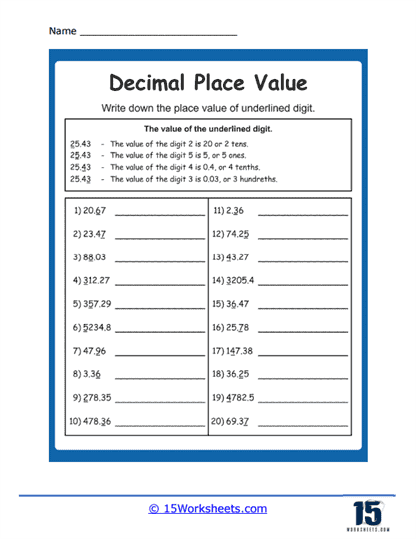
Students identify the exact value of a highlighted digit in a decimal number. This strengthens understanding of tenths, hundredths, thousandths, and beyond. The activity makes place value concrete by tying digits to their real numerical meaning. A great way to build precision with decimals.
Underlined Value
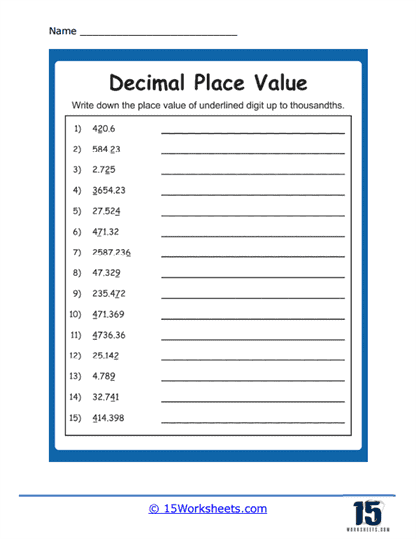
Here, learners determine the place of an underlined digit in a decimal. It reinforces the role of each position relative to the decimal point. The worksheet encourages accuracy in recognizing tenths, hundredths, and smaller places. Perfect for sharpening place value awareness.
To the Millionths
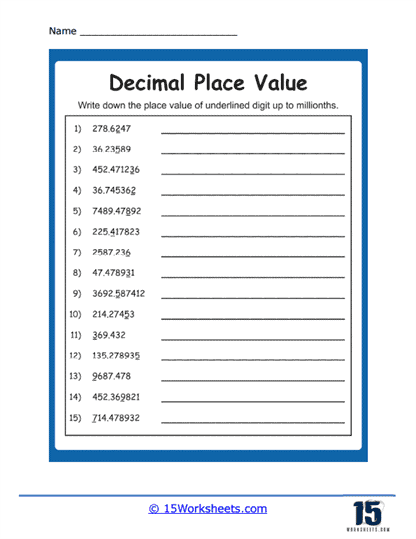
This worksheet stretches students into very fine decimal places, like thousandths and millionths. It’s a deep dive into advanced place value recognition. Learners get comfortable working with numbers beyond everyday decimals. A solid tool for preparing for higher-level math.
Naming Places
Students practice labeling digits with the correct place names-tenths, hundredths, thousandths, etc. This builds vocabulary alongside numeric understanding. It ensures students can talk about decimals as well as solve with them. Great for bridging math concepts and language.
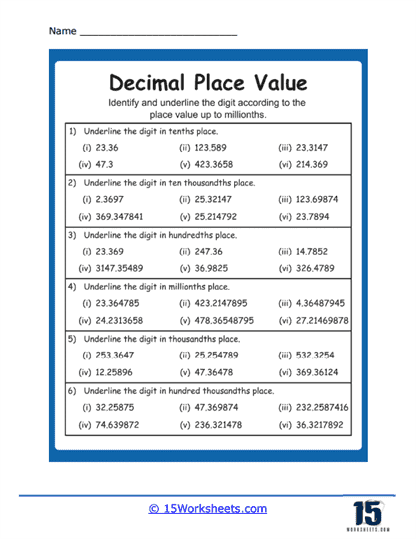
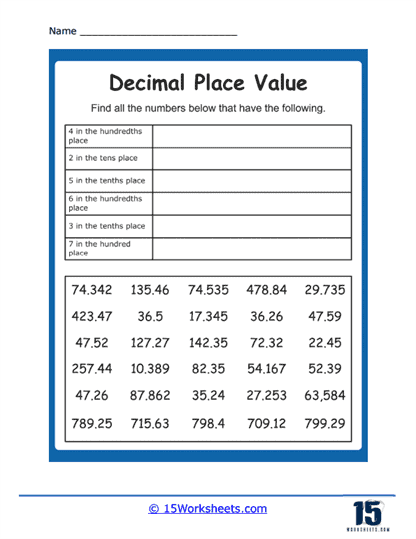
Underline the Place
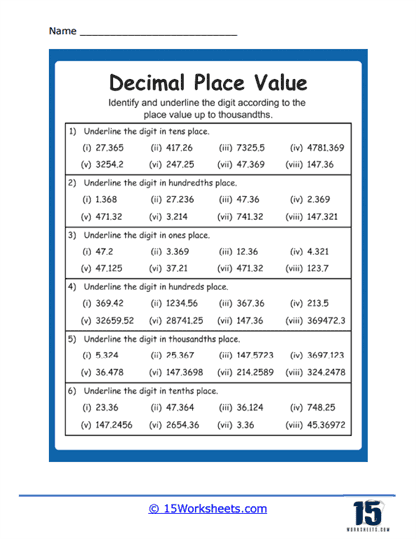
This activity asks learners to underline the digit in a specified decimal place. It flips the usual format, requiring students to locate the right digit themselves. It encourages careful reading and attention to detail. A fun twist that keeps students engaged.
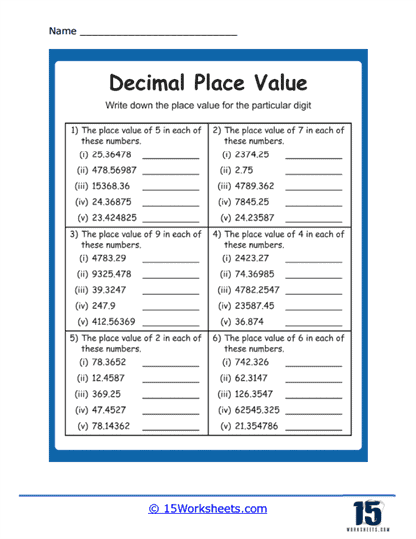
Particular Digits
Students zoom in on specific digits and identify their value or place. This reinforces precision and close observation of decimal numbers. The exercise helps learners avoid “glossing over” small details. Great for strengthening accuracy with decimals.
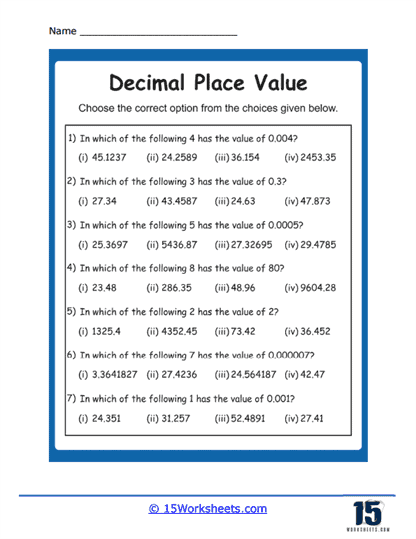
Multiple Choice
Here, decimals are presented with options to choose the correct value or place. This format tests recognition and decision-making skills quickly. It helps build confidence in distinguishing close but different decimal values. Ideal for practice in a quiz-like style.
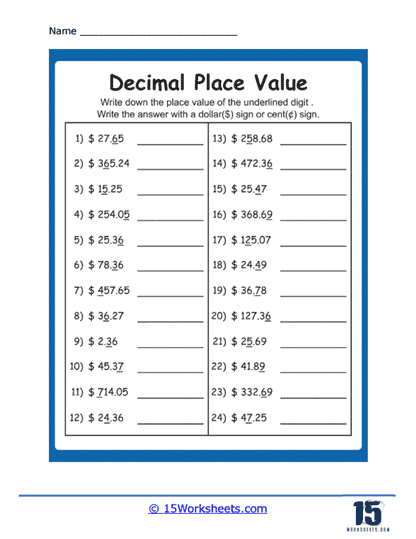
Dollars and Cents
Decimals connect directly to money in this worksheet. Students match decimal values to amounts in dollars and cents. It bridges abstract decimal concepts with real-world applications. Perfect for practical learning and financial literacy.
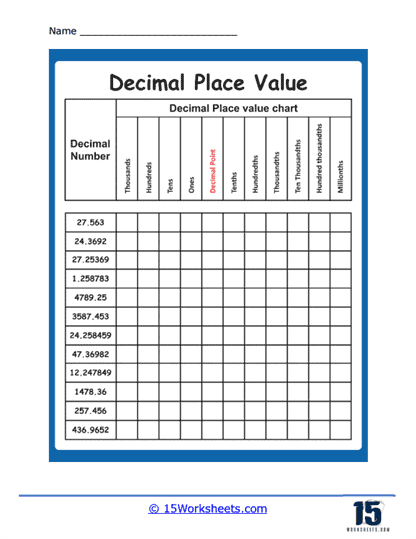
Chart Setups
Students fill in place value charts with decimal numbers. The visual layout helps them see how each digit fits into its correct place. It reinforces the structure of decimals in a clear way. Very effective for visual learners.
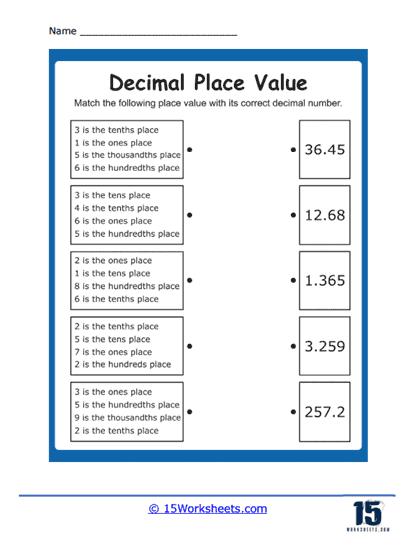
Find the Names
This activity asks learners to write or match place names to the digits in a decimal number. It blends naming practice with number recognition. The exercise strengthens both vocabulary and numeric accuracy. A helpful step for mastering place value language.
Place Value Riddle
Students solve riddles by identifying digits and their places in decimals. This makes practice playful and interactive. It encourages logical thinking while reinforcing skills. A fun way to keep learners motivated.
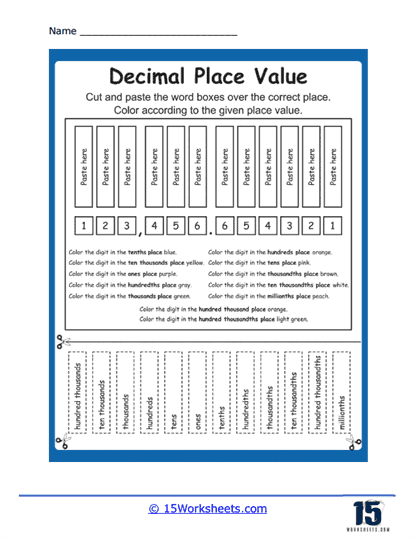
Cut and Paste
This worksheet involves cutting out place names and matching them to digits. It’s a hands-on way to interact with decimal place value. Perfect for kinesthetic learners who benefit from movement. Adds variety to math practice.
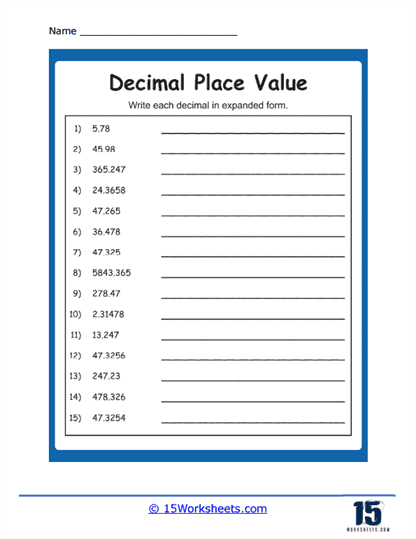
Expand It
Here, students rewrite decimals in expanded form (like 0.56 = 5 tenths + 6 hundredths). It shows exactly how each digit contributes to the whole number. This builds a deep conceptual understanding of decimals. A strong bridge toward algebraic thinking.
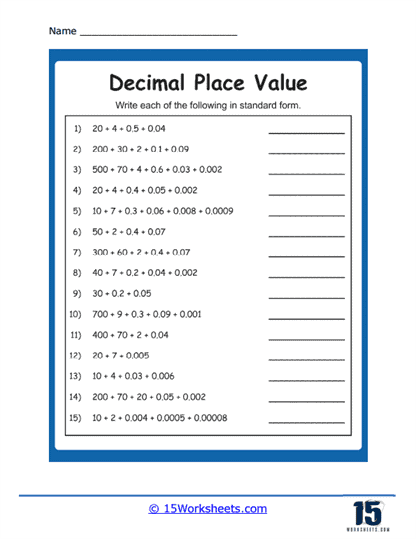
Places to Standard Forms
Students convert between place names and standard decimal notation. It strengthens flexibility in thinking about numbers in multiple formats. This builds strong foundational skills for more advanced math. Helpful for making connections between concepts.
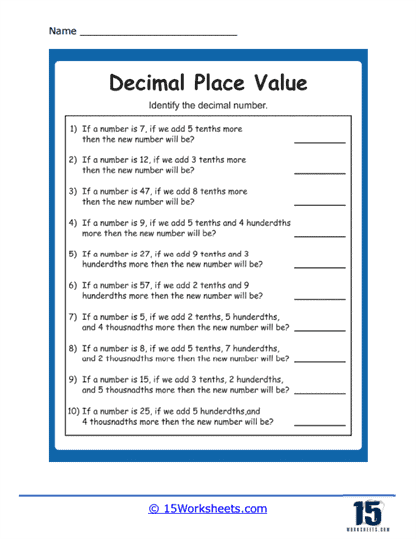
Math Sentences
Decimals are placed into complete math sentences for students to interpret or solve. It blends place value recognition with computation. The activity pushes students to apply their understanding in context. A strong way to combine skills into real problem solving.
What Is Place Value of Decimals?
Place value of decimals is a way to understand what each digit means when it sits to the right of the decimal point. Just like the number 345 has a “3” in the hundreds place and a “4” in the tens place, decimals work with tenths, hundredths, thousandths, and so on. For example, in the number 0.56, the “5” is worth five tenths, and the “6” is worth six hundredths. Each digit gets its own “job” based on where it stands.
This concept matters because decimals pop up all around us-in money, measurements, and even sports scores. If you know that $3.25 means 3 dollars and 25 hundredths of a dollar, you can connect decimals to real-life amounts. Place value makes sure we don’t mix up 0.2 and 0.02, which might look similar but mean very different things.
These worksheets give students plenty of practice to master this essential skill. By breaking decimals into place names, expanded forms, and real-world examples, kids can see both the “big picture” and the small details. Once they’re confident with place value, decimals stop feeling confusing and start becoming tools they can use with ease.