
Tracing Shapes Worksheets
About These 15 Worksheets
Tracing Shapes Worksheets are designed to help young learners build foundational shape recognition and drawing skills. By tracing a wide variety of shapes-basic geometric ones like squares or circles, plus more complex or unusual forms-students gradually build confidence with both straight lines and curves. The repeated tracing helps strengthen hand-eye coordination, fine motor skills, and control over pencils or crayons, all essential for writing and drawing.
These worksheets are arranged in increasing complexity: starting with simple shapes and progressing towards more angles or irregular forms. This gradual progression helps avoid overwhelming learners, allowing them to master simpler shapes before moving to more complicated ones. The inclusion of familiar shapes (like hearts, stars), plus novel ones, keeps interest high and supports recognition across different visual forms.
Tracing shapes doesn’t just help with drawing-it supports geometry readiness, spatial awareness, and geometric vocabulary (sides, angles, curves). It also helps children develop steadiness, precision, and visual discrimination. When kids are comfortable with shapes, later tasks like copying letters, drawing diagrams, or understanding shape properties in math become much easier.
Have a Look Inside Each Worksheet
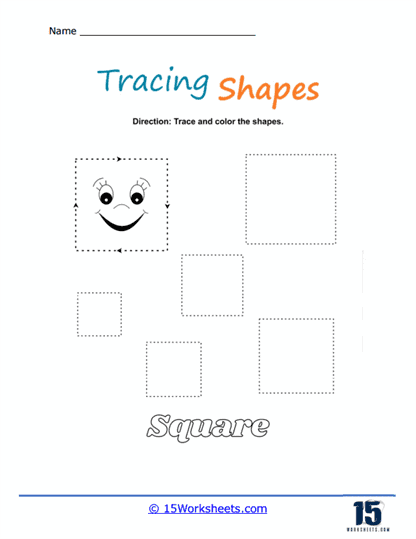
Squares
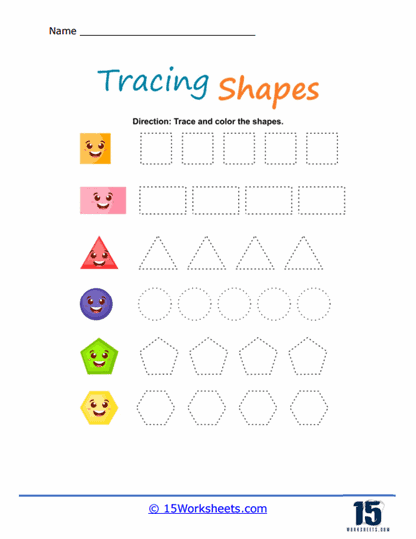
Children trace outlines of squares (likely dotted or dashed lines). This helps with recognizing the square shape and practicing straight edge tracing. It also builds fine motor control and confidence in drawing shapes. Students become more familiar with sides and corners of shapes.
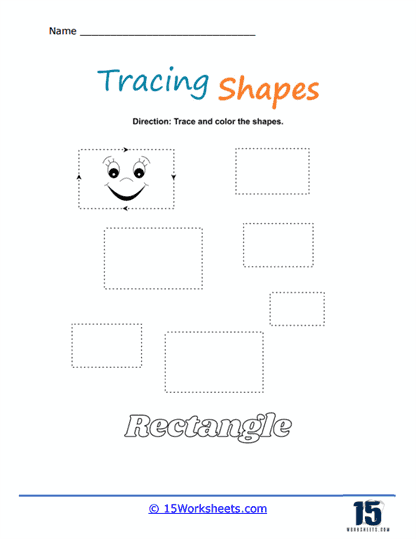
Rectangles
Learners trace the outlines of rectangles. They practice distinguishing length vs width (longer vs shorter sides). It reinforces understanding of properties of rectangles. The worksheets support precision with straight lines.
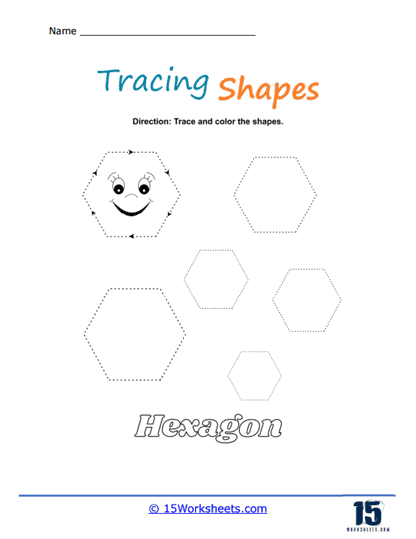
Trace Hexagon
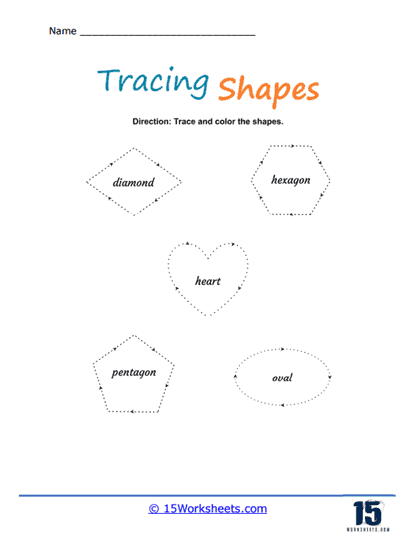
Students trace a hexagon’s outline, which has six sides. Tracing this more complex polygon helps with managing multiple angles. Encourages attention to symmetry and pattern in shape design. Useful stepping stone toward more detailed drawings.
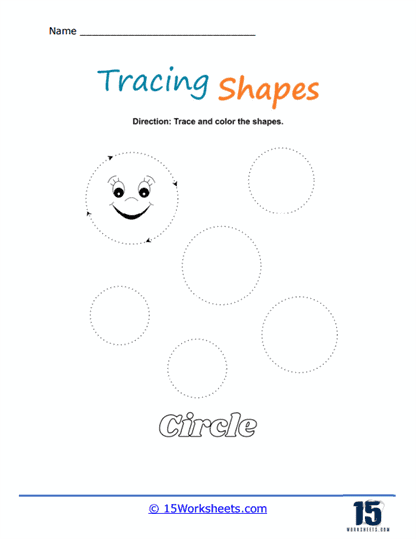
Circles
Children trace circular shapes. Circles require smooth, continuous motion and help refine curved stroke control. Students build wrist strength and learn to keep consistent curves. These shapes often feel fun and flowing.
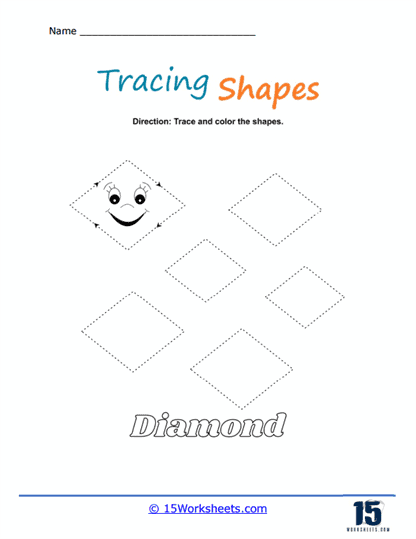
Diamonds
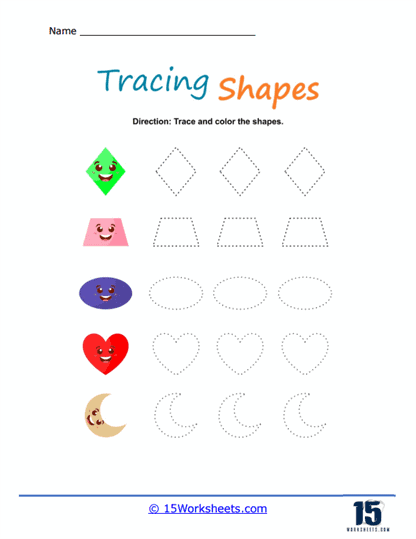
Learners trace diamond shapes (a rhombus — slanted square). They practice tracing slanted edges and understanding pivot angles. Helps with diagonal control. Shape awareness gets deeper with angled lines.
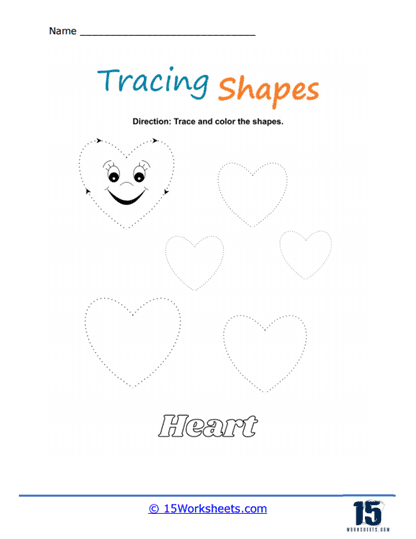
Hearts
Kids trace heart outlines. This combines curved and pointed edges, making it slightly more advanced. Good for both fine motor control (curves) and attention to detail at points. Also engaging because of the familiar, “fun” shape.
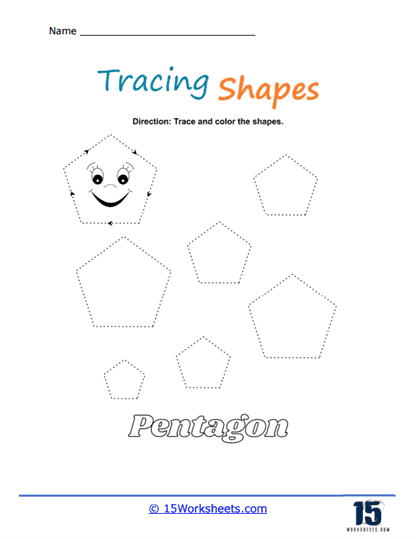
Pentagons
This asks students to trace pentagons (five-sided shapes). It becomes more complex with more sides. Helps with managing various angles in drawing. Reinforces polygon vocabulary and shape counting.
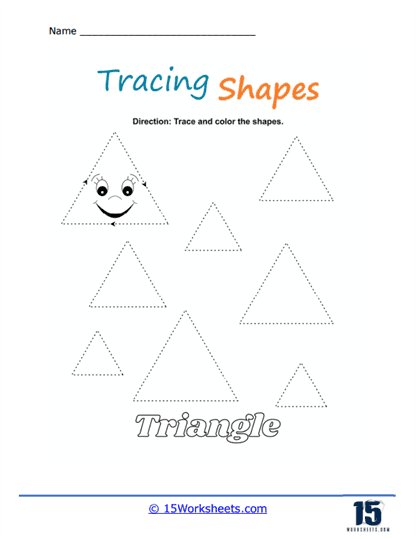
My Tris
Likely a worksheet with a mix (“tris” suggests maybe triangles or trio shapes) for tracing: possibly triangles or sets of three shapes. Students trace a series of shapes, perhaps combining different kinds. Helps with variety, recognizing shapes, and repeating patterns.
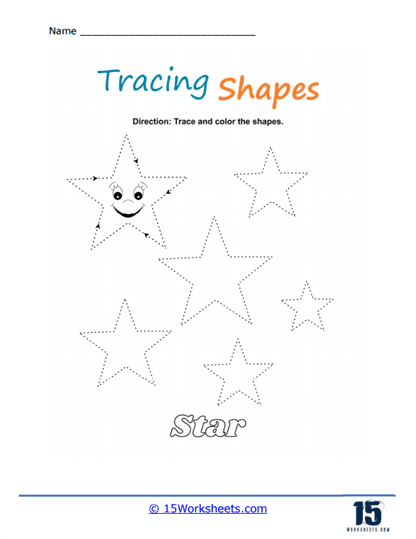
Trace Stars
Children trace star shapes. Stars have many points and intersecting angles, which is more challenging. This helps refine precision, patience, and motor skills. Also fun and visually appealing.
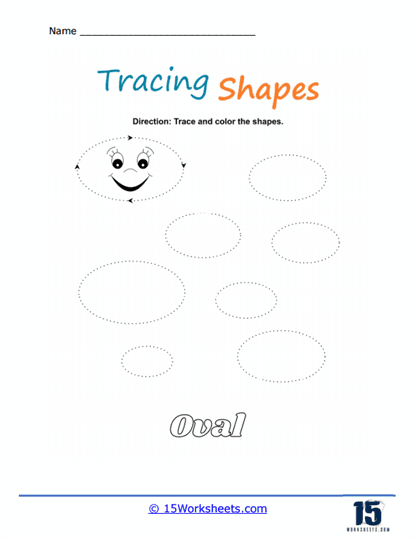
Ovals Everywhere
Learners trace multiple oval shapes in different orientations. Ovals are stretched circles, so control of curve-variance matters. Students practice curves in varying widths and heights. Boosts ability to manage elongation in shapes.
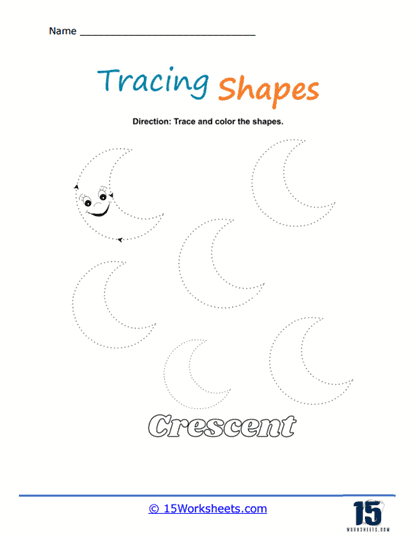
Crescent Shapes
This worksheet involves tracing crescent forms (partial curves). Good for tracing concave curves (inward curves) and flowing lines. Builds comfort with non-complete circles. Encourages attention to curve transitions.
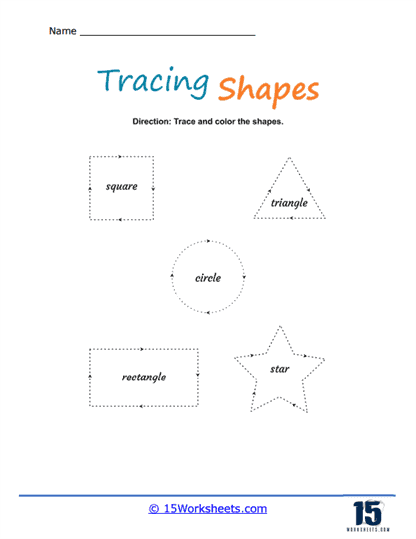
The Basic Shapes
Students trace a variety of basic shapes: probably squares, circles, triangles, rectangles. Helps with recognition across shape types. Reinforces naming shapes and form differences. Also supports variety so skills generalize.
Nontraditional Shapes
This goes beyond basic geometric shapes. Students trace perhaps more unusual or abstract shapes. Challenges spatial recognition and adaptability. Encourages flexibility in tracing and visual perception. Keeps interest high with novel shapes.
Start and Follow
Learners probably trace directional paths: starting at one point, following a given route along shapes. Helps with following directions, sequence, and consistent tracing. Encourages planning hand movement. Strengthens hand-eye coordination and spatial tracking.
Unique Shape Tracing
This worksheet likely introduces one-of-a-kind, possibly complex or combined shapes. Students trace shapes they haven’t seen before. That pushes observation, patience, and adaptability. Builds confidence in tackling unfamiliar shape outlines.
Why Tracing Shapes Is a Superpower
Tracing shapes might look simple, but it’s actually training young learners’ hands and brains at the same time. Every time a child follows the lines of a square, circle, or star, they’re practicing control, patience, and precision. These are the same skills they’ll need later for writing letters, solving math problems, and even doing art projects. In other words, tracing turns wiggly little lines into steady strokes and confident learners.
Tracing shapes also builds fine motor strength in the fingers and wrists. That’s the muscle power kids rely on when they hold pencils, cut with scissors, or color inside the lines. By practicing straight lines, curves, and angles, children are secretly training for all the movements that make handwriting easier. Think of it as “gym class for the hands.”
Tracing helps with visual and spatial awareness. Kids begin to notice how shapes are balanced and how different parts connect to form a whole. As they practice, they start to understand symmetry and see patterns more clearly. This builds attention to detail and gives them a strong start in geometry. Even though tracing feels like play, it helps develop important skills for reading, math, and creativity later on.