
Mixed Word Family Review Worksheets


About These 15 Worksheets
Learning to read is a lot like building with blocks-you stack one sound on top of another until suddenly you’ve got a whole word standing tall! Our Mixed Word Family Review worksheets are designed to give kids a chance to play with lots of different families at once. Instead of focusing on just one ending, these sheets mix things up so learners can practice spotting patterns across many families. It keeps things fresh, fun, and a little surprising, which is perfect for keeping attention strong.
These worksheets give students plenty of chances to build strong reading skills. They’ll match sounds, finish words, sort endings, and even create simple sentences with rhyming words. By using fun word matching activities, kids can move between families like -at, -op, and -en while learning how word parts fit together. As they practice, they begin to see patterns more clearly, and their confidence grows as reading starts to feel like a game.
And here’s the best part: these worksheets aren’t just for the classroom. Parents can print them for home practice, teachers can use them in literacy centers, and kids can even try them out independently once they get the hang of it. Whether they’re coloring, cutting, brainstorming, or building, students are soaking up the patterns that make reading and spelling easier. Word families show up everywhere-books, signs, conversations-so this review set helps kids get ready to recognize them wherever they pop up in real life!
About Each Worksheet
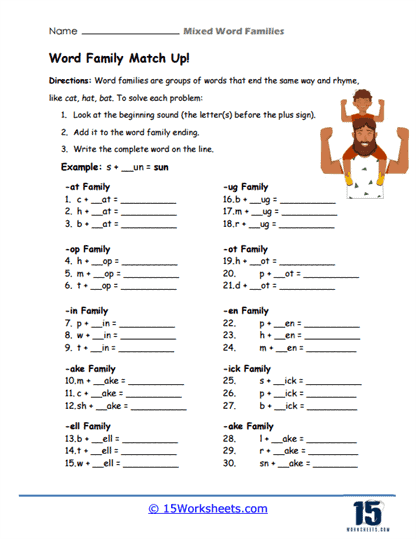
Family Builder
This worksheet is all about mixing and matching beginnings and endings to build real words. Kids take a starting sound, snap it onto a word family ending, and boom-they’ve got a brand-new word. Families like -at, -op, -in, and -ake pop up to give plenty of practice. It’s like playing with phonics puzzle pieces until the picture makes sense. Great for centers, small groups, or just a little at-home word-building fun.
Rhyme Finder
Get ready to play detective with rhyming words! In this worksheet, kids read short sentences and spot the word family words hiding inside. They’ll underline, circle, and giggle when they notice how many endings repeat across different words. It’s a sneaky way to practice comprehension while still focusing on phonics. Perfect for kids who like their reading practice wrapped up in a challenge.
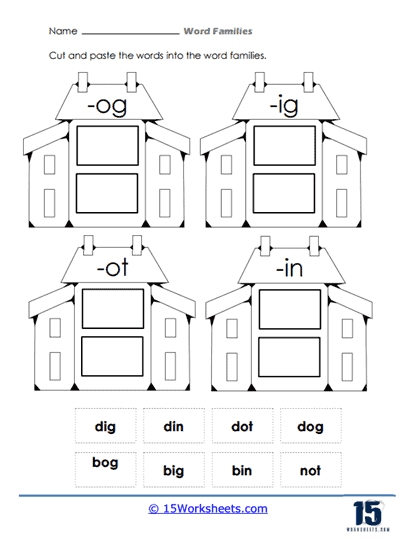
Find Homes for Words
Every word needs a home, and in this worksheet, kids sort words into houses based on their family ending. Each house belongs to a rhyming clan like -og, -ig, -ot, or -in. Students cut, paste, and match words like “dog,” “big,” and “not” to the right home. It’s hands-on learning with a little construction-zone flair. Sorting words has never felt so neighborly!
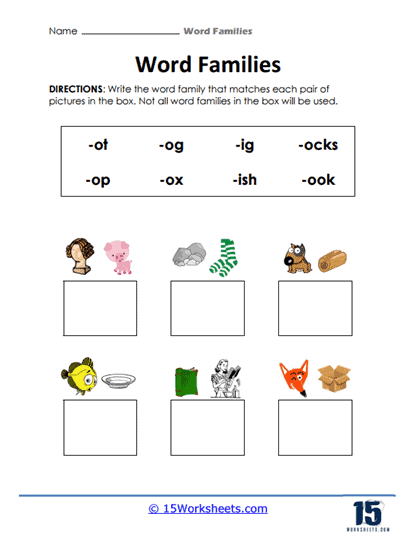
Image Clues
Pictures tell the story in this phonics puzzle. Students look at two images, listen for the rhyme, and figure out which word family they share. A mop and a top? Yep, that’s the -op family! With every match, kids strengthen their listening skills and connect visuals with sound patterns. This worksheet turns rhyming into a picture-perfect game.
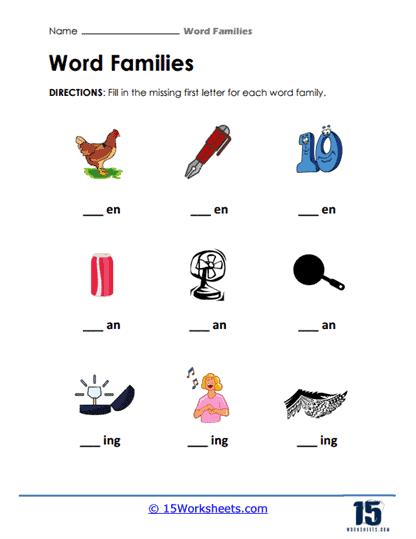
First Letters
This one puts the spotlight on beginnings. Students see a picture, like a hen or a fan, and fill in the missing first letter to complete the word. Each ending is already in place, so all they have to do is choose the right starter sound. It’s a simple but powerful way to connect initial sounds with familiar word families. By the end, kids will be chanting “I can build that word!”
Five for Each
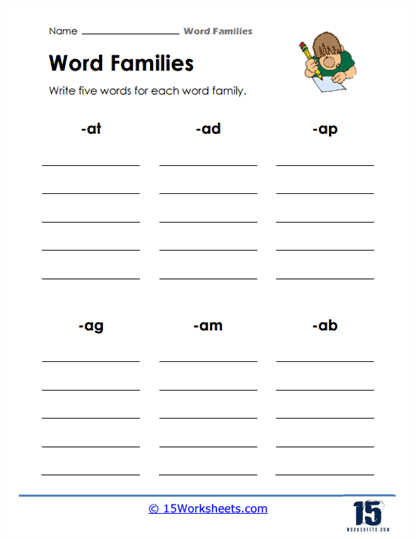
Think of this as a word family brainstorm party! Kids are challenged to come up with five words for each family ending listed. It’s a chance to be creative, try out silly ideas, and test spelling skills. With families like -at or -ab, the possibilities keep flowing. This one works great as a warm-up or quick practice sheet to stretch word knowledge.
Guess the Word
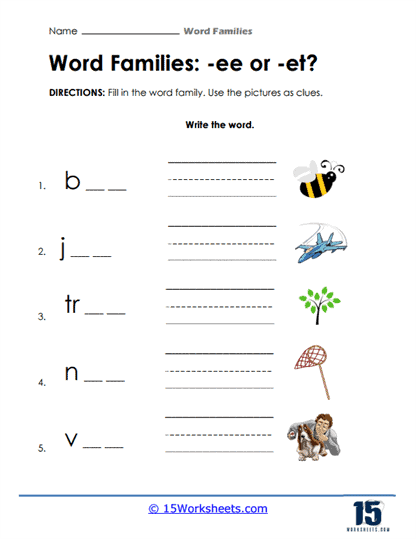
Can you tell the difference between -ee and -et? That’s the puzzle in this worksheet, where pictures give the clues. A buzzing bee or a dog with a net helps students decide which family fits. They’ll fill in the blanks, decode the picture, and solve the word mystery. It’s part riddle, part phonics drill, and all fun.
Neighborhood -Un or -Ug?
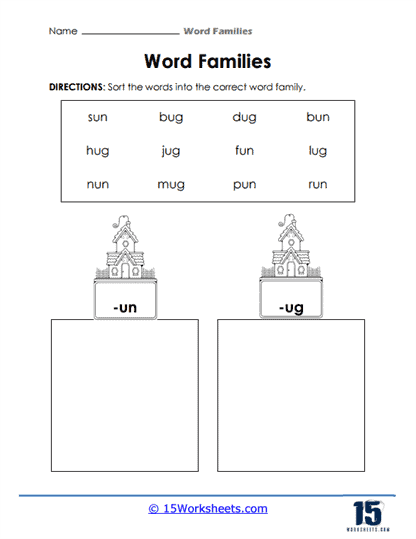
This worksheet is a showdown between the -un and -ug families. Students take a list of words and sort them into the right category, like moving into two different neighborhoods. It’s a great way to practice hearing the difference in similar sounds. The friendly layout makes the sorting clear and easy to follow. It feels like organizing a word party with two guest lists!
Coloring in Circles
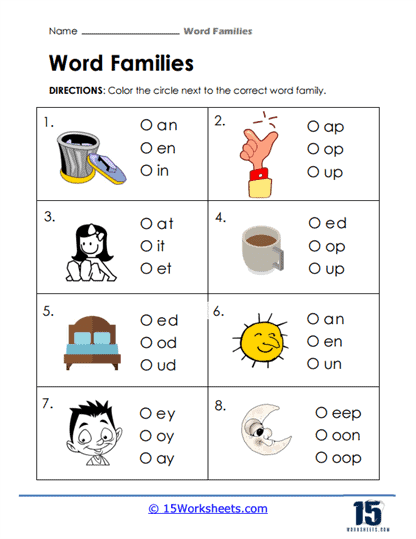
Bring on the crayons! Kids look at a picture, listen for the rhyme, and color the circle with the right word family ending. From cans to suns, every image points the way to a word pattern. The coloring twist keeps kids engaged while still targeting phonics. It’s a lively activity that doubles as both literacy practice and art time.
Ends in -Op
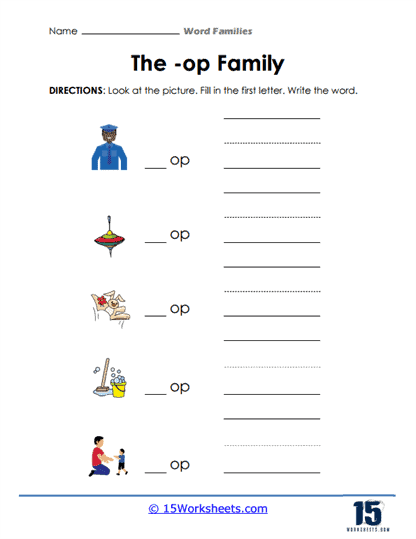
Here’s a chance to celebrate the -op family in style. Each image represents an -op word, and kids complete the word by adding the missing beginning sound. A cop, a top, and a mop all make an appearance. With every correct answer, students get a little more confident in recognizing this rhyming group. This worksheet is short, snappy, and just right for extra practice.
Add What’s Missing
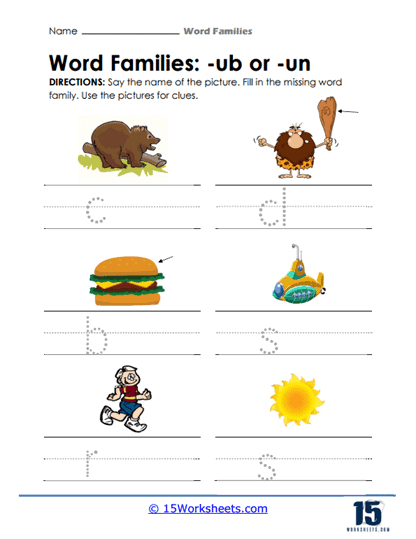
Pictures take the lead again as kids fill in the missing endings from the -ub and -un families. A sun, a tub, and a sub make sure learners practice both sound groups side by side. Students say the picture name, listen carefully, and write the missing part. The combo of speaking, listening, and writing builds a strong word connection. It’s simple, effective, and surprisingly fun.
Wordify and Categorize
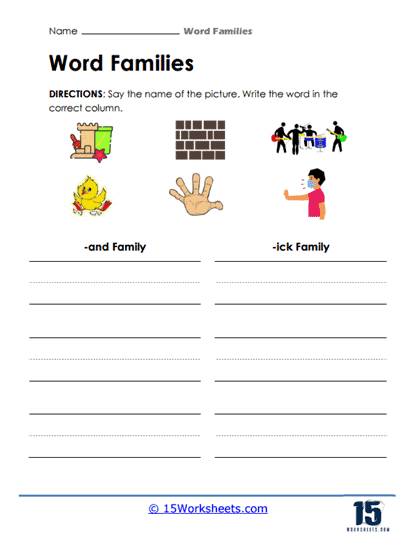
This worksheet asks kids to play word sorter with two families at once: -and and -ick. Each picture gives away its word, and students write it into the right column. A band goes one way, a trick goes the other. The side-by-side setup makes the differences super clear. It’s like running a word-sorting competition right on the page.
Fill the Gaps
Kids see a picture, spot the missing letters, and finish the word. This worksheet focuses on the -ip and -ib families, so learners sharpen their ears for subtle differences. A lip, a clip, and a rib all show up to keep things interesting. Filling in the blanks feels like solving a secret code. With each word completed, confidence clicks into place.
Phonetic Mastery
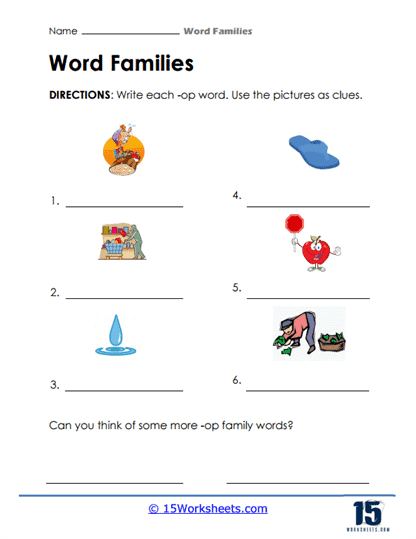
This one takes the -op family a step further. Students match pictures to words like mop and hop, then brainstorm their own extra -op words. It turns simple identification into creative word-building practice. Kids feel proud when they can think of more examples on their own. By the end, they’ve truly mastered this rhyming clan.
Use It in a Sentence
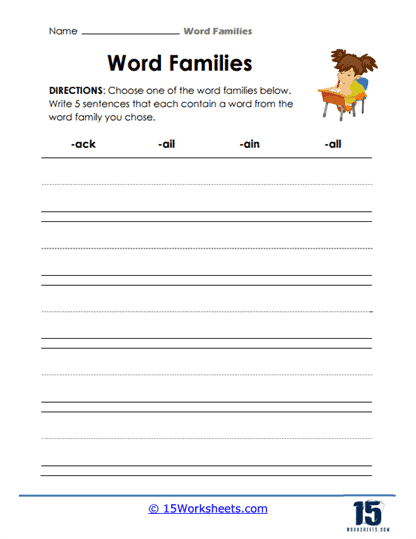
The final challenge gives kids a choice: -ack, -ail, -ain, or -all. They pick a family and then write their very own sentences with words from that group. It’s a chance to stretch creativity and see how these rhyming words work in real writing. Silly or serious, every sentence shows understanding. This worksheet is the perfect bridge between phonics practice and real reading and writing.
What is the Mixed Word Family Word Family?
A word family is a group of words that all share the same ending, like cat, hat, and mat. When we say “mixed word family,” we’re talking about a fun grab bag of different families all together in one place. Instead of just practicing -at or -op, kids get to bounce between endings like -in, -ick, -ug, and -ake. It’s like a phonics buffet where every word is a tasty bite of learning. Mixing families helps students compare sounds and notice patterns faster.
What makes these families so powerful is how predictable they are. Once a child knows how to read “dog,” it’s not a big leap to read “log,” “hog,” or “frog.” That’s the magic of families-they cut down on the guesswork and turn reading into pattern play. When kids practice across many endings in the same activity, they build flexibility too. They start to see that words can swap beginnings but still rhyme and make sense.
You’ll also find that mixed word family practice shows up everywhere in real life. Kids will notice rhymes in their bedtime stories, on signs at the grocery store, or even in silly songs they sing at school. Teachers love using them for fluency practice, and parents love seeing the lightbulb moment when reading finally “clicks.” From nouns like fan and dog to verbs like sit and run, these families cover many parts of speech. The more kids play with them, the more natural reading and spelling become.