
Tracing Sentences Worksheets
All About These 15 Worksheets
Tracing sentences is like giving kids a double workout – they’re learning how to read and how to write at the same time. Each page gives them a dotted sentence to follow, usually with a cheerful little picture that makes the words click into place. The focus is on simple, kid-friendly sentences, so children don’t feel overwhelmed by too many words or complicated structures. By the end of a few worksheets, they’re already connecting what they see, what they say, and what they write.
The beauty of this collection is that it sneaks in important early literacy skills while kids feel like they’re just “coloring in letters.” They practice spacing, punctuation, and capital letters without even realizing they’re learning rules of writing. Plus, tracing whole sentences makes it easier for young learners to understand that words work together, not just one by one. It’s like moving from eating single M&Ms to enjoying the whole cookie!
And don’t underestimate the role of confidence – kids light up when they can read back a full sentence they just traced themselves. Suddenly, they’re not just letter tracers, they’re readers and writers. These worksheets are a bridge between learning ABCs and writing little stories, making that leap fun and stress-free.
Have a Look Inside Each Worksheet
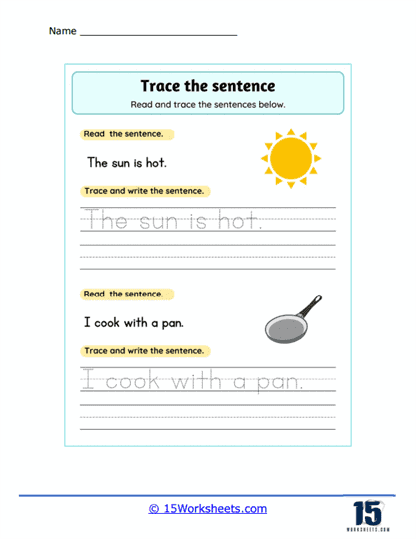
The Hot Sun
Kids trace and write a simple sentence about “the hot sun,” probably with an image of a sun. They’ll work on recognizing sight words and common vocabulary (“hot”, “sun”) and practice writing the letters in context. Fine motor practice comes in from tracing dotted letters or words. Supports early literacy by linking image, meaning, and writing.
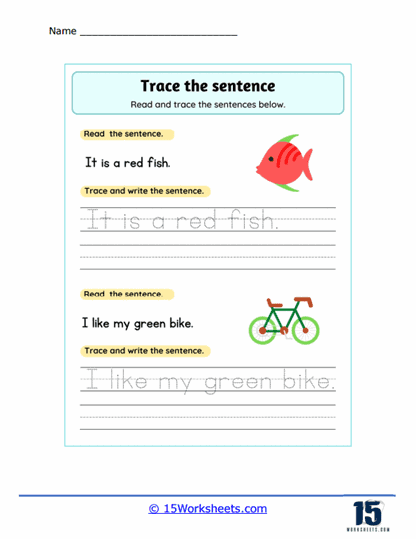
Red Fish And Green Bike
This worksheet uses color words and concrete nouns (fish, bike) so children trace a sentence containing “red,” “fish,” “green,” etc. Great for color recognition and adjective-noun combinations. Helps with letter formation and spacing. Reinforces reading simple sentences with descriptive words.
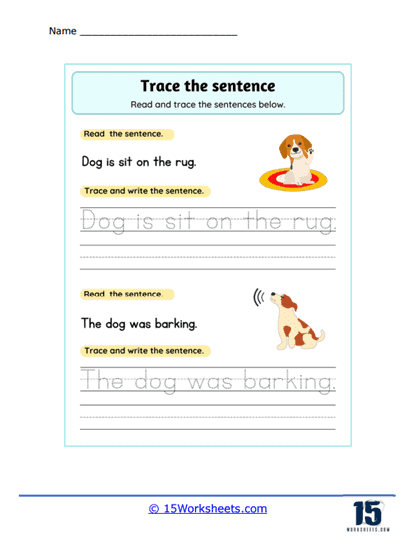
What Is The Dog Doing?
Children trace a question sentence (asking what the dog is doing). Helps with punctuation (question mark) and with forming more complex sentence structure (“What is … doing?”). Also builds comprehension via image: they see a dog doing something. Improves tracing skill and introduces question form.
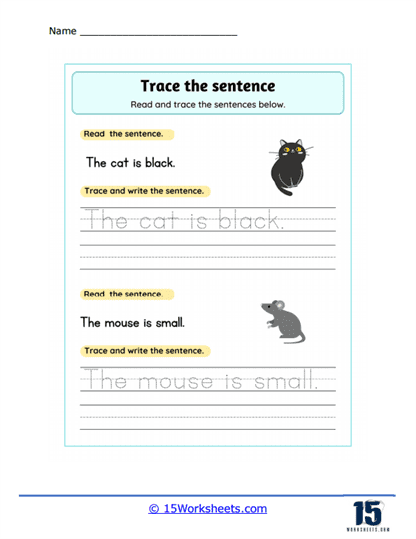
Cat And Mouse
Tracing a sentence about a cat and mouse—common animal pair. Useful for familiar vocabulary, comparing small animals. Encourages understanding subject + object (cat, mouse) in a sentence. Good for letter shapes & spacing again + linking word meaning to image.
Playing And Tossing
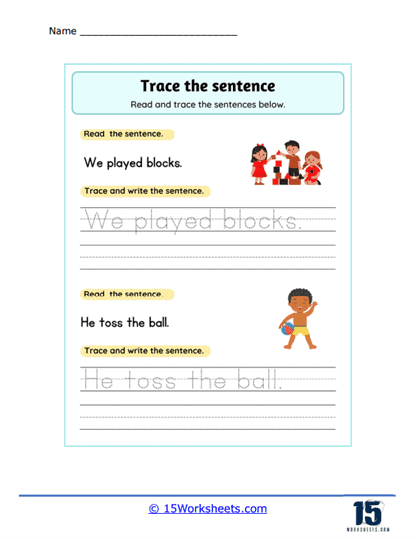
Likely a sentence with action verbs “playing, tossing,” so child traces verbs, an -ing form. Helps with recognizing action words. Fine motor tracing of letters, plus perhaps distinguishing between similar words. Supports vocabulary around actions and present progressive.
The Tall Man
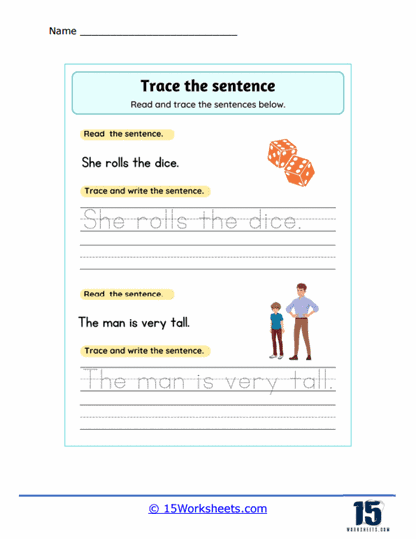
A sentence including “tall man” gives adjective + noun structure. Helps children see descriptive language (tall). Tracing the letters, understanding height adjective, image support. Rooms for practice of word spacing and capitalization.
Running On The Road
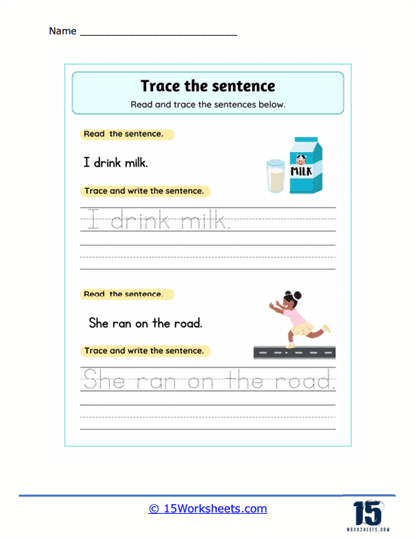
Action + prepositional phrase (“on the road”) makes sentences more complex. Kids trace, see verb + “on” + “road”—supports spatial vocabulary. Helps motor control, plus reading sentences with more words & complexity.
Soft Tail And Hard Shell
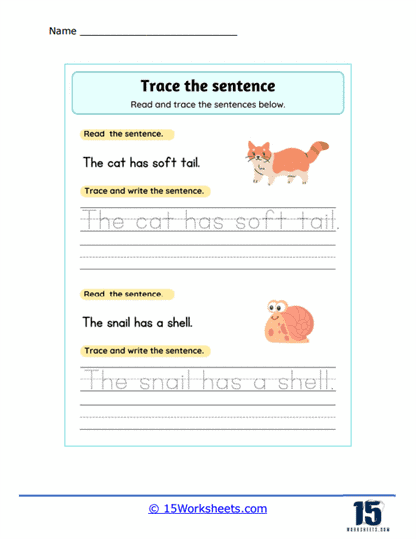
Contrasting adjectives (“soft” vs. “hard”) and nouns (“tail”, “shell”). Helps with comparative descriptive language, opposites. Tracing plus visual cues. Supports understanding of texture words and animal body parts perhaps.
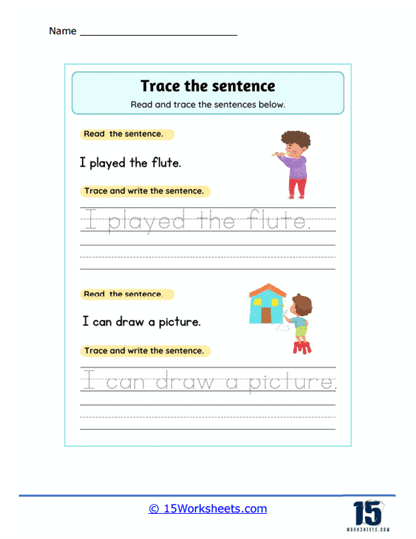
I Can Draw!
A short, motivational sentence with “I,” a helping verb, etc., maybe exclamatory. Good for pronouns and simple verb forms. Encouragement for personal expression. Tracing helps build confidence; exclamation introduces different punctuation.
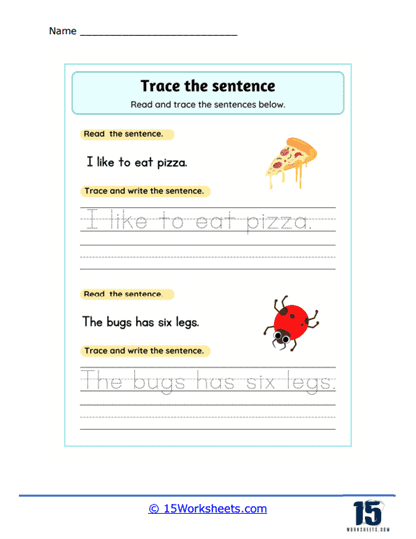
I Like Pizza
Another simple sentence expressing preference (“I like…”) + a common noun (“pizza”). Helps with sentence pattern that kids themselves can use. Familiar vocabulary, fun subject. Practice with writing that reflects personal likes helps engagement.
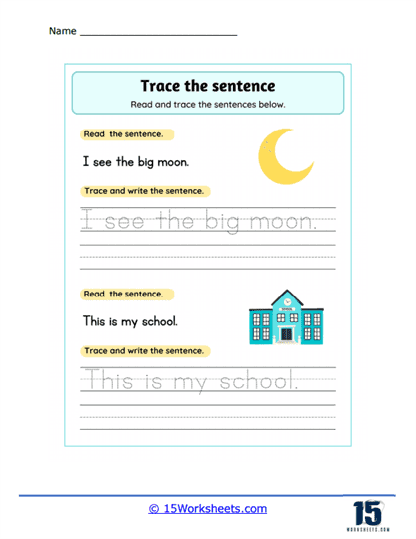
The Big Moon
Descriptive sentence: “big” + noun “moon.” Helps with size adjectives, astronomical object. Useful for vocabulary expansion. Fine motor tracing, letter formation with “big” and “moon,” spacing, etc.
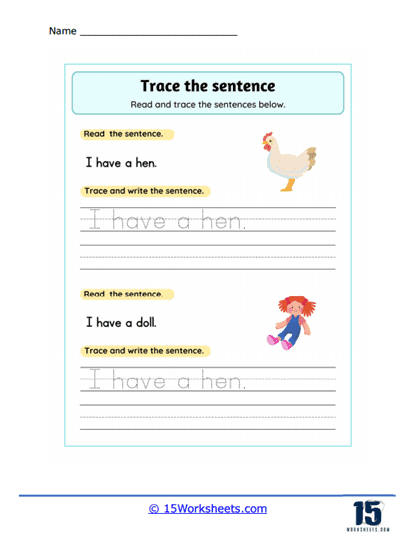
I Have A…
“I have a…” likely followed by picture (object). Could be “I have a …” blank or full sentence. Helps with possession / simple sentence pattern. Good for children to complete ideas and practice tracing.
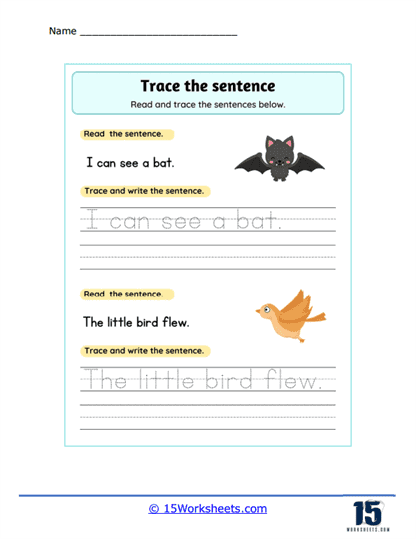
Bat And Bird
Animals again (bat, bird) – tracing sentence connects them. Vocabulary, animal words, perhaps comparing or just listing. Good for reading and writing familiar nouns.
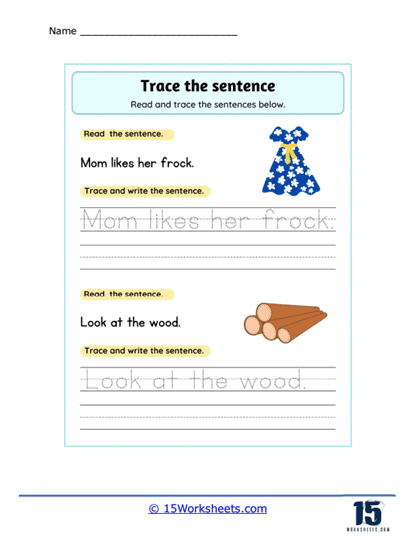
Mom’s Frock
A sentence about “Mom’s frock” – introduces possessive “ ’s ”. Helps with understanding ownership. Allows exposure to apostrophe usage. Tracing and copying support writing these slightly more complex forms.
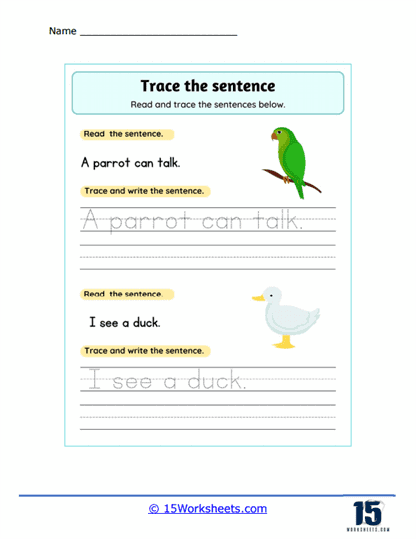
Talking Parrot
A sentence about a parrot speaking or “talking parrot.” Helps with verb + noun, possibly quoting speech or not. Encourages vocabulary around animals and action. Tracing supports both reading and writing.
Why Tracing Sentences Helps Preschoolers
Tracing sentences is a fun and effective way for preschoolers to start learning how to write. It helps them practice holding a pencil, controlling their hand movements, and following the shapes of letters. This builds fine motor skills that are needed for writing on their own.
When children trace full sentences, they also begin to understand how words work together. They see that sentences start with a capital letter, have spaces between words, and end with punctuation. Saying the words while tracing can even boost vocabulary and early reading skills.
Most importantly, tracing sentences gives preschoolers confidence. Each completed worksheet feels like a small achievement, and that positive experience makes them excited to keep learning. Tracing connects writing, reading, and grammar in a simple way that prepares children for stronger literacy skills in kindergarten and beyond.