
Exclamation Points Worksheets
About Our Exclamation Points Worksheets
Exclamation marks are like the fireworks of punctuation-small but full of energy! They don’t just end a sentence, they add extra excitement, surprise, or strong emotion. Without them, writing can feel a little flat, like telling a joke without laughing at the punchline. These worksheets are designed to help kids spot when it’s time to add that extra pop of punctuation, so their sentences sparkle with feeling.
This collection walks students through exclamations in lots of playful ways: tracing, circling, rewriting, and even working with cartoon dialogues. Each activity sneaks in grammar practice while keeping the fun alive. By practicing in different formats, kids strengthen both their writing mechanics and their awareness of tone. They’ll walk away with punctuation confidence that carries over to stories, essays, and everyday communication.
And let’s not forget, punctuation isn’t just about rules-it’s about people and feelings. Learning when to use exclamation marks helps kids match written words to real-life emotion. These worksheets give them the tools to show joy, surprise, excitement, or urgency on paper, just like they’d do with their voices in real life. It’s punctuation that feels human, not robotic.
Have a Look Inside Each Worksheet
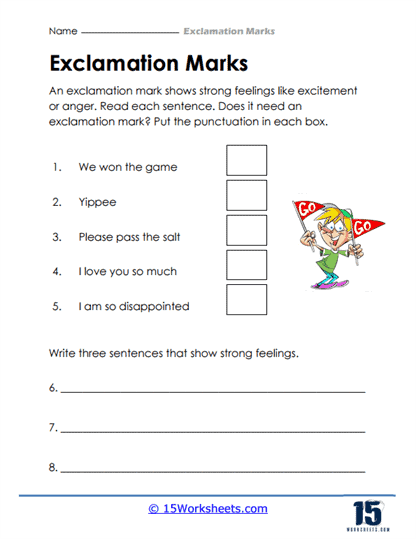
Is It Needed?
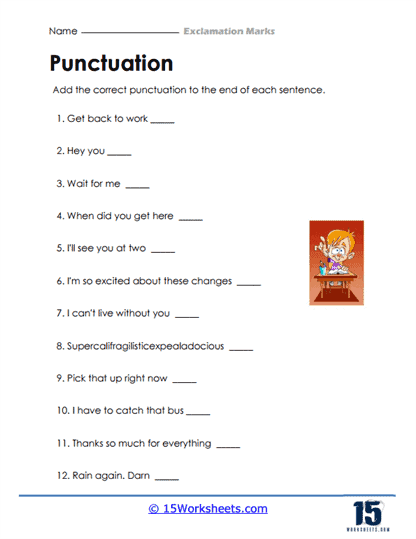
This worksheet helps kids decide whether an exclamation mark belongs at the end of a sentence or not. Students read each sentence and make punctuation choices based on emotion and tone. It builds awareness of when strong feelings are expressed. Kids will gain confidence in recognizing situations that call for extra punch in their writing.
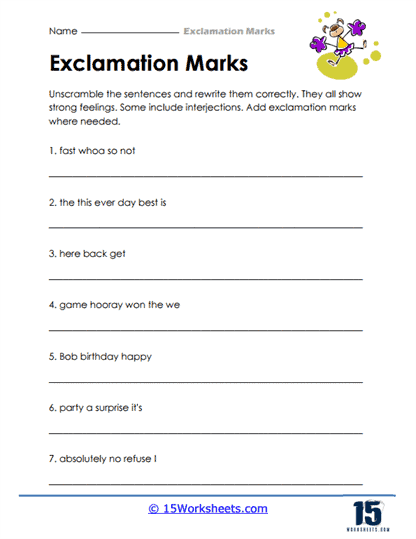
Unscramble And Add
Students unscramble mixed-up words to create clear sentences, then finish them with the correct punctuation. This fun twist challenges both grammar skills and punctuation awareness. It’s like solving a word puzzle and practicing exclamations at the same time. Learners sharpen their understanding of structure and emotional expression in writing.
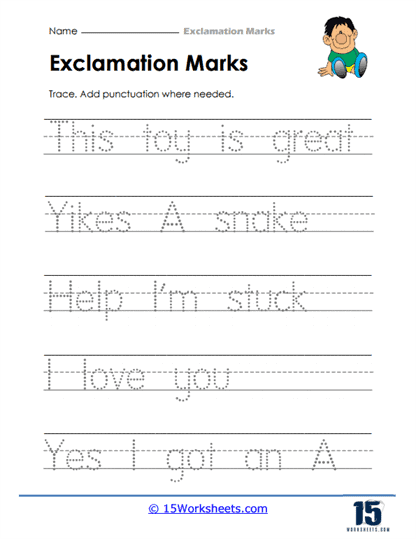
Trace And Punctuate
In this activity, students trace simple sentences and decide which punctuation mark completes them. The tracing reinforces handwriting while the punctuation practice boosts grammar skills. It’s perfect for early learners who need both fine-motor and language support. The worksheet ties emotion to punctuation, showing how a small mark changes meaning.
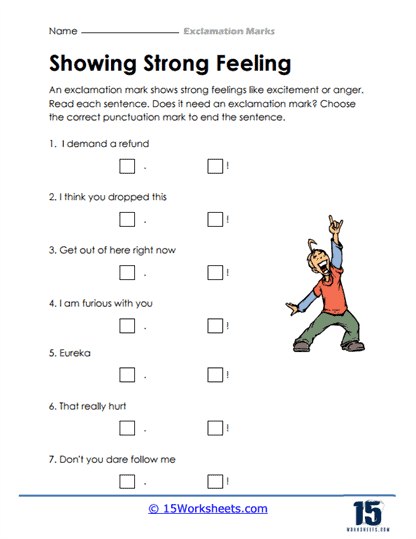
Ending Sentences
This worksheet asks students to choose the correct ending punctuation for various sentences. They decide between periods, question marks, and exclamation marks. By comparing different types of sentences, learners see the unique role of exclamations. It turns punctuation practice into an easy decision-making game.
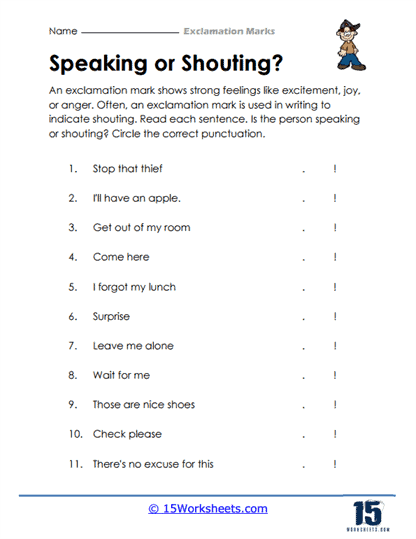
Speaking Or Shouting?
Students look at sentences and decide if they should be spoken calmly or shouted with excitement. They then punctuate accordingly with exclamation marks or periods. This worksheet builds a strong sense of tone and voice in writing. Kids will love exploring how punctuation changes the volume of words on paper.
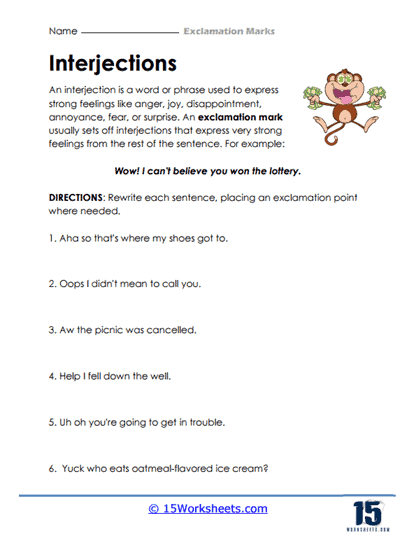
Place And Rewrite
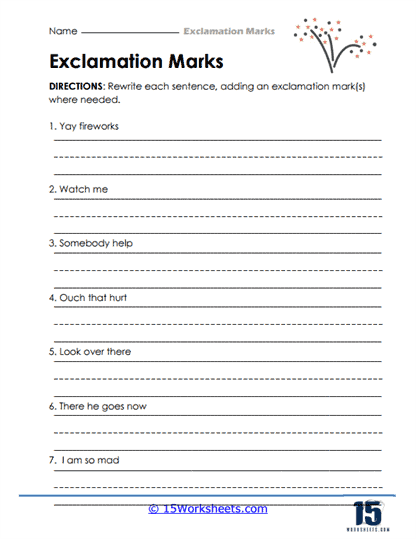
Learners insert missing exclamation marks into sentences and then rewrite them correctly. This helps with both placement and understanding of emphasis. Students see how rewriting makes sentences more expressive. It’s a hands-on way to build punctuation mastery while reinforcing neat writing.
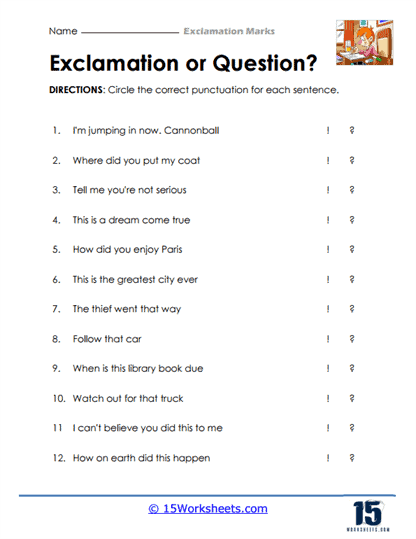
Circle Your Choice
Students read sentences and circle the correct punctuation to finish them. Choices include periods, question marks, or exclamation marks. The task encourages quick thinking and application of grammar rules. It’s a fun way to train punctuation instincts through repetition and choice-making.
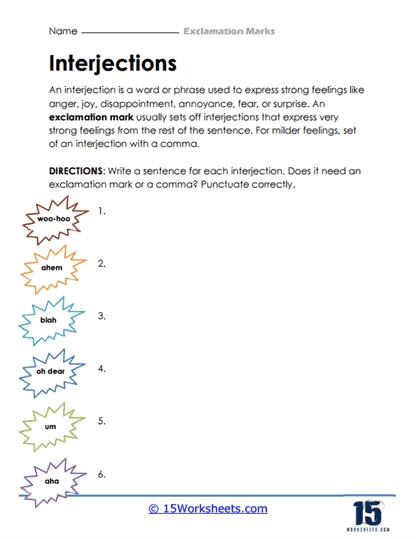
Punctuating Interjections
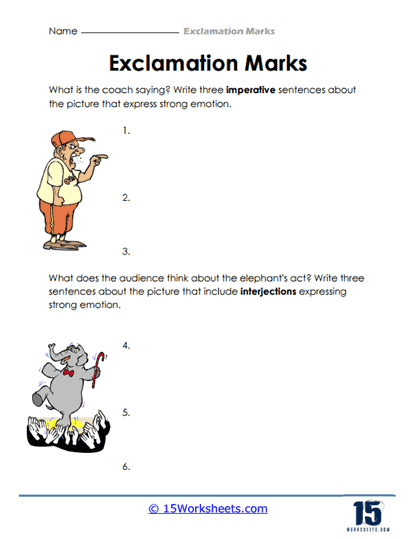
This worksheet focuses on interjections like “Wow” or “Oh” that often need exclamation marks. Kids identify these words in sentences and punctuate them properly. It connects grammar with real-life expressions of surprise or excitement. Learners will start noticing interjections everywhere and know just how to punctuate them.
Visual Dialogue
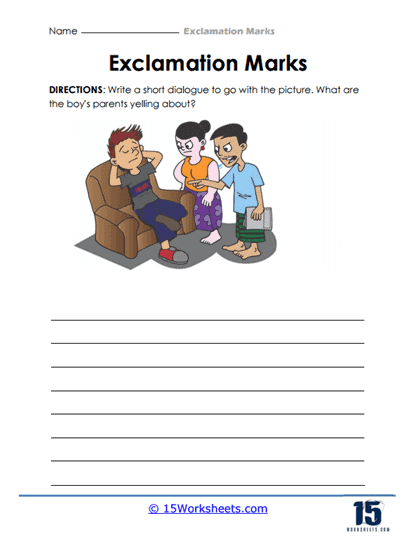
Students work with cartoon-like dialogue boxes and add punctuation to match the emotions of speakers. It’s a mix of reading comprehension and punctuation practice. The visuals make it engaging, and learners quickly see how exclamations express emotion. This worksheet bridges writing with real-world communication.
Terminal Punctuations
Here students practice distinguishing between exclamation marks, question marks, and periods. Each sentence requires careful reading to determine the correct ending. It’s an all-in-one punctuation workout. Kids finish knowing exactly when to add a burst of excitement to their sentences.
Applying Exclamation
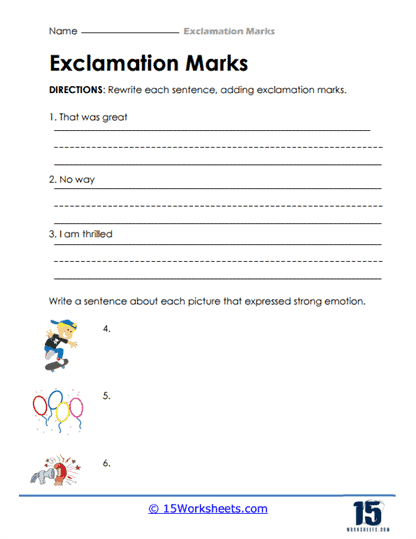
This worksheet challenges kids to rewrite regular sentences as exciting exclamations. They transform calm statements into ones filled with energy and feeling. It’s a creative spin on punctuation practice. Students learn how language changes dramatically with the right punctuation mark.
Showing Emotion
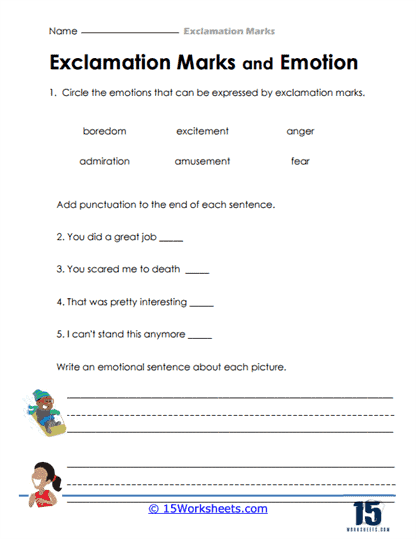
Here learners match sentences to the feelings they express, then punctuate them correctly. It links emotion directly with grammar. Kids develop both empathy and punctuation skills in one activity. By the end, they’ll see that punctuation isn’t just about rules-it’s about feelings too.
Two-Part Exercise
This worksheet combines identifying correct punctuation with rewriting sentences more expressively. The two-step approach deepens understanding by reinforcing skills in different ways. Students first analyze, then apply what they’ve learned. It’s a well-rounded punctuation practice tool for building mastery.
Strong Feelings
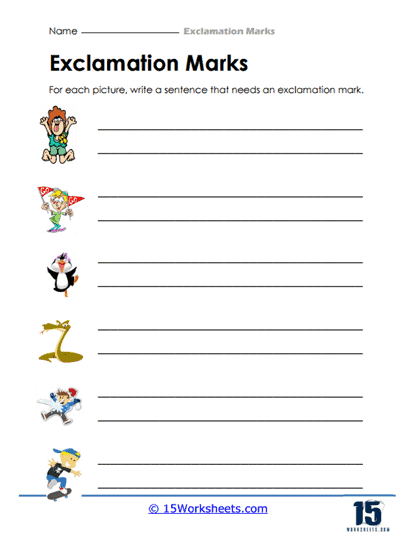
Students are given sentences that clearly express strong emotions and must punctuate them with exclamation marks. They practice recognizing tone and mood in writing. The activity shows how punctuation amplifies meaning. It’s perfect for learning to channel big emotions into clear written expression.
Sentence Compositions
In this worksheet, learners write their own sentences and decide when to add exclamation marks. It combines creativity with grammar practice. Students get to express themselves while learning punctuation rules. This worksheet empowers kids to bring excitement into their own writing.
What Are the Rules for Using Exclamation Marks?
Using exclamation marks can be really fun, but you’ve got to know the rules! Here are some guidelines to help you out:
Expressing strong emotions – This is the most common use of an exclamation mark. You can use it at the end of a sentence to express strong feelings like surprise, excitement, anger, or joy. For example, “I can’t believe we won the championship!”
After interjections – Interjections are words that express strong emotions or sudden outbursts. Exclamation marks are often used after interjections. For example, “Wow! That’s amazing!” or “Oh! I didn’t see you there.”
In exclamatory sentences – These are sentences that express strong emotions and they usually start with “what” or “how”. For example, “What a beautiful sunset!” or “How wonderful it is to see you again!”
Avoid in formal writing – While exclamation marks can be great in casual writing or dialogue, they should be used sparingly in formal writing like essays or business letters. Too many exclamation marks can make your writing seem unprofessional or overly emotional.
Not to end every sentence – Exclamation marks are powerful, and if you use them at the end of every sentence, they lose their effect. It’s like if someone was shouting all the time-you would eventually stop paying attention, right?
Don’t use with other punctuation – Exclamation marks should not be used with other punctuation marks like question marks, periods, or commas at the end of a sentence. However, you can use it in a sentence that’s both a question and an exclamation, for example, “Are you really going on a space mission?!”
One is enough – It’s best to use only one exclamation mark at the end of a sentence. Multiple exclamation marks (like “!!!” or “?!?!”) are seen as informal, and are typically used in digital communication like text messages or social media to express extra-strong emotion.