
Paper Airplane Launcher
Worksheet Description
This worksheet introduces a hands-on project where students create a paper airplane launcher to delve into the concepts of potential and kinetic energy. As participants launch a paper airplane using the device, potential energy stored within the stretched rubber band is converted into kinetic energy propelling the airplane forward. Throughout the activity, students can observe and understand the energy transformations occurring during the plane’s flight. Guiding questions further help in reinforcing the concepts and analyzing the observations made.
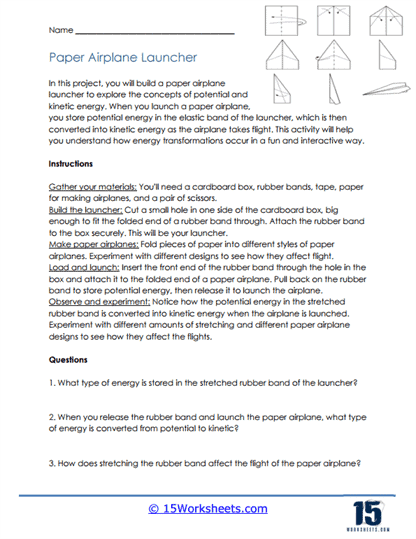
To execute the skill, students first gather essential materials, including a cardboard box, rubber bands, tape, and paper for crafting airplanes. They’ll modify the cardboard box, ensuring there’s a hole sizable enough for the folded end of a rubber band to be threaded through, which will act as the launcher’s core mechanism. After attaching the rubber band to the box, students will pull back on it to store potential energy, then release it to project the paper airplane. By experimenting with varying amounts of rubber band stretching and different airplane designs, participants can observe the distinct effects these factors have on flight.
The core objective of this worksheet is to provide students with a tactile experience to understand the principles of potential and kinetic energy. By engaging in the building and launching process, learners can visualize the transformation of stored energy (potential) to motion-based energy (kinetic). The act of stretching the rubber band and observing its impact on the airplane’s flight offers a practical demonstration of these energy forms at play. The questions prompt deeper thinking and exploration, ensuring that students not only grasp the theoretical concepts but also witness their real-world applications, enriching their learning experience.