
Personification Worksheets


About These 15 Worksheets
Personification is one of those literary tricks that makes writing sparkle-it’s what happens when objects, animals, or even ideas start acting like people. Instead of just saying “the wind blew,” writers can say “the wind whispered,” and suddenly the description feels alive. These worksheets introduce kids to that magic step by step, so they can learn not only how to spot personification, but also how to create it in their own writing.
The collection gives students plenty of variety to keep things fresh. Some worksheets focus on simple recognition, asking kids to find personified words or phrases, while others let them flex their creativity by writing their own imaginative sentences. There are even activities that push them into full storytelling or poetry, where they get to decide how objects laugh, dance, sigh, or shout. With such a mix, students build both confidence and skill while still having fun.
At the same time, these activities connect figurative language to the real world. Kids start to notice how writers use personification in books, poems, and even everyday speech to make ideas more relatable. By practicing with these worksheets, they see language not as flat or rigid, but as something flexible and playful. That awareness makes them stronger readers and more expressive writers who can bring their own words to life.
Have a Look Inside Each Worksheet
What’s Being Personified
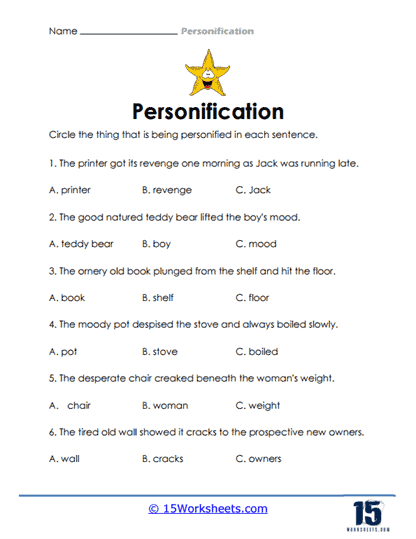
This worksheet presents sentences or phrases and asks students to identify which non-human subjects have been given human traits. It encourages close reading and critical thinking about figurative language. The activity blends vocabulary with interpretation in a playful way. It helps students distinguish between literal and imaginative descriptions.
The Thing Is
In this worksheet, learners explore statements where objects or ideas are described in human terms, then identify the underlying meaning. It challenges students to unpack unusual descriptions. The task stretches their expressive reading skills and imagination. It supports deeper understanding of language nuance.
The Walrus and the Carpenter
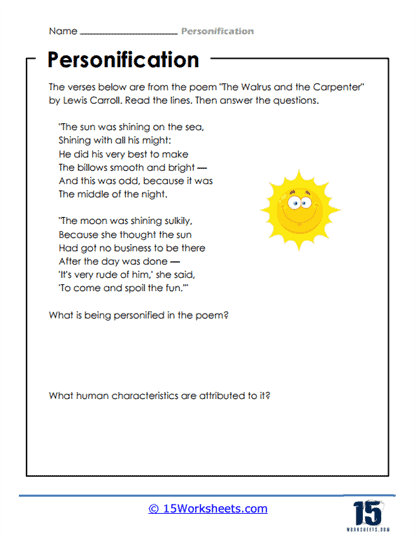
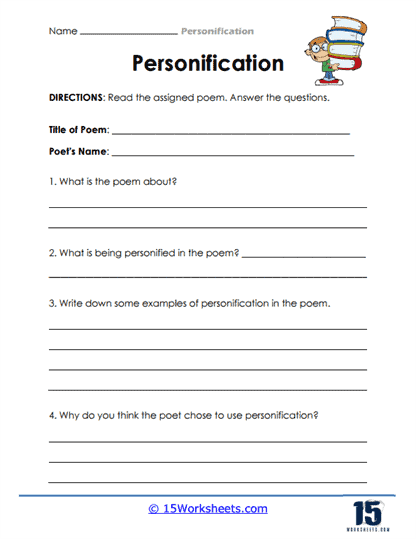
Inspired by poetic imagery, this worksheet uses lines from the poem “The Walrus and the Carpenter” to prompt recognition of personification. Students analyze how non-human characters are brought to life through human-like actions. It blends literature with figurative language exploration. It supports appreciation for creative writing.
Check Marks
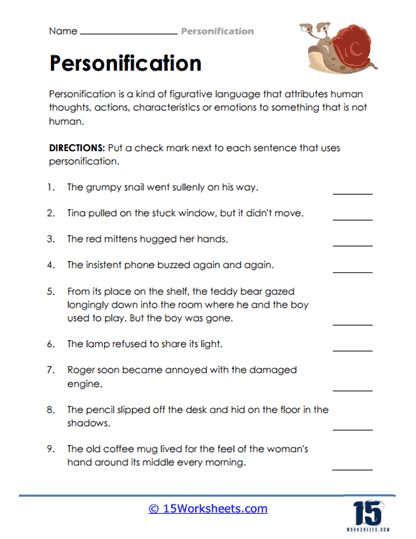
Here, students review sentences and mark those that contain personification. It’s a quick, interactive way to reinforce recognition skills. The match-or-mark format makes it engaging and accessible. It supports fast grasp of the concept in context.
Verbs In
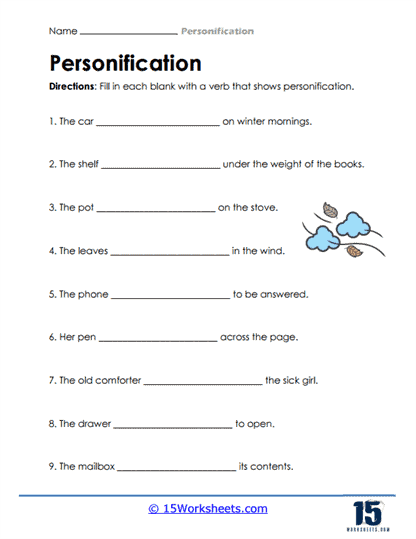
This worksheet highlights verbs in sentences and asks students to consider whether those verbs make the subjects seem human. It encourages focused attention on descriptive language. The activity supports dissecting how personification works at the word level.
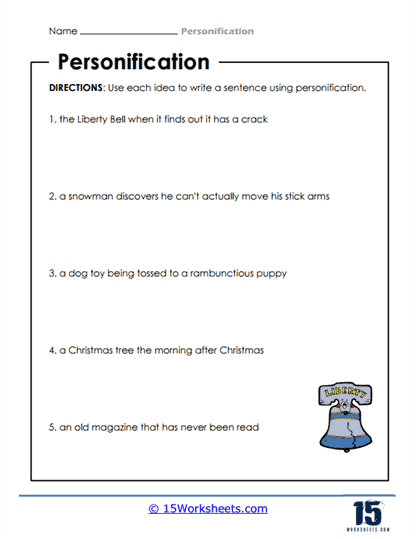
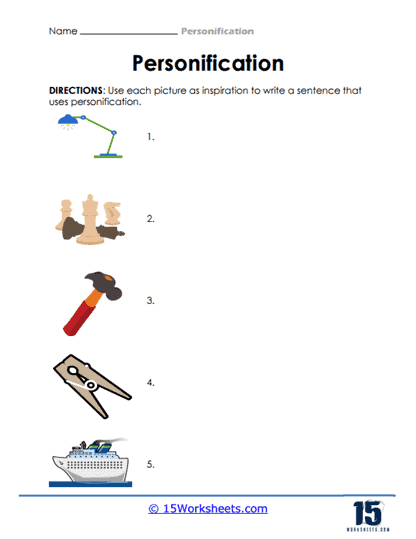
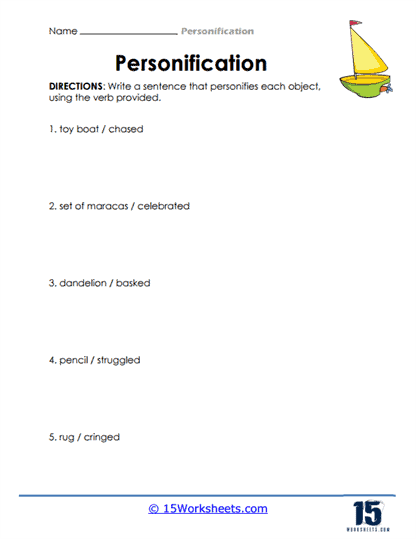
Write the Sentence
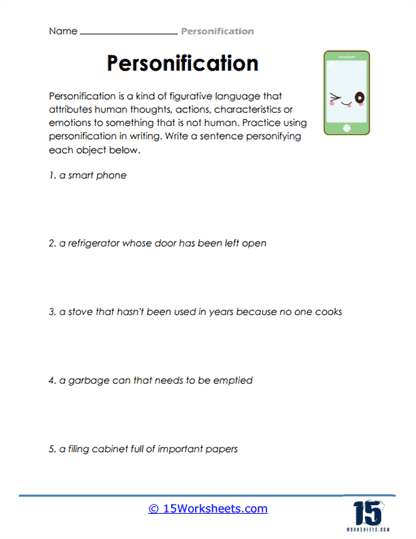
Students create their own sentences using personification based on prompts or images. This turns recognition into creative production. It invites learners to play with language and invent imaginative scenarios. It supports expressive writing and grasp of figurative tools.
Bring Objects to Life
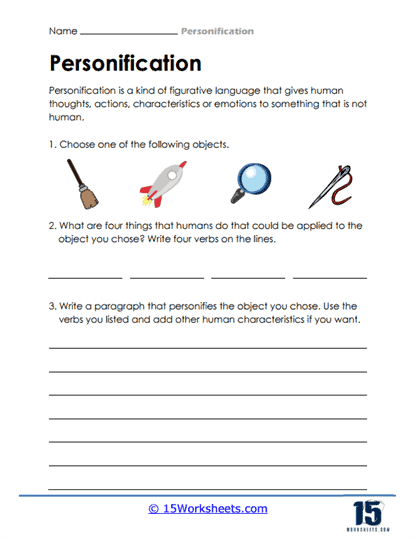
In this activity, children are asked to give human qualities to everyday objects-like apples that giggle or lamps that sigh. It’s a fun, creative exercise that warms up their descriptive writing muscles. The task supports playful language use and originality.
Adding Power
Learners enhance basic sentences by introducing personification to make descriptions more dynamic. It’s a step-by-step transformation from plain to poetic. The activity shows the impact figurative language can have. It supports skillful revision and embellishment.
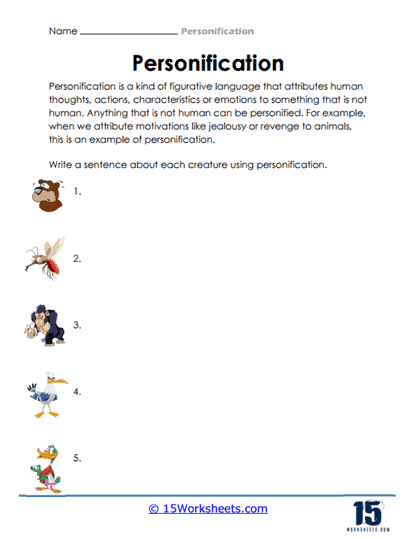
Creature Feature
This worksheet takes objects or ideas and asks students to describe them as if they were living characters. It often involves writing short paragraphs or captions. The task blends storytelling with stylistic technique. It supports imaginative writing grounded in linguistic devices.
Lively Poem
Students rewrite or write short poems incorporating personification. It turns figurative language into rhythmic expression. The task nurtures poetic voice alongside comprehension. It supports creative and lyrical writing skills.
Dancing Objects
This fun screen calls for motion-students describe objects as if they are dancing, hopping, or performing human-like movements. It’s a vivid introduction to dynamic description. The activity supports sensory and imaginative writing.
Adding Emotions
Here, learners assign feelings to non-human subjects, such as “the angry thunder” or “a cheerful wind.” It deepens the emotional dimension of personification. The task fosters empathy and expressive language. It supports blending feeling with figurative style.
Human Actions
Students match objects with human activities-like “the chair yawned” or “the moon winked.” It’s a playful way to illustrate how personification works. The activity supports comprehension through analogy and humor.
Why It Does That
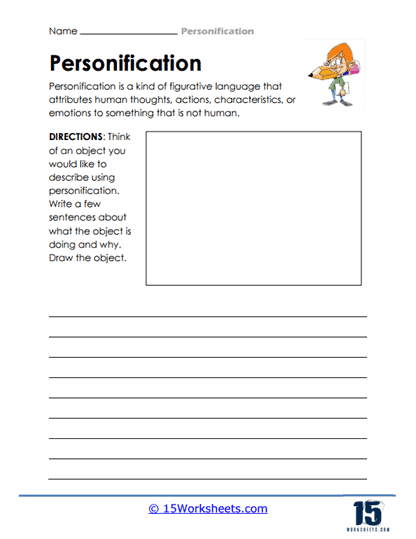
This worksheet asks students to explain why an inanimate object might behave in a human-like way. It encourages reflection on the purpose and effect of figurative language. The task supports critical thinking about style and tone.
Personifying Objects
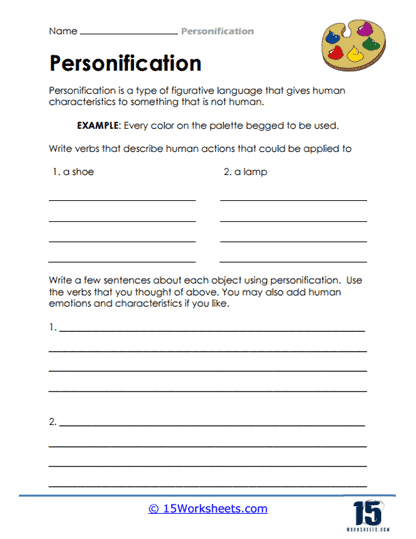
Learners create descriptions of everyday things imbued with human traits-perhaps a “sad pencil” or “singing teapot.” This pushes creative boundaries. It supports expressive writing by practicing personification firsthand.
Why Do Authors Use Personification In Their Work?
Authors use personification in their work for several reasons:
Adding Vividness and Imagery – Personification brings inanimate objects or abstract ideas to life by attributing human qualities to them. By giving human characteristics or behaviors to non-human things, authors create vivid and imaginative descriptions that engage the reader’s senses. Personification adds a layer of visual and sensory imagery, making the writing more memorable and evocative.
Creating Emotional Connection – Personification helps create an emotional connection between the reader and the objects or ideas being personified. By attributing human qualities, readers can relate to and empathize with them on a deeper level. Personification can evoke emotions and foster a sense of familiarity or understanding, making the writing more impactful and emotionally resonant.
Enhancing Descriptions and Storytelling – Personification adds depth and richness to descriptions and storytelling. By ascribing human characteristics to non-human elements, authors can provide unique perspectives, insights, or commentary on the subject matter. Personification makes the writing more dynamic and engaging, allowing readers to see the world from a fresh and imaginative viewpoint.
Conveying Abstract Concepts or Ideas – Personification helps make abstract concepts or ideas more concrete and relatable. By giving them human qualities, authors can make complex or intangible concepts more accessible to readers. Personification can make philosophical or metaphorical ideas easier to grasp by presenting them in familiar and human terms.
Creating Symbolism and Allegory – Personification can be used to create symbolism or allegory in literature. By assigning human characteristics to objects or ideas, authors can convey deeper meanings or represent larger concepts. For example, personifying death as a hooded figure can represent mortality and evoke specific cultural or literary associations.
Adding Literary Flair and Creativity – Personification allows authors to showcase their creativity and linguistic skills. By personifying objects or ideas, authors demonstrate their inventiveness in finding new and imaginative ways to express themselves. Personification adds a touch of literary flair, making the writing more interesting and distinct.