
Define And Differentiate
Worksheet Description
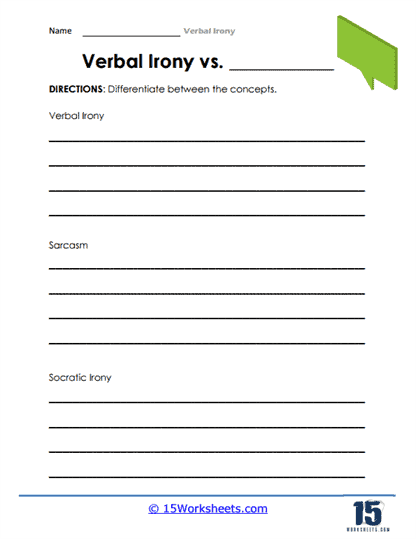
This worksheet focuses on the distinctions between different forms of irony, specifically verbal irony, sarcasm, and Socratic irony. Verbal irony is a figure of speech where what is said is often the opposite of what is meant, it requires context to understand the disparity between statement and meaning. Sarcasm, a sharp and often satirical or ironic utterance designed to cut or give pain, is a form of verbal irony but typically conveys contempt. Socratic irony, named after the classical Greek philosopher Socrates, involves feigning ignorance to expose the ignorance or inconsistency of someone else.
The worksheet prompts students to articulate their understanding of these concepts by providing definitions or examples that illustrate the nuanced differences. It serves as an educational tool to foster deeper critical thinking and comprehension of literary devices. By comparing and contrasting these forms of irony, students enhance their analytical skills and their appreciation of nuanced language used in literature and dialogue. They learn to identify not just what is being said, but also the intent and underlying meaning behind the words. This skill is vital for interpreting texts and engaging in sophisticated communication.