
Using pH Scale
Worksheet Description
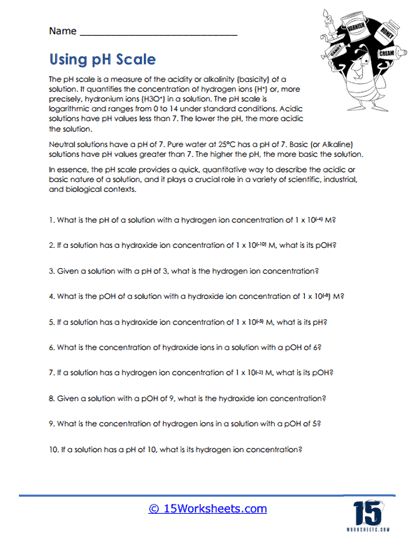
This worksheet helps in understanding the significance of the pH scale and its application in determining the acidic or basic nature of solutions. Mastering the pH scale is pivotal for many scientific and industrial applications, from determining water quality to preparing solutions in labs or industries.
The scale is fundamental in various fields, from science and industry to biology and medicine. By interpreting and applying the pH scale, one can quantify how acidic or basic a solution is.
The goal of this worksheet is to:
Understand the importance and use of the pH scale.
Practice calculating pH, pOH, and ion concentrations for various solutions.
Recognize the distinctions between acidic, neutral, and basic solutions.
Concept Explanation
pH Scale – This is a logarithmic scale that ranges from 0 to 14 and quantifies the acidity or alkalinity of a solution. It is determined based on the concentration of hydrogen ions ([H+]) in the solution.
pOH – Similar to pH but refers to the measure of the basicity of a solution, based on the concentration of hydroxide ions ([OH-]).
Acidic, Neutral, and Basic (Alkaline) Solutions:
Acidic solutions have a pH less than 7.
Neutral solutions have a pH of 7 (like pure water at 25°C).
Basic or Alkaline solutions have a pH greater than 7.
Relation between pH, pOH, and Ion Concentration – The sum of the pH and pOH of a solution is always 14 in water at 25°C. The pH and pOH can be determined based on the concentrations of [H+] and [OH-], respectively.