
Understanding Acid and Base Solutions
Worksheet Description
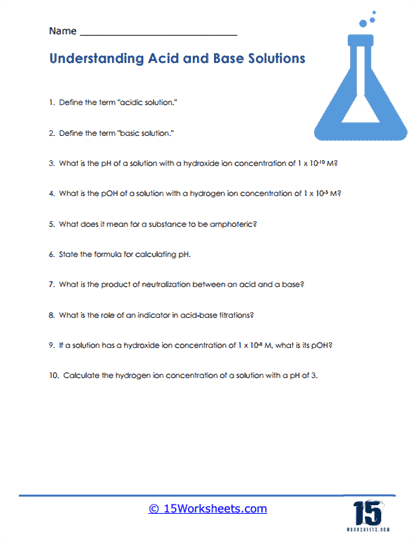
This worksheet is a comprehensive tool for assessing and reinforcing knowledge about acid-base chemistry, including the behavior, reactions, and properties of acids and bases. To excel, students need a solid theoretical foundation coupled with practical application skills.
The worksheet aims to:
Define and distinguish between acidic and basic solutions.
Understand the principles behind pH and pOH.
Recognize the properties of substances, including amphoterism.
Know how to calculate pH from hydrogen ion concentrations and vice versa.
Understand neutralization reactions and the role of indicators.
Acidic solutions have a pH less than 7 and have a high concentration of hydrogen ions (H+). Basic solutions, on the other hand, have a pH greater than 7 and have a high concentration of hydroxide ions (OH-).
The pH scale quantifies the acidity or basicity of a solution. It’s a logarithmic scale that typically ranges from 0 (very acidic) to 14 (very basic), with 7 being neutral. The pOH provides information about the basicity of a solution, and pH and pOH are related such that pH + pOH = 14 at 25°C.
An amphoteric substance can act as both an acid and a base.
Neutralization – It’s a reaction between an acid and a base to produce water and a salt.
Indicators – These are substances that change color based on the pH of the solution they are in, making them invaluable in titrations to determine the endpoint.