
Simple Matches
Worksheet Description
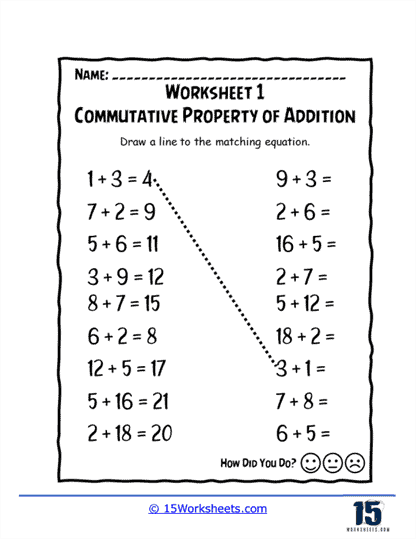
This worksheet is structured to help students practice the commutative property of addition through a matching activity. It contains two columns of addition problems: one with complete equations including the sums, and the other with only the addends and the equals sign, leaving the sum to be determined.
This worksheet is structured to help students practice the commutative property of addition through a matching activity. It contains two columns of addition problems: one with complete equations including the sums, and the other with only the addends and the equals sign, leaving the sum to be determined. Students are tasked to draw lines from the complete equations on the left to the matching commutative equations on the right. An example is provided, showing a line connecting the equation ‘1 + 3 = 4’ on the left with ‘3 + 1 =’ on the right, indicating that these two are equivalent through the commutative property.
The worksheet teaches students that in addition, the order of numbers does not affect the sum-a fundamental concept in mathematics known as the commutative property. By connecting equations that have the same numbers in a different order, students learn that the sum remains unchanged. This activity not only reinforces their addition skills but also prepares them for understanding more complex mathematical operations. Furthermore, it promotes critical thinking as students must analyze and identify equivalent pairs among the given problems.