
Designing an Experiment
Worksheet Description
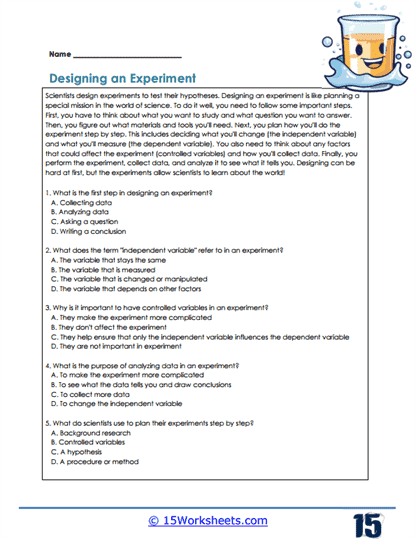
This worksheet focuses on the process of designing a scientific experiment. It emphasizes the importance of establishing a hypothesis and then methodically planning the steps required to test it. The worksheet outlines key components in experiment design, such as identifying the independent and dependent variables, and underscores the critical nature of collecting data and drawing conclusions. Furthermore, it uses a series of questions to challenge students’ comprehension of the described concepts and processes.
To adeptly design a scientific experiment, one must first establish a clear hypothesis or prediction to test. This is followed by determining the independent variable (what will be changed or manipulated) and the dependent variable (what will be measured). The next step involves setting up a controlled environment, ensuring that all other variables remain constant, to ascertain that any observed changes can be attributed to the manipulation of the independent variable. Once the experiment is conducted, it’s crucial to gather data methodically, analyze the results, and conclude whether the hypothesis is supported or refuted.
The primary objective of this worksheet is to cultivate students’ understanding of the fundamental principles and procedures involved in designing a scientific experiment. It aims to highlight the sequential nature of the process, from hypothesis formulation to data analysis. By walking students through the conceptual and practical aspects of experiment design and encouraging them to answer related questions, the worksheet seeks to foster critical thinking, methodical planning, and a deep appreciation for the meticulous approach required in scientific investigations.