
Benign Violation Theory
Worksheet Description
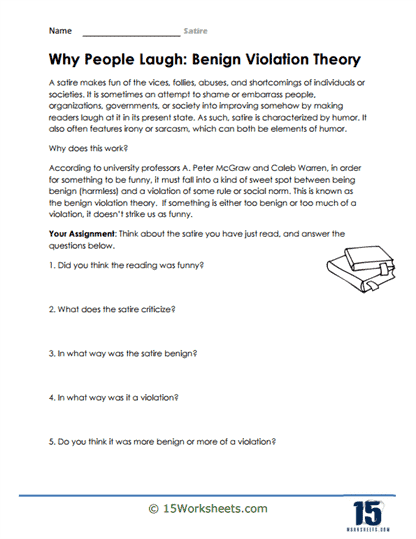
The worksheet is titled “Why People Laugh: Benign Violation Theory” and delves into the understanding of satire as a literary genre. It begins by defining satire as a vehicle for critiquing vices, follies, abuses, and shortcomings of individuals or societies, with the aim of inducing improvement. Satire operates by evoking laughter through humor, irony, or sarcasm, which are its fundamental elements. The worksheet cites the benign violation theory proposed by Peter McGraw and Caleb Warren, which suggests that humor arises when a situation simultaneously violates some norm but is still perceived as benign or harmless. This balance is crucial; if the violation is too offensive or the situation too benign, it fails to be funny.
Students are tasked with reflecting on a piece of satirical writing. They must consider if they found the content funny, identify the target of the satire, and determine whether the satirical element was more benign or a violation, thus applying the benign violation theory in practice. The goal is to foster critical thinking about how satire works and why it can be an effective form of social commentary. By engaging with these concepts, students can better appreciate the delicate craft involved in creating satire that is humorous yet pointed in its message.