
Rules in Classifying Elements
Worksheet Description
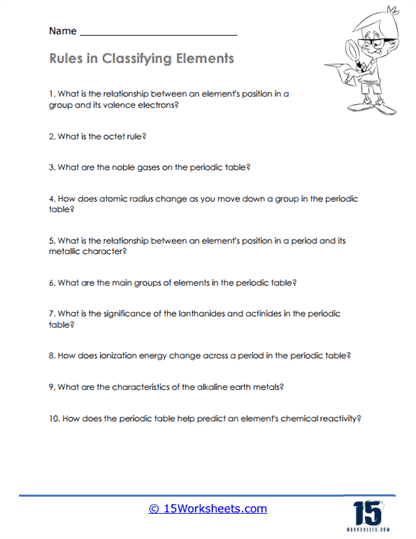
The worksheet focuses on the foundational principles and guidelines that govern the classification of elements on the Periodic Table. It examines the correlation between an element’s position and various properties, such as its valence electrons and metallic character. Topics of focus include the octet rule, characteristics of noble gases, variations in atomic radius, the significance of lanthanides and actinides, ionization energy trends, and traits of the alkaline earth metals. Lastly, the worksheet emphasizes the predictive power of the Periodic Table in determining an element’s chemical reactivity.
To adeptly tackle this worksheet, one should begin by familiarizing themselves with the basic structure of the Periodic Table and understanding the significance of each group and period. A deep comprehension of electron configurations and the octet rule is vital to grasp the concept of valence electrons and their impact on an element’s reactivity. Recognizing the inherent traits of specific elemental groups, such as noble gases or alkaline earth metals, will provide a clearer perspective on their unique roles. Furthermore, understanding trends like changes in atomic radius or ionization energy will enable students to make informed predictions about elemental properties.
This worksheet aspires to instill in students a comprehensive understanding of the criteria and principles employed to categorize elements on the Periodic Table. By elucidating the connections between an element’s position and its subsequent properties, it aims to fortify their foundational knowledge of elemental classification. The content encourages students to recognize the inherent patterns and trends present on the table, emphasizing its utility as a predictive tool. Ultimately, through this worksheet, learners are equipped with the knowledge and skills to confidently categorize, predict, and understand the behaviors of various elements based on their placement on the Periodic Table.