
Coincidental Or Incidental?
Worksheet Description
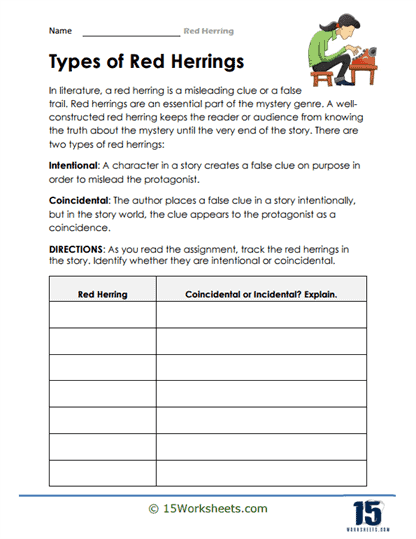
This worksheet serves as a guide to understanding the different types of red herrings in literature, a concept critical to the mystery genre. A red herring is a plot device used to mislead or distract the audience from the actual issue, and it plays a vital role in maintaining the suspense in a story. The worksheet distinguishes between two types of red herrings: intentional and coincidental. Intentional red herrings are deliberately placed by a character within the narrative to mislead another character, often the protagonist, while coincidental red herrings are presented by the author as seemingly significant clues that are actually unrelated to the story’s resolution.
Students are instructed to closely read a text and identify instances of both intentional and coincidental red herrings, providing explanations for their classifications. This task encourages critical thinking and a deeper understanding of narrative techniques. By actively engaging with the text and dissecting the author’s method of crafting a story, students develop the ability to analyze complex literary devices, enhancing their reading comprehension and appreciation for intricate storytelling.