
Properties of Elements
Worksheet Description
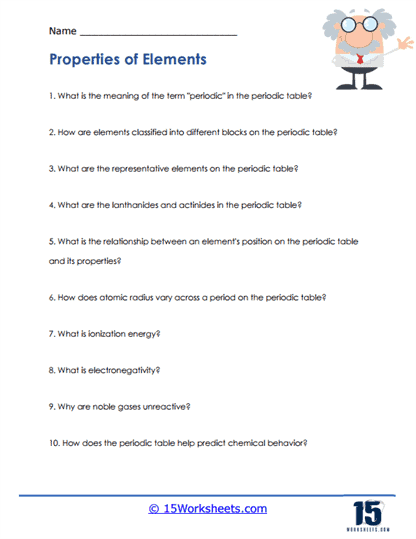
The worksheet focuses on deepening students’ understanding of various intrinsic characteristics of elements as delineated in the Periodic Table. It delves into the semantics of the term “periodic,” the categorization of elements into distinct blocks, and introduces specific groups such as representative elements, lanthanides, and actinides. Moreover, the worksheet explores the correlation between an element’s position on the table and its inherent properties, addressing concepts like atomic radius, ionization energy, electronegativity, and the inert nature of noble gases. Lastly, it prompts students to contemplate how the Periodic Table can be a predictive tool in discerning the chemical behavior of elements.
To adeptly navigate the content of this worksheet, students should commence by reviewing the Periodic Table and its layout, noting the systematic arrangement of elements based on their atomic numbers. A deeper comprehension of specific terminologies such as ionization energy and electronegativity is vital, and students should refer to chemistry resources or textbooks for clear definitions and examples. Familiarizing themselves with trends across periods and groups, like the variation in atomic radius or the characteristics of noble gases, will enable students to draw connections and answer the questions efficiently. Additionally, understanding the historical evolution of the Periodic Table and the significance of periodicity will provide a broader context to address the worksheet’s queries.
The worksheet aspires to equip students with a nuanced understanding of the various properties of elements and how they relate to their positions on the Periodic Table. It endeavors to reinforce foundational concepts while introducing more advanced notions, bridging the gap between basic and intricate chemical knowledge. By posing questions on specific groups, elemental trends, and the predictive power of the table, the worksheet emphasizes the multifaceted nature of the Periodic Table as both an organizational and analytical tool. In essence, the worksheet aims to cultivate critical thinking and analytical skills, enabling students to view the Periodic Table as a dynamic map of elemental properties and behaviors.