
Periodicity
Worksheet Description
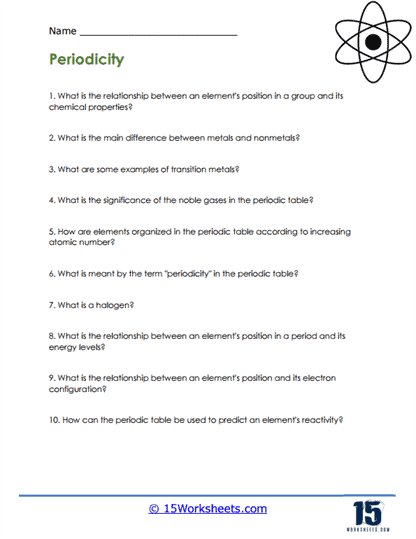
The worksheet dives into the periodic trends and behaviors exhibited by elements in the Periodic Table. It touches on the relationships between an element’s position and its various properties, the distinctions between metals and nonmetals, the role and significance of noble gases, and the very concept of “periodicity” in the table. Further, it explores specific classifications like transition metals and halogens, connecting an element’s placement with its energy levels and electron configuration. Lastly, it contemplates how the Periodic Table can be a predictive tool for an element’s reactivity.
To tackle this worksheet effectively, students should begin by familiarizing themselves with the Periodic Table’s layout, focusing on the patterns and trends exhibited across periods and groups. Recognizing the distinct characteristics of metals and nonmetals, and understanding the role of transition metals, will be fundamental. A comprehension of electron configurations will elucidate the relationship between an element’s position and its energy levels, while a grasp on periodicity will enable an appreciation for the recurring trends in elemental properties. By synthesizing this knowledge, students can predict reactivity patterns and truly grasp the Periodic Table’s utility.
The worksheet is designed to deepen students’ understanding of the systematic patterns and trends observed in the Periodic Table. It aims to equip students with the ability to discern the correlations between an element’s position and its physical and chemical properties. The worksheet emphasizes the significance of periodicity, underscoring the repetitive nature of elemental properties as one navigates the table. In essence, it strives to cultivate a holistic understanding, encouraging students to see the Periodic Table not just as a list of elements, but as a tool for prediction and comprehension of the elemental world.