
Periodic Trends
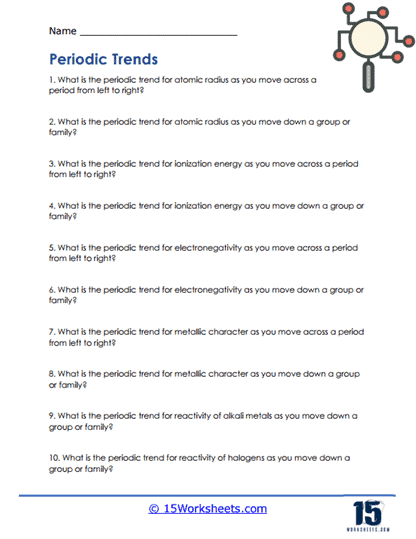
Worksheet Description
The worksheet examines the systematic variations observed in elemental properties as one traverses the Periodic Table. The questions focus on key trends including the changes in atomic radius, ionization energy, electronegativity, metallic character, and reactivity for specific groups of elements, such as alkali metals and halogens. By analyzing the behavior of elements both horizontally (across a period) and vertically (down a group or family), the worksheet seeks to elucidate how and why elemental properties manifest as they do. The worksheet’s goal is to foster an understanding of the underlying reasons behind these periodic trends.
To master the concepts detailed in the worksheet, students should first acquaint themselves with the fundamental properties of atoms, like atomic radius and ionization energy. It’s essential to recognize how atomic structure, particularly the arrangement of electrons, impacts these properties. Students should then visualize the Periodic Table, noting how atomic number increases from left to right and understanding the significance of electron shells as one moves down a group. Utilizing this foundation, they can then discern and rationalize the trends in properties like electronegativity and metallic character based on an element’s position on the table.
The worksheet aims to provide students with a deep understanding of periodic trends observed in the properties of elements. It seeks to underscore the importance of an element’s position on the Periodic Table and how that position correlates with its inherent characteristics. By spotlighting specific trends, such as the behavior of alkali metals or the reactivity of halogens, the worksheet encourages students to discern patterns and relationships between elements. Ultimately, the intent is to empower students with the ability to predict an element’s behavior and properties based on its location within the Periodic Table.