
Shakespeare’s Sonnet 130
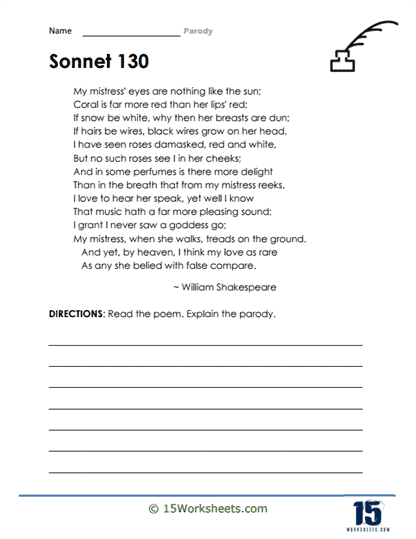
Worksheet Description
The worksheet presents William Shakespeare’s “Sonnet 130,” which stands out as a parody of the traditional love sonnets of his time. In this sonnet, Shakespeare deliberately eschews the hyperbolic similes and metaphors commonly used by poets to idealize their lovers. Instead, he employs a series of negative comparisons, humorously subverting the conventional standards of female beauty celebrated in Petrarchan sonnets.
The first stanza of the sonnet contrasts the mistress’s eyes with the sun, her lips with red coral, and her breasts with snow, noting that the sun is brighter, coral is redder, and snow is whiter, thus rejecting the exaggerated comparisons often found in love poetry. The subsequent quatrains continue this pattern, comparing her cheeks to roses, her voice to music, and her gait to a goddess’s, only to conclude that she falls short of these poetic ideals. The closing couplet, however, turns this parody into a sincere declaration of love, asserting that his mistress is as dear to him as any woman falsely compared to impossible standards. This worksheet invites readers to read and reflect on the poem, then explain how Shakespeare’s use of parody serves to both criticize the overused clichés of his era’s sonnets and to assert a more realistic, grounded expression of love.