
The Liar’s Paradox
Worksheet Description
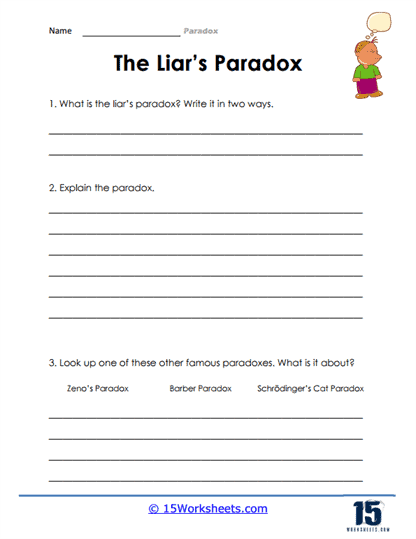
This worksheet is designed to explore the concept of paradoxes, particularly focusing on the well-known “Liar’s Paradox.” The Liar’s Paradox is a statement that a person makes, declaring that they are lying. For instance, “I am lying” or “This statement is false.” If the statement is true, then the person is indeed lying, which means the statement is false, but if the statement is false, then the person is not lying, which means the statement is true. This creates a loop of contradiction, as the statement cannot simultaneously be true and false.
The second part of the worksheet encourages students to articulate their understanding of the paradox. It provides a space for learners to express in their own words why the Liar’s Paradox is a contradiction and to explore the implications of such a paradox in logical terms.
Finally, the worksheet prompts students to engage with other famous paradoxes, such as Zeno’s Paradox, which deals with the dichotomy of motion and infinity; the Barber Paradox, which tackles a logical inconsistency through the example of a barber who shaves all and only those who do not shave themselves; and Schrödinger’s Cat Paradox, a thought experiment that illustrates the strangeness of quantum mechanics. Each of these paradoxes challenges students to think deeply about the nature of truth, reality, and the limits of human understanding.