
More Periodic Trends
Worksheet Description
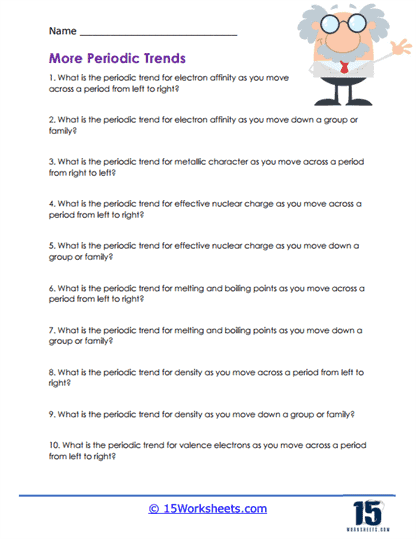
The worksheet extends the exploration of systematic variations observed in the properties of elements on the Periodic Table. It delves deeper into nuanced trends such as electron affinity, effective nuclear charge, melting and boiling points, density, and the behavior of valence electrons. Unlike basic periodic trends, this worksheet emphasizes a more advanced understanding, focusing on the intricacies of atomic structure and behavior. It seeks to provide a holistic perspective on how the physical and chemical properties of elements evolve based on their position on the table.
To excel at these advanced concepts, students should start with a solid grasp of atomic structure, particularly the arrangement and behavior of electrons in different shells and orbitals. Knowledge of how nuclear charge affects electron behavior is crucial, as is understanding how atomic size and electron configurations influence properties like density and melting points. Students should consistently refer to the Periodic Table, noting the changes in these properties as they move across periods (horizontally) and down groups (vertically). Applying foundational concepts of chemistry, like electron affinity and valence electron interactions, will aid in comprehending the more intricate periodic trends.
This worksheet endeavors to cultivate a deeper understanding of the myriad trends that manifest in the Periodic Table. By diving into advanced topics like effective nuclear charge and electron affinity, it challenges students to think critically about the reasons behind the observable behaviors of elements. The worksheet underscores the interconnectedness of various atomic properties, demonstrating how one property can influence another. The ultimate aim is to empower students with a comprehensive understanding of the Periodic Table, enabling them to predict and explain elemental properties and behaviors with confidence.