
Cell Division in Reproduction
Worksheet Description
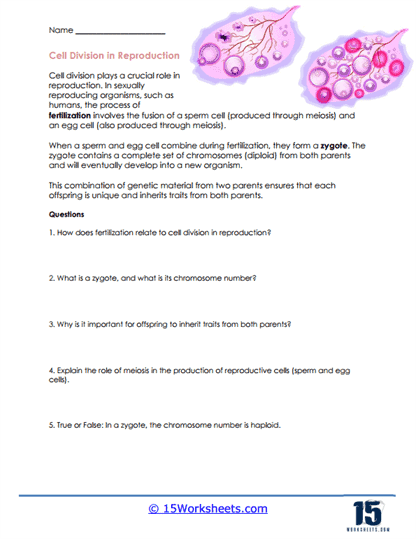
This worksheet looks into the significance of cell division in the realm of sexual reproduction. Specifically, it addresses the processes involved in the formation of reproductive cells, like sperm and egg, through meiosis, and how their union during fertilization results in a zygote. The worksheet underscores the zygote’s diploid chromosome composition, derived from both parents, which ultimately develops into a new organism. Accompanied by visual aids, the worksheet presents a series of questions prompting students to contemplate the intricacies of fertilization, the nature of zygotes, and the inheritance of genetic traits.
To successfully navigate this worksheet, students should begin by thoroughly reading the provided information, ensuring they grasp the core concepts associated with meiosis, fertilization, and the formation of a zygote. Once they’ve assimilated the details, they can proceed to answer the questions, using the text as a reference point. While some questions are straightforward and require direct answers from the passage, others might necessitate a deeper understanding and application of the knowledge. As a beneficial approach, students might want to underline or highlight key points in the text before answering, ensuring they’ve captured the essence of each concept.
The intent behind this worksheet is to instill in students a fundamental understanding of the role of cell division, specifically meiosis, in sexual reproduction. It aims to elucidate how the union of sperm and egg cells, each produced through meiosis, culminates in the creation of a zygote, which possesses genetic material from both parents. By posing questions that range from basic recall to more analytical queries, the worksheet encourages students to think critically about the processes and their implications. Ultimately, it aspires to reinforce the idea that each offspring is genetically unique, inheriting traits from both parental units, and the importance of meiosis in this biological dance of inheritance.