
Ladder Method
Worksheet Description
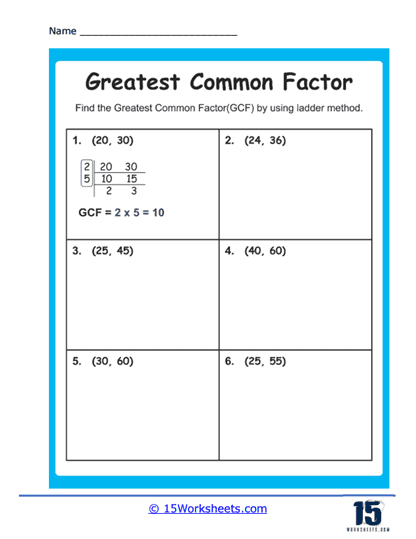
This worksheet is designed to guide students in finding the greatest common factor (GCF) of pairs of numbers using the ladder method. The ladder method involves dividing the numbers by their common prime factors until no more common factors are left. An example is provided with the pair (20, 30), where the numbers are divided by common factors of 2 and then 5, leading to the GCF of 10. The worksheet includes spaces for students to apply this method to other pairs of numbers: (24, 36), (25, 45), (40, 60), (30, 60), and (25, 55).
The purpose of the worksheet is to teach students how to calculate the greatest common factor, which is the largest number that divides two or more numbers without a remainder. Through the ladder method, students learn a systematic approach to factorization that emphasizes the identification and division by common prime factors. This technique is useful for simplifying fractions, finding least common multiples, and solving problems that involve ratios. By practicing with this worksheet, students enhance their number theory skills and their overall mathematical problem-solving abilities.