
Fun Facts About Sea Animals
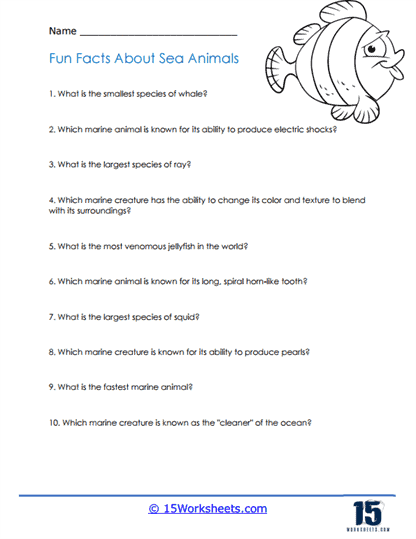
Worksheet Description
These fun facts about sea animals highlight the remarkable diversity and adaptations that make marine life so intriguing and unique. Whether it’s the intelligence of octopuses, the parenting role reversal of sea horses, or the shocking abilities of electric eels, the world beneath the waves is filled with fascinating creatures and phenomena waiting to be discovered.
Octopuses Have Three Hearts – Octopuses are known for their intelligence and unique anatomy. One interesting fact about them is that they have three hearts. Two of these hearts pump blood to the gills to pick up oxygen, while the third heart pumps oxygenated blood to the rest of the body. This efficient system helps octopuses thrive in their underwater environments.
Dolphins Use Echolocation – Dolphins are highly intelligent marine mammals known for their playful behavior. What’s fascinating is that they use a technique called echolocation to navigate and locate prey. They emit high-frequency sounds, and by listening to the echoes, they can determine the location, size, and shape of objects in their environment.
Sea Horses Are the Only Male-Pregnant Animals – Sea horses are unique among animals because it’s the males that become pregnant and give birth. After a courtship dance, the female transfers her eggs into a special pouch on the male’s abdomen, where he fertilizes and carries them until they hatch. This reproductive strategy is truly one-of-a-kind in the animal kingdom.
Electric Eels Are Living Batteries – Electric eels, found in South America, are not actually eels but a type of knifefish. They have specialized cells called electrocytes that can generate electric shocks. Electric eels use these shocks for hunting, navigation, and communication. A powerful discharge can even stun or deter potential predators.
Mantis Shrimp Have Super Speed and Vision – Mantis shrimp are small but mighty predators found in tropical waters. They are known for their incredibly fast and powerful claw strikes, which can break aquarium glass. They also possess some of the most complex vision systems in the animal kingdom, with up to 16 types of photoreceptor cells, allowing them to see a broad spectrum of colors and detect polarized light.