
Chekhov’s Gun
Worksheet Description
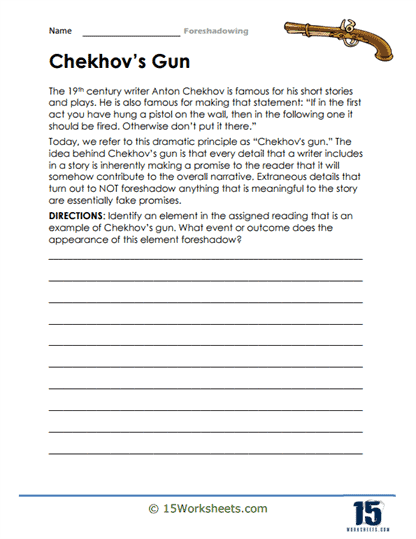
This worksheet focuses on the literary concept of Chekhov’s Gun, a principle named after the famous 19th-century Russian playwright and short-story writer, Anton Chekhov. The principle states that every element in a narrative should be necessary and irrelevant components should be removed; exemplified by Chekhov’s famous statement that if a gun is shown in the first act, it should be fired by the third. The concept serves as a metaphor for foreshadowing and the economy of storytelling.
The worksheet is designed to encourage students to engage with a text critically by identifying an instance of Chekhov’s Gun within their assigned reading. This involves recognizing and noting down a narrative detail that promises significance to the unfolding story. Students are then tasked with predicting the element’s relevance to the overall plot, enhancing their analytical skills and understanding of narrative structure. This exercise not only helps students appreciate the intricacy of foreshadowing but also teaches them the importance of narrative elements that serve the story’s progression, adhering to Chekhov’s guidance on narrative efficiency.