
Electron Configuration
Worksheet Description
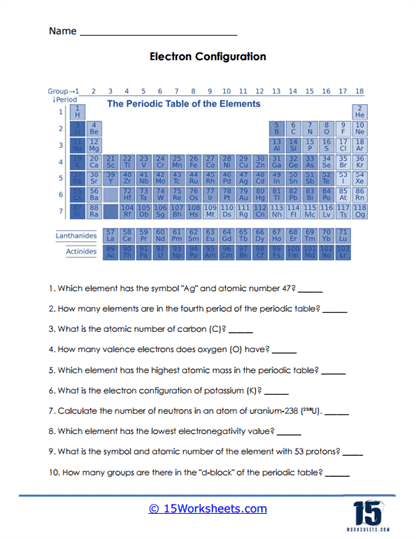
This worksheet revolves around the Periodic Table of Elements, with a pronounced emphasis on elemental properties and behaviors. The questions challenge students to identify specific elements based on given attributes, decipher the atomic number or symbol, discern the number of valence electrons, and grasp the concept of electron configurations. Additionally, it touches on atomic mass, periodic trends such as electronegativity, and an understanding of the different blocks of the table, including the “d-block.” The embedded Periodic Table serves as an indispensable reference for students to correlate and retrieve the requisite information.
To tackle this worksheet efficiently, students need to first familiarize themselves with the Periodic Table’s layout and the concept of atomic numbers. A deeper understanding of atomic structure is vital, especially when addressing questions on valence electrons and electron configurations. It’s essential to comprehend how electron shells and subshells fill up to determine an element’s configuration. For calculating the number of neutrons or discerning trends like electronegativity, an understanding of atomic mass and periodic tendencies is requisite.
The worksheet is designed to cultivate students’ knowledge and understanding of the Periodic Table, emphasizing the electron configurations of elements. Through carefully crafted questions, it guides learners to navigate and analyze the table, emphasizing the significance of electron behaviors in atomic structures. The worksheet instills a foundational grasp of elemental properties, from basic identifications to deeper concepts like electron distributions in atoms. Ultimately, the aim is to provide students with a well-rounded comprehension of the Periodic Table and the intricacies of atomic structures, preparing them for more advanced chemical studies.